Gary Marchionini – författare
Visar alla böcker från författaren Gary Marchionini. Handla med fri frakt och snabb leverans.
3 produkter
3 produkter
Del 9 - Cambridge Series on Human-Computer Interaction
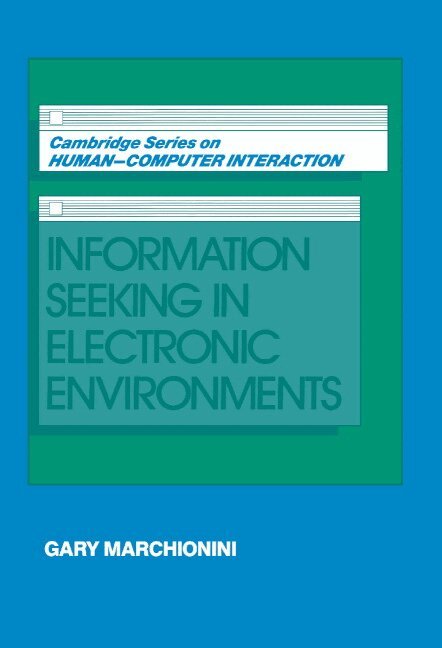
Information Seeking in Electronic Environments
Häftad, Engelska, 1997
630 kr
Skickas inom 7-10 vardagar
Significant amounts of our time and energy are devoted to creating, managing, and avoiding information. Computers and telecommunications technology have extended our regard for information and are driving changes in how we learn, work, and play. One result of these developments is that skills and strategies for storing and retrieving information have become more essential and more pervasive in our culture. This book considers how electronic technologies have changed these skills and strategies and augmented the fundamental human activity of information seeking. The author makes a case for creating new interface designs that allow the information seeker to choose what strategy to apply according to their immediate needs. Such systems may be designed by providing information seekers with alternative interface mechanisms for displaying and manipulating multiple levels of representation for information objects. Information Seeking in Electronic Environments is essential reading for researchers and graduate students in information science, human-computer interaction, and education, as well as for designers of information retrieval systems and interfaces for digital libraries and archives.
Häftad, Engelska, 2010
318 kr
Skickas inom 10-15 vardagar
Information is essential to all human activity, and information in electronic form both amplifies and augments human information interactions. This lecture surveys some of the different classical meanings of information, focuses on the ways that electronic technologies are affecting how we think about these senses of information, and introduces an emerging sense of information that has implications for how we work, play, and interact with others. The evolutions of computers and electronic networks and people's uses and adaptations of these tools manifesting a dynamic space called cyberspace. Our traces of activity in cyberspace give rise to a new sense of information as instantaneous identity states that I term proflection of self. Proflections of self influence how others act toward us. Four classical senses of information are described as context for this new form of information. The four senses selected for inclusion here are the following: thought and memory, communication process,artifact, and energy. Human mental activity and state (thought and memory) have neurological, cognitive, and affective facets.The act of informing (communication process) is considered from the perspective of human intentionality and technical developments that have dramatically amplified human communication capabilities. Information artifacts comprise a common sense of information that gives rise to a variety of information industries. Energy is the most general sense of information and is considered from the point of view of physical, mental, and social state change. This sense includes information theory as a measurable reduction in uncertainty. This lecture emphasizes how electronic representations have blurred media boundaries and added computational behaviors that yield new forms of information interaction, which, in turn, are stored, aggregated, and mined to create profiles that represent our cyber identities. Table of Contents: The Many Meanings of Information / Information asThought and Memory / Information as Communication Process / Information as Artifact / Information as Energy / Information as Identity in Cyberspace: The Fifth Voice / Conclusion and Directions
E-bok
PDF, Engelska, 2022408 kr
Läs direkt efter köp
Information is essential to all human activity, and information in electronic form both amplifies and augments human information interactions. This lecture surveys some of the different classical meanings of information, focuses on the ways that electronic technologies are affecting how we think about these senses of information, and introduces an emerging sense of information that has implications for how we work, play, and interact with others. The evolutions of computers and electronic networks and people''s uses and adaptations of these tools manifesting a dynamic space called cyberspace. Our traces of activity in cyberspace give rise to a new sense of information as instantaneous identity states that I term proflection of self. Proflections of self influence how others act toward us. Four classical senses of information are described as context for this new form of information. The four senses selected for inclusion here are the following: thought and memory, communication process,artifact, and energy. Human mental activity and state (thought and memory) have neurological, cognitive, and affective facets.The act of informing (communication process) is considered from the perspective of human intentionality and technical developments that have dramatically amplified human communication capabilities. Information artifacts comprise a common sense of information that gives rise to a variety of information industries. Energy is the most general sense of information and is considered from the point of view of physical, mental, and social state change. This sense includes information theory as a measurable reduction in uncertainty. This lecture emphasizes how electronic representations have blurred media boundaries and added computational behaviors that yield new forms of information interaction, which, in turn, are stored, aggregated, and mined to create profiles that represent our cyber identities. Table of Contents: The Many Meanings of Information / Information asThought and Memory / Information as Communication Process / Information as Artifact / Information as Energy / Information as Identity in Cyberspace: The Fifth Voice / Conclusion and Directions