Gary S. Schajer – författare
1 403 kr
Skickas inom 5-8 vardagar
1 692 kr
Läs direkt efter köp
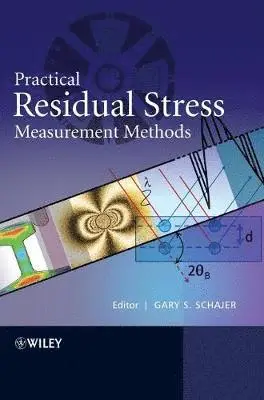
An introductory and intermediate level handbook written in pragmatic style to explain residual stresses and to provide straightforward guidance about practical measurement methods.
Residual stresses play major roles in engineering structures, with highly beneficial effects when designed well, and catastrophic effects when ignored. With ever-increasing concern for product performance and reliability, there is an urgent need for a renewed assessment of traditional and modern measurement techniques. Success critically depends on being able to make the most practical and effective choice of measurement method for a given application.
Practical Residual Stress Measurement Methods provides the reader with the information needed to understand key residual stress concepts and to make informed technical decisions about optimal choice of measurement technique. Each chapter, written by invited specialists, follows a focused and pragmatic format, with subsections describing the measurement principle, residual stress evaluation, practical measurement procedures, example applications, references and further reading. The chapter authors represent both international academia and industry. Each of them brings to their writing substantial hands-on experience and expertise in their chosen field.
Fully illustrated throughout, the book provides a much-needed practical approach to residual stress measurements. The material presented is essential reading for industrial practitioners, academic researchers and interested students.
Key features: • Presents an overview of the principal residual stress measurement methods, both destructive and non-destructive, with coverage of new techniques and modern enhancements of established techniques • Includes stand-alone chapters, each with its own figures, tables and list of references, and written by an invited team of international specialists
1 692 kr
Läs direkt efter köp
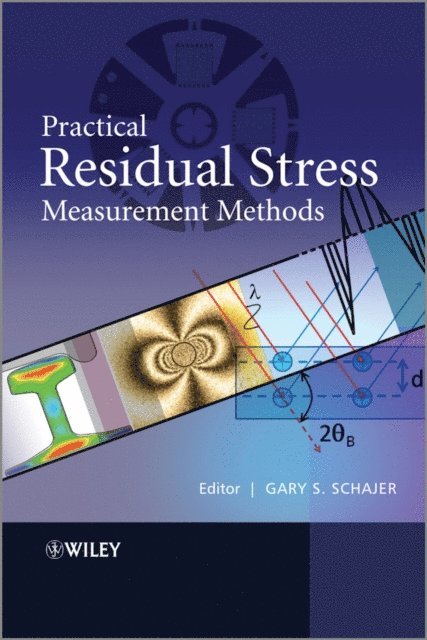
An introductory and intermediate level handbook written in pragmatic style to explain residual stresses and to provide straightforward guidance about practical measurement methods.
Residual stresses play major roles in engineering structures, with highly beneficial effects when designed well, and catastrophic effects when ignored. With ever-increasing concern for product performance and reliability, there is an urgent need for a renewed assessment of traditional and modern measurement techniques. Success critically depends on being able to make the most practical and effective choice of measurement method for a given application.
Practical Residual Stress Measurement Methods provides the reader with the information needed to understand key residual stress concepts and to make informed technical decisions about optimal choice of measurement technique. Each chapter, written by invited specialists, follows a focused and pragmatic format, with subsections describing the measurement principle, residual stress evaluation, practical measurement procedures, example applications, references and further reading. The chapter authors represent both international academia and industry. Each of them brings to their writing substantial hands-on experience and expertise in their chosen field.
Fully illustrated throughout, the book provides a much-needed practical approach to residual stress measurements. The material presented is essential reading for industrial practitioners, academic researchers and interested students.
Key features: • Presents an overview of the principal residual stress measurement methods, both destructive and non-destructive, with coverage of new techniques and modern enhancements of established techniques • Includes stand-alone chapters, each with its own figures, tables and list of references, and written by an invited team of international specialists
687 kr
Läs direkt efter köp
This book describes the theory and practice of the Hole-Drilling Method for measuring residual stresses in engineering components. Such measurements are important because residual stresses have a "hidden" character because they exist locked-in within a material, independent of any external load. These stresses are typically created during component manufacture, for example, during welding, casting, or forming. Because of their hidden nature, residual stresses are difficult to measure and consequently are often ignored. However, they directly add to loading stresses and can cause catastrophic failure if not properly included during engineering design. Thus, there is an urgent need to be able to identify and measure residual stresses conveniently and reliably.
The Hole-Drilling Method provides an adaptable and well-proven method for measuring residual stresses in a wide range of materials and component types. It is convenient to use and gives reliable results. Because of the hidden nature of residual stresses, the measurement method must necessarily be indirect, thus, additional care and conceptual understanding are necessary to achieve successful results. This book provides a practical introduction to the Hole-Drilling Method, starting from its historical roots and going on to focus on its modern practice. The various chapters describe the nature of residual stresses, the principle of hole-drilling measurements, procedures and guidance on how to make successful measurements, and effective mathematical procedures for stress computation and analysis. The book is intended for practitioners who need to make residual stress measurements either occasionally or routinely, for practicing engineers, for researchers, and for graduate engineering and science students.
549 kr
Skickas inom 10-15 vardagar