Gaylon S. Campbell – författare
Visar alla böcker från författaren Gaylon S. Campbell. Handla med fri frakt och snabb leverans.
7 produkter
7 produkter
E-bok
PDF, Engelska, 2015602 kr
Läs direkt efter köp
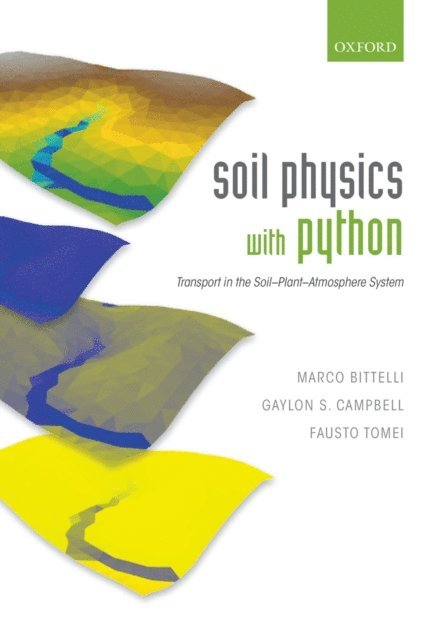
This innovative study presents concepts and problems in soil physics, and provides solutions using original computer programs. It provides a close examination of physical environments of soil, including an analysis of the movement of heat, water and gases. The authors employ the programming language Python, which is now widely used for numerical problem solving in the sciences. In contrast to the majority of the literature on soil physics, this text focuses onsolving, not deriving, differential equations for transport. Using numerical procedures to solve differential equations allows the solution of quite difficult problems with fairly simple mathematical tools. Numerical methods convert differential into algebraic equations, which can be solved usingconventional methods of linear algebra. Each chapter introduces a soil physics concept, and proceeds to develop computer programs to solve the equations and illustrate the points made in the discussion.Problems at the end of each chapter help the reader practise using the concepts introduced. The text is suitable for advanced undergraduates, graduates and researchers of soil physics. It employs an open source philosophy where computer code is presented, explained and discussed, and provides the reader with a full understanding of the solutions. Once mastered, the code can be adapted and expanded for the user''s own models, fostering further developments. The Python tools provide a simplesyntax, Object Oriented Programming techniques, powerful mathematical and numerical tools, and a user friendly environment.
E-bok
Engelska, 2015602 kr
Läs direkt efter köp
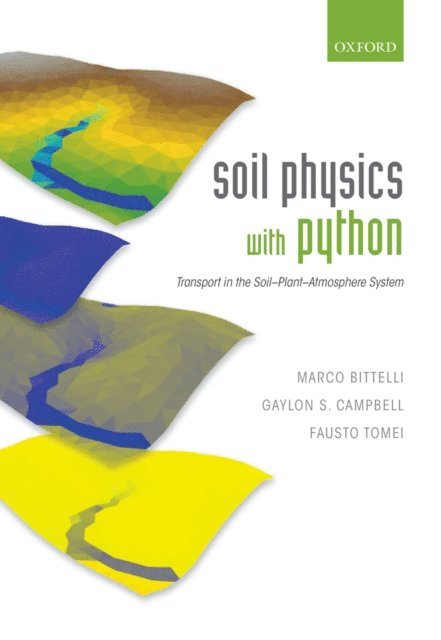
This innovative study presents concepts and problems in soil physics, and provides solutions using original computer programs. It provides a close examination of physical environments of soil, including an analysis of the movement of heat, water and gases. The authors employ the programming language Python, which is now widely used for numerical problem solving in the sciences. In contrast to the majority of the literature on soil physics, this text focuses onsolving, not deriving, differential equations for transport. Using numerical procedures to solve differential equations allows the solution of quite difficult problems with fairly simple mathematical tools. Numerical methods convert differential into algebraic equations, which can be solved usingconventional methods of linear algebra. Each chapter introduces a soil physics concept, and proceeds to develop computer programs to solve the equations and illustrate the points made in the discussion.Problems at the end of each chapter help the reader practise using the concepts introduced. The text is suitable for advanced undergraduates, graduates and researchers of soil physics. It employs an open source philosophy where computer code is presented, explained and discussed, and provides the reader with a full understanding of the solutions. Once mastered, the code can be adapted and expanded for the user''s own models, fostering further developments. The Python tools provide a simplesyntax, Object Oriented Programming techniques, powerful mathematical and numerical tools, and a user friendly environment.
Häftad, Engelska, 2020
638 kr
Skickas inom 5-8 vardagar
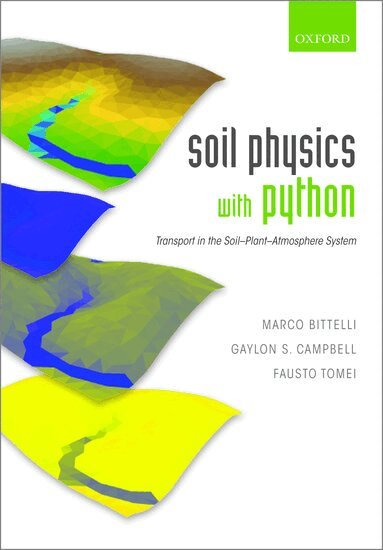
This innovative study presents concepts and problems in soil physics, and provides solutions using original computer programs. It provides a close examination of physical environments of soil, including an analysis of the movement of heat, water and gases. The authors employ the programming language Python, which is now widely used for numerical problem solving in the sciences. In contrast to the majority of the literature on soil physics, this text focuses on solving, not deriving, differential equations for transport. Using numerical procedures to solve differential equations allows the solution of quite difficult problems with fairly simple mathematical tools. Numerical methods convert differential into algebraic equations, which can be solved using conventional methods of linear algebra. Each chapter introduces a soil physics concept, and proceeds to develop computer programs to solve the equations and illustrate the points made in the discussion.Problems at the end of each chapter help the reader practise using the concepts introduced. The text is suitable for advanced undergraduates, graduates and researchers of soil physics. It employs an open source philosophy where computer code is presented, explained and discussed, and provides the reader with a full understanding of the solutions. Once mastered, the code can be adapted and expanded for the user's own models, fostering further developments. The Python tools provide a simple syntax, Object Oriented Programming techniques, powerful mathematical and numerical tools, and a user friendly environment.
Inbunden, Engelska, 2015
1 350 kr
Skickas inom 5-8 vardagar
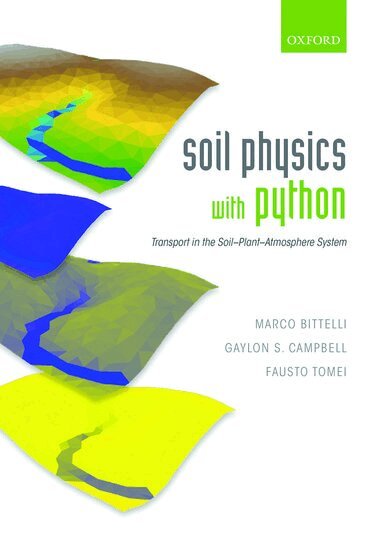
This innovative study presents concepts and problems in soil physics, and provides solutions using original computer programs. It provides a close examination of physical environments of soil, including an analysis of the movement of heat, water and gases. The authors employ the programming language Python, which is now widely used for numerical problem solving in the sciences. In contrast to the majority of the literature on soil physics, this text focuses on solving, not deriving, differential equations for transport. Using numerical procedures to solve differential equations allows the solution of quite difficult problems with fairly simple mathematical tools. Numerical methods convert differential into algebraic equations, which can be solved using conventional methods of linear algebra. Each chapter introduces a soil physics concept, and proceeds to develop computer programs to solve the equations and illustrate the points made in the discussion.Problems at the end of each chapter help the reader practise using the concepts introduced. The text is suitable for advanced undergraduates, graduates and researchers of soil physics. It employs an open source philosophy where computer code is presented, explained and discussed, and provides the reader with a full understanding of the solutions. Once mastered, the code can be adapted and expanded for the user's own models, fostering further developments. The Python tools provide a simple syntax, Object Oriented Programming techniques, powerful mathematical and numerical tools, and a user friendly environment.
Häftad, Engelska, 1997
919 kr
Skickas inom 10-15 vardagar
This book shows how basic physical principles can be applied to describe interactions between living organisms and their microenvironment. Emphasis is placed on teaching the student how to calculate actual heat and mass transfer rates, rather than just studying the concepts involved. Numerous examples are provided to illustrate many of the principles, and problems are included at the end of each chapter to help the student develop skills in using the equations and to gain an understanding of modern environmental biophysics. The book is an engineering approach to environmental biology.
E-bok
PDF, Engelska, 20121 179 kr
Läs direkt efter köp
This book shows how basic physical principles can be applied to describe interactions between living organisms and their microenvironment. Emphasis is placed on teaching the student how to calculate actual heat and mass transfer rates, rather than just studying the concepts involved. Numerous examples are provided to illustrate many of the principles, and problems are included at the end of each chapter to help the student develop skills in using the equations and to gain an understanding of modern environmental biophysics. The book is an engineering approach to environmental biology.
E-bok
PDF, Engelska, 20121 140 kr
Läs direkt efter köp
The study of environmental biophysics probably began earlier in man''s history than that of any other science. The study of organism-environment interaction provided a key to survival and progress. Systematic study of the science and recording of experimental results goes back many hundreds of years. Ben jamin Franklin, the early American statesman, inventor, printer, and scientist studied conduction, evaporation, and radiation. One of his observations is as follows: My desk on which I now write, and the lock of my desk, are both exposed to the same temperature of the air, and have therefore the same degree of heat or cold; yet if I lay my hand successively on the wood and on the metal, the latter feels much the coldest, not that it is really so, but being a better conductor, it more readily than the wood takes away and draws into itself the fire that was in my skin. 1 Franklin probably was not the first to discover this principle, and certainly was not the last. Modem researchers rediscover this principle frequently in their own work. It is sometimes surprising how slowly progress is made. Progress in environmental biophysics, since the observa tions of Franklin and others, has been mainly in two areas: use of mathematical models to quantify rates of heat and mass transfer and use of the continuity equation that has led to energy budget analyses.