Gene D. Phillips - Böcker
Visar alla böcker från författaren Gene D. Phillips. Handla med fri frakt och snabb leverans.
9 produkter
9 produkter
1 284 kr
Skickas inom 10-15 vardagar
Francis Ford Coppola's career has spanned five decades, from low budget films he produced in the early 1960s to more personal films of recent years. Because of the tremendous popular success of The Godfather and the tremendous critical success of its sequel, Coppola is considered to be one of the best directors of all time.The entries in this encyclopedia focus on all aspects of Coppola's work—from his early days with producer Roger Corman to his films as the director of the 1970s. This extensive reference contains material on all of the films Coppola has played a role in, from screenwriter to producer to director, including such classics as Patton, The Godfather, The Conversation, The Godfather Part II, and Apocalypse Now. Each entry is followed by a bibliography of published sources, both in print and online, making The Francis Ford Coppola Encyclopedia the most comprehensive reference on this director's body of work.
519 kr
Skickas inom 3-6 vardagar
WITH A FOREWORD BY WALTER MURCH Gene Phillips blends biography, studio history, and film criticism to complete the most comprehensive work on Coppola ever written. The force behind such popular and critically acclaimed films as Apocalypse Now and the Godfather trilogy, Coppola has imprinted his distinct style on each of his movies and on the landscape of American popular culture. In Godfather, Phillips argues that Coppola has repeatedly bucked the Hollywood "factory system" in an attempt to create distinct films that reflect his own artistic vision -- often to the detriment of his career and finances. Phillips conducted interviews with the director and his colleagues and examined Coppola's production journals and screenplays. Phillips also reviewed rare copies of Coppola's student films, his early excursions into soft-core pornography, and his less celebrated productions such as One from the Heart and Tucker: The Man and His Dream. The result is the definitive assessment of one of Hollywood's most enduring and misunderstood mavericks.
644 kr
Skickas inom 3-6 vardagar
Two-time Academy Award winner Sir David Lean (1908-1991) was a prominent director in the world of twentieth-century cinema, responsible for such classics as The Bridge on the River Kwai, Doctor Zhivago, and Lawrence of Arabia. British-born Lean asserted himself in Hollywood as a major artistic voice with his epic storytelling and panoramic depictions of history, but he was also a highly skilled film editor in Great Britain before he became a director who brought an art-house sensibility to big market films. Lean's approach to filmmaking was far different from that of his contemporaries. He carefully chose his projects and, as a result, directed only sixteen films in a span of more than forty years. Those films, however, are some of the landmarks of motion-picture history. In addition to his epics, Lean also made adaptations of well-known novels, including Great Expectations, Oliver Twist, and A Passage to India, and plays, including Brief Encounter. Using elements of both biography and film criticism, author Gene D. Phillips examines the screenplays and production histories central to Lean's body of work and interviews actors and other directors who worked with Lean. Phillips also explores Lean's lesser-studied films, such as The Passionate Friends, unearthing new details. This in-depth examination of Lean in a cultural, historic, and cinematic context makes Beyond the Epic truly unique -- a vital assessment of a great director's artistic process and his place in an evolving film industry.
581 kr
Skickas inom 3-6 vardagar
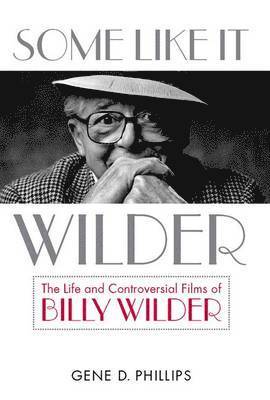
One of the most accomplished writers and directors of classic Hollywood, Billy Wilder (1906--2002) directed numerous acclaimed films, including Sunset Boulevard (1950), Sabrina (1954), The Seven Year Itch (1955), Witness for the Prosecution (1957), and Some Like It Hot (1959). Featuring Gene D. Phillips's unique, in-depth critical approach, Some Like It Wilder: The Life and Controversial Films of Billy Wilder provides a groundbreaking overview of a filmmaking icon. Wilder began his career as a screenwriter in Berlin but, because of his Jewish heritage, sought refuge in America when Germany came under Nazi control. Making fast connections in Hollywood, Wilder immediately made the jump from screenwriter to director. His classic films Five Graves to Cairo (1943), Double Indemnity (1945), and The Lost Weekend (1945) earned Academy Awards for best picture, director, and screenplay. During the 1960s, Wilder continued to direct and produce controversial comedies, including Kiss Me, Stupid (1964) and The Apartment (1960), which won Oscars for best picture and director. This definitive biography reveals that Wilder was, and remains, one of the most influential directors in filmmaking.
572 kr
Skickas inom 3-6 vardagar
More than any other writer, Raymond Chandler (1888-1959) is responsible for raising detective stories from the level of pulp fiction to literature. Chandler's hard-boiled private eye Philip Marlowe set the standard for rough, brooding heroes who managed to maintain a strong sense of moral conviction despite a cruel and indifferent world. Chandler's seven novels, including The Big Sleep (1939) and The Long Goodbye (1953), with their pessimism and grim realism, had a direct influence on the emergence of film noir. Chandler worked to give his crime novels the flavor of his adopted city, Los Angeles, which was still something of a frontier town, rife with corruption and lawlessness. In addition to novels, Chandler wrote short stories and penned the screenplays for several films, including Double Indemnity (1944) and Strangers on a Train (1951). His work with Billy Wilder and Alfred Hitchcock on these projects was fraught with the difficulties of collaboration between established directors and an author who disliked having to edit his writing on demand.Creatures of Darkness is the first major biocritical study of Chandler in twenty years. Gene Phillips explores Chandler's unpublished script for Lady in the Lake, examines the process of adaptation of the novel Strangers on a Train, discusses the merits of the unproduced screenplay for Playback, and compares Howard Hawks's director's cut of The Big Sleep with the version shown in theaters. Through interviews he conducted with Wilder, Hitchcock, Hawks, and Edward Dmytryk over the past several decades, Phillips provides deeper insight into Chandler's sometimes difficult personality.Chandler's wisecracking Marlowe has spawned a thousand imitations. Creatures of Darkness lucidly explains the author's dramatic impact on both the literary and cinematic worlds, demonstrating the immeasurable debt that both detective fiction and the neo-noir films of today owe to Chandler's stark vision.
716 kr
Skickas inom 10-15 vardagar
While the gangster film may have enjoyed its heyday in the 1930s and ’40s, it has remained a movie staple for almost as long as cinema has existed. From the early films of Humphrey Bogart, James Cagney, and Edward G. Robinson to modern versions like Bugsy, Public Enemies, and Gangster Squad, such films capture the brutality of mobs and their leaders.In Gangsters and G-Men on Screen: Crime Cinema Then and Now, Gene D. Phillips revisits some of the most popular and iconic representations of the genre. While this volume offers new perspectives on some established classics—usual suspects like Little Caesar, Bonnie and Clyde, and The Godfather Part II—Phillips also calls attention to some of the unheralded but no less worthy films and filmmakers that represent the genre. Expanding the viewer’s notion of what constitutes a gangster film, Phillips offers such unusual choices as You Only Live Once, Key Largo, The Lady from Shanghai, and even the 1949 version of The Great Gatsby. Also included in this examination are more recent ventures, such as modern classics The Grifters and Martin Scorsese’s The Departed. In his analyses, Phillips draws on a number of sources, including personal interviews with directors and other artists and technicians associated with the films he discusses. Of interest to film historians and scholars, Gangsters and G-Men on Screen will also appeal to anyone who wants to better understand the films that represent an important contribution to crime cinema.
333 kr
Skickas inom 10-15 vardagar
328 kr
Skickas inom 7-10 vardagar
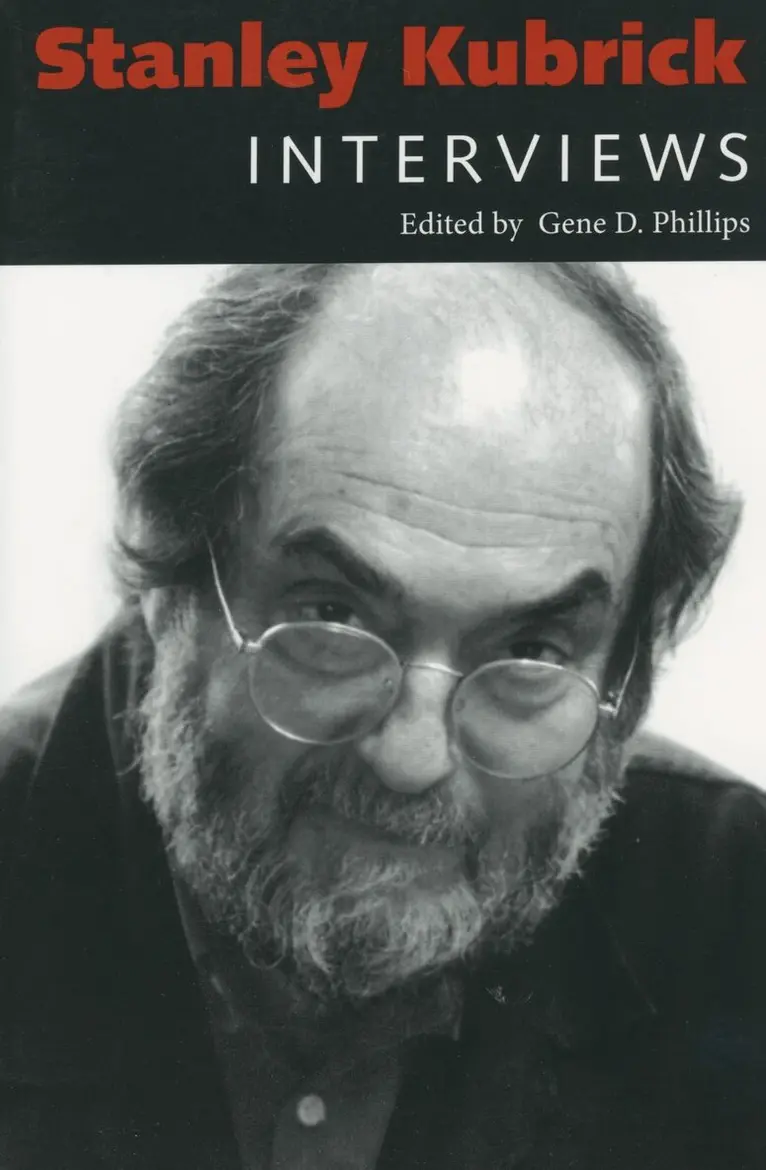
From his first feature film, Fear and Desire (1953), to his final, posthumously released Eyes Wide Shut (1999), Stanley Kubrick excelled at probing the dark corners of human consciousness. In doing so, he adapted such popular novels as The Killing, Lolita, A Clockwork Orange, and The Shining and selected a wide variety of genres for his films -- black comedy (Dr. Strangelove), science fiction (2001: A Space Odyssey), and war (Paths of Glory and Full Metal Jacket). Because he was peerless in unveiling the intimate mysteries of human nature, no new film by Kubrick ever failed to spark debate or to be deeply pondered. Kubrick (1928-1999) has remained as elusive as the subjects of his films. Unlike many other filmmakers he was not inclined to grant interviews, instead preferring to let his movies speak for themselves. By allowing both critics and moviegoers to see the inner workings of this reclusive filmmaker, this first comprehensive collection of his relatively few interviews is invaluable. Ranging from 1959 to 1987 and including Kubrick's conversations with Gene Siskel, Jeremy Bernstein, Gene D. Phillips, and others, this book reveals Kubrick's diverse interests -- nuclear energy and its consequences, space exploration, science fiction, literature, religion, psychoanalysis, the effects of violence, and even chess -- and discloses how each affects his films. He enthusiastically speaks of how advances in camera and sound technology made his films more effective.Kubrick details his hands-on approach to filmmaking as he discusses why he supervises nearly every aspect of production. ""All the hand-held camerawork is mine,"" he says in a 1972 interview about A Clockwork Orange. ""In addition to the fun of doing the shooting myself, I find it virtually impossible to explain what I want in a hand-held shot to even the most talented and sensitive camera operator. ""Neither guarded nor evasive, the Kubrick who emerges from these interviews is candid, opinionated, confident, and articulate. His incredible memory and his gift for organization come to light as he quotes verbatim sections of reviews, books, and articles. Despite his reputation as a recluse, the Kubrick of these interviews is approachable, witty, full of anecdotes, and eager to share a fascinating story.
328 kr
Skickas inom 7-10 vardagar
Of all the American filmmakers who emerged from the 1970s, Francis Ford Coppola (b. 1939) may be the one most passionately revered by both critics and mainstream audiences. The Godfather and The Godfather: Part II are landmark epics whose shots and dialogue sequences have become wholly absorbed by popular culture. Apocalypse Now, his visionary reworking of Joseph Conrad's Heart of Darkness, remains an enduring and controversial template for all future films about the Vietnam War. Coppola's films featured pivotal roles for such actors as Robert Duvall, Al Pacino, Diane Keaton, Gene Hackman, and Harrison Ford and cemented the reputations of Marlon Brando and Robert De Niro. His production company, American Zoetrope, helped to launch the careers of directors George Lucas, John Milius, and Carroll Ballard. Francis Ford Coppola: Interviews shows Coppola to be both an intensely personal auteur and a studio-savvy Hollywood player. From the beginning of his career to the present, these conversations reveal him to be brash, candid, sensitive, and willing to engage in heated debate. He reiterates his desire to change the Hollywood system from within and talks openly about the creation of his independent film production company. Featuring interviews conducted by film critics Michael Sragow and Gene D. Phillips and the New Yorker's Lillian Ross, among others, the volume shows how Coppola has evolved from hotshot film maverick to elder statesman of American cinema. Gene D. Phillips, S.J., is a professor of English and film history at Loyola University, Chicago. He is the author of several books on film, including Godfather: The Intimate Francis Ford Coppola, and is the editor of Stanley Kubrick: Interviews (University Press of Mississippi). Rodney Hill is a doctoral candidate in theater and film at the University of Kansas, and his work has been published in such periodicals as Literature/Film Quarterly and Post Script. He cowrote with Gene D. Phillips The Encyclopedia of Stanley Kubrick.