Gennady P. Berman - Böcker
Visar alla böcker från författaren Gennady P. Berman. Handla med fri frakt och snabb leverans.
9 produkter
9 produkter
Del 21 - Lecture Notes in Physics Monographs
Crossover-Time in Quantum Boson and Spin Systems
Häftad, Engelska, 2013
535 kr
Skickas inom 10-15 vardagar
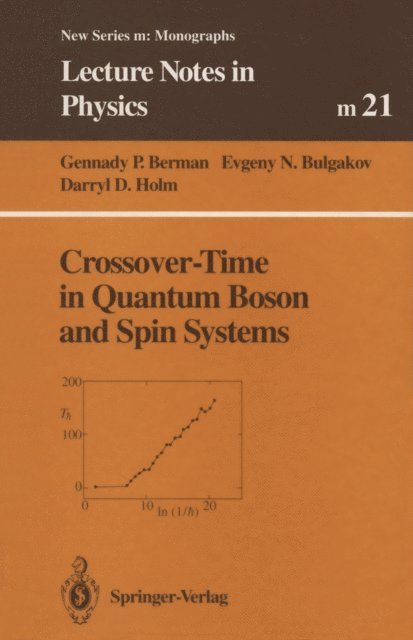
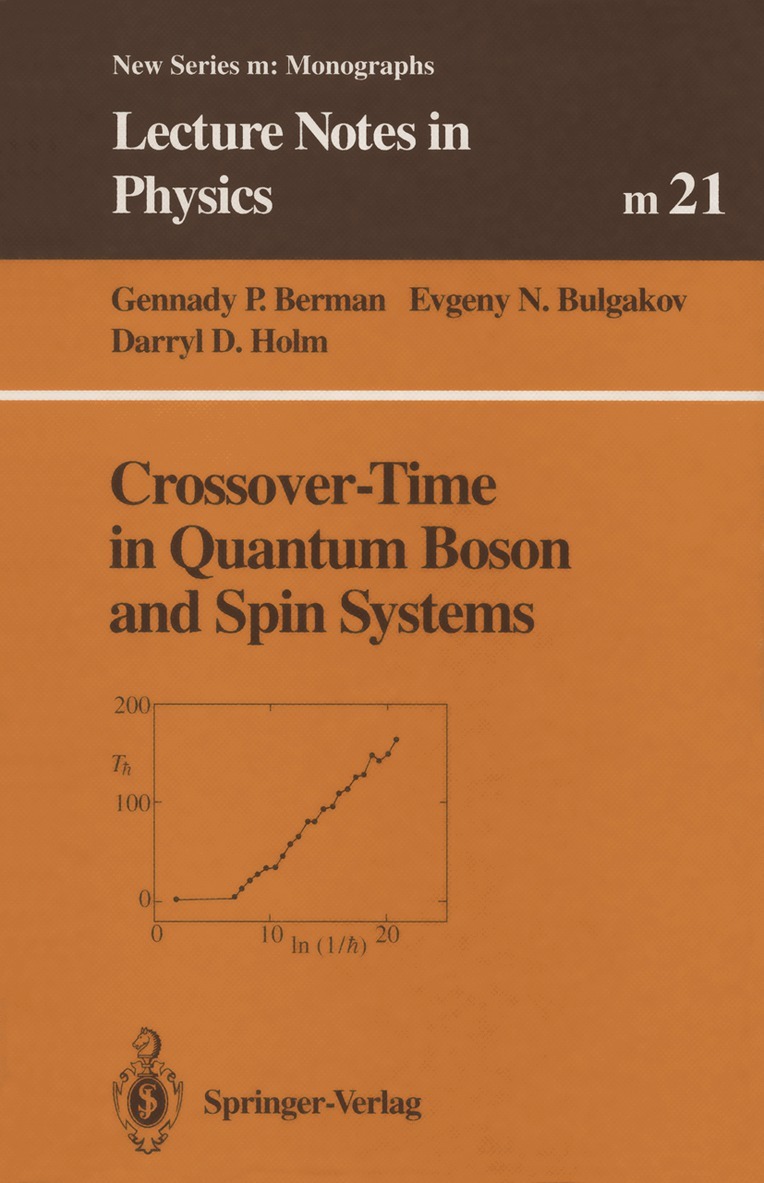
We consider quantum dynamical systems (in general, these could be either Hamiltonian or dissipative, but in this review we shall be interested only in quantum Hamiltonian systems) that have, at least formally, a classical limit. This means, in particular, that each time-dependent quantum-mechanical expectation value X (t) has as i cl Ii -+ 0 a limit Xi(t) -+ x1 )(t) of the corresponding classical sys- tem. Quantum-mechanical considerations include an additional di- mensionless parameter f = iiiconst. connected with the Planck constant Ii. Even in the quasiclassical region where f~ 1, the dy- namics of the quantum and classicalfunctions Xi(t) and XiCcl)(t) will be different, in general, and quantum dynamics for expectation val- ues may coincide with classical dynamics only for some finite time. This characteristic time-scale, TIi., could depend on several factors which will be discussed below, including: choice of expectation val- ues, initial state, physical parameters and so on. Thus, the problem arises in this connection: How to estimate the characteristic time- scale TIi. of the validity of the quasiclassical approximation and how to measure it in an experiment?For rather simple integrable quan- tum systems in the stable regions of motion of their corresponding classical phase space, this time-scale T" usually is of order (see, for example, [2]) const TIi. = p,li , (1.1) Q where p, is the dimensionless parameter of nonlinearity (discussed below) and a is a constant of the order of unity.
1 078 kr
Tillfälligt slut
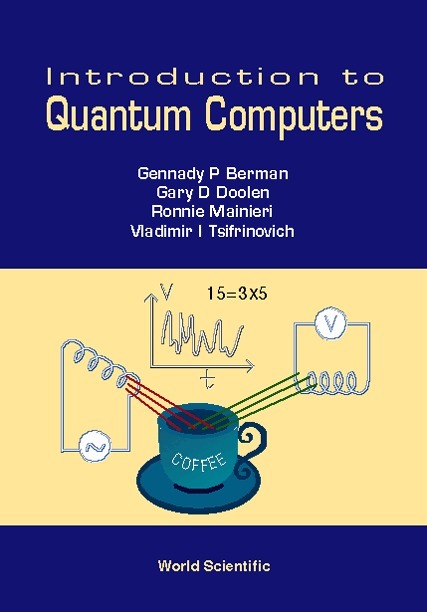
Quantum computing promises to solve problems which are intractable on digital computers. Highly parallel quantum algorithms can decrease the computational time for some problems by many orders of magnitude. This important book explains how quantum computers can do these amazing things. Several algorithms are illustrated: the discrete Fourier transform, Shor's algorithm for prime factorization; algorithms for quantum logic gates; physical implementations of quantum logic gates in ion traps and in spin chains; the simplest schemes for quantum error correction; correction of errors caused by imperfect resonant pulses; correction of errors caused by the nonresonant actions of a pulse; and numerical simulations of dynamical behavior of the quantum Control-Not gate. An overview of some basic elements of computer science is presented, including the Turing machine, Boolean algebra, and logic gates. The required quantum ideas are explained.
583 kr
Skickas inom 5-8 vardagar
Quantum computing promises to solve problems which are intractable on digital computers. Highly parallel quantum algorithms can decrease the computational time for some problems by many orders of magnitude. This important book explains how quantum computers can do these amazing things. Several algorithms are illustrated: the discrete Fourier transform, Shor's algorithm for prime factorization; algorithms for quantum logic gates; physical implementations of quantum logic gates in ion traps and in spin chains; the simplest schemes for quantum error correction; correction of errors caused by imperfect resonant pulses; correction of errors caused by the nonresonant actions of a pulse; and numerical simulations of dynamical behavior of the quantum Control-Not gate. An overview of some basic elements of computer science is presented, including the Turing machine, Boolean algebra, and logic gates. The required quantum ideas are explained.
1 031 kr
Tillfälligt slut
This textbook connects an undergraduate course in physics with modern science and technology. The first part of the book gives an overview of “hot” directions in modern physics and technology. The second part contains problems which are related to those directions. Where necessary, the problems have detailed solutions. The text also includes a brief review of undergraduate physics.A huge chasm has developed between modern science and undergraduate education. The result of this chasm is that students who are graduating from college are unable to exploit the many opportunities offered by modern science and technology. Consequently, student interest in undergraduate physics is very low. The authors propose to try to bridge this chasm between modern science and technology and undergraduate education.Modern science and technology widely uses the methods of classical physics, but these modern applications are not reflected in the problems on physics often suggested to students. Solving practical problems is a very effective way to inform students about contemporary science, to show the important relationships between modern and classical physics, and to prepare them for future activity in the modern technological environment. The authors have prepared a set of problems based on some of the latest developments in science and technology which can be solved using the classical physics accessible in a standard undergraduate program.
441 kr
Tillfälligt slut
This textbook connects an undergraduate course in physics with modern science and technology. The first part of the book gives an overview of “hot” directions in modern physics and technology. The second part contains problems which are related to those directions. Where necessary, the problems have detailed solutions. The text also includes a brief review of undergraduate physics.A huge chasm has developed between modern science and undergraduate education. The result of this chasm is that students who are graduating from college are unable to exploit the many opportunities offered by modern science and technology. Consequently, student interest in undergraduate physics is very low. The authors propose to try to bridge this chasm between modern science and technology and undergraduate education.Modern science and technology widely uses the methods of classical physics, but these modern applications are not reflected in the problems on physics often suggested to students. Solving practical problems is a very effective way to inform students about contemporary science, to show the important relationships between modern and classical physics, and to prepare them for future activity in the modern technological environment. The authors have prepared a set of problems based on some of the latest developments in science and technology which can be solved using the classical physics accessible in a standard undergraduate program.
1 080 kr
Tillfälligt slut
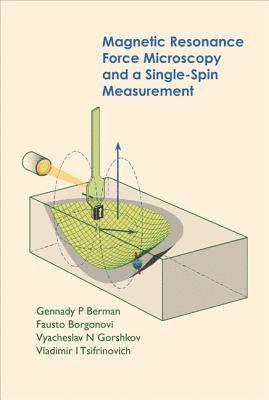
Magnetic resonance force microscopy (MRFM) is a rapidly evolving field which originated in 1990s and matured recently with the first detection of a single electron spin below the surface of a non-transparent solid. Further development of MRFM techniques will have a great impact on many areas of science and technology including physics, chemistry, biology, and even medicine. Scientists, engineers, and students from various backgrounds will all be interested in this promising field.The objective of this “multi-level” book is to describe the basic principles, applications, and the advanced theory of MRFM. Focusing on the experimental oscillating cantilever-driven adiabatic reversals (OSCAR) detection technique for single electron spin, this book contains valuable research data for scientists working in the field of quantum physics or magnetic resonance. Readers unfamiliar with quantum mechanics and magnetic resonance will be able to obtain an understanding and appreciation of the basic principles of MRFM.
987 kr
Skickas inom 5-8 vardagar
This book provides simple introduction to quantitative finance for students and junior quants who want to approach the typical industry problems with practical but rigorous ambition. It shows a simple link between theoretical technicalities and practical solutions. Mathematical aspects are discussed from a practitioner perspective, with a deep focus on practical implications, favoring the intuition and the imagination. In addition, the new post-crisis paradigms, like multi-curves, x-value adjustments (xVA) and Counterparty Credit Risk are also discussed in a very simple framework. Finally, real world data and numerical simulations are compared in order to provide a reader with a simple and handy insight on the actual model performances.
851 kr
Skickas inom 5-8 vardagar
A huge chasm has developed between modern science and undergraduate education. The result of this chasm is that students who are graduating from college are unable to exploit the many opportunities offered by modern science and technology. Modern science and technology widely uses the methods of classical physics, but these modern applications are not reflected in the physics problems often suggested to students. Solving practical problems is a very effective way to inform students about contemporary science, to illustrate the important relationships between modern and classical physics, and to prepare them for future activity in the modern technological environment. The aim of this book is to try to bridge this chasm between modern science and technology and an undergraduate course in physics.The first part of the book gives an overview of "hot" directions in modern physics and technology. The second part includes a brief review of undergraduate physics, followed by problems which are related to those directions. These problems, which are based on some of the latest developments in science and technology, can be solved using the classical physics accessible in a standard undergraduate program. Where necessary, the problems have detailed solutions.The second edition of Modern Physics and Technology for Undergraduates includes six new subsections dealing with the most recent developments in science, and a fully updated and expanded list of problems.
449 kr
Skickas inom 5-8 vardagar
A huge chasm has developed between modern science and undergraduate education. The result of this chasm is that students who are graduating from college are unable to exploit the many opportunities offered by modern science and technology. Modern science and technology widely uses the methods of classical physics, but these modern applications are not reflected in the physics problems often suggested to students. Solving practical problems is a very effective way to inform students about contemporary science, to illustrate the important relationships between modern and classical physics, and to prepare them for future activity in the modern technological environment. The aim of this book is to try to bridge this chasm between modern science and technology and an undergraduate course in physics.The first part of the book gives an overview of "hot" directions in modern physics and technology. The second part includes a brief review of undergraduate physics, followed by problems which are related to those directions. These problems, which are based on some of the latest developments in science and technology, can be solved using the classical physics accessible in a standard undergraduate program. Where necessary, the problems have detailed solutions.The second edition of Modern Physics and Technology for Undergraduates includes six new subsections dealing with the most recent developments in science, and a fully updated and expanded list of problems.