Geoff Walsham – författare
Visar alla böcker från författaren Geoff Walsham. Handla med fri frakt och snabb leverans.
6 produkter
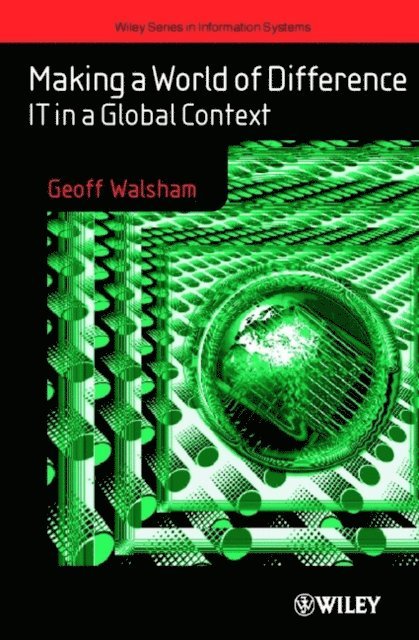
Making a World of Difference
IT in a Global Context
E-bok, 2003
788 kr
Lägg i varukorg
Information Technology has become an essential component of contemporary society, allowing much faster and more widespread communication, not least through the growth of the Internet. However, many issues concerned with the human aspects of the use of IT remain problematic despite technological …
Making a World of Difference
IT in a Global Context
Inbunden, 2001
1030 kr
Lägg i varukorg
Information Technology has become an essential component of contemporary society, allowing much faster and more widespread communication, not least through the growth of the Internet. However, many issues concerned with the human aspects of the use of IT remain problematic despite technological …
Information Technology in Context
Studies from the Perspective of Developing Countries
Av Chrisanthi Avgerou, Geoff Walsham
Häftad, 2019
531 kr
Lägg i varukorg
This title was first published in 2001. A discussion of information technology (IT) in developing countries. The contributors can be considered to share the following set of broad premises: information and communication technologies, and related systems, have significant potential to aid the …
Information Technology in Context
Studies from the Perspective of Developing Countries
Av Chrisanthi Avgerou, Geoff Walsham
Inbunden, 2017
2512 kr
Lägg i varukorg
This title was first published in 2001. A discussion of information technology (IT) in developing countries. The contributors can be considered to share the following set of broad premises: information and communication technologies, and related systems, have significant potential to aid the …
Information Technology in Context
Studies from the Perspective of Developing Countries
Av Geoff Walsham, Chrisanthi Avgerou
E-bok, 2017
1000 kr
Lägg i varukorg
This title was first published in 2000. A discussion of information technology (IT) in developing countries. The contributors can be considered to share the following set of broad premises: information and communication technologies, and related systems, have significant potential to aid the …
Information Technology in Context
Studies from the Perspective of Developing Countries
Av Geoff Walsham, Chrisanthi Avgerou
E-bok, 2017
1022 kr
Lägg i varukorg
This title was first published in 2000. A discussion of information technology (IT) in developing countries. The contributors can be considered to share the following set of broad premises: information and communication technologies, and related systems, have significant potential to aid the …