Geoffrey D. Kimball – författare
Visar alla böcker från författaren Geoffrey D. Kimball. Handla med fri frakt och snabb leverans.
5 produkter
5 produkter
1 054 kr
Skickas inom 10-15 vardagar
An American Indian language belonging to the Muskogean linguistic family, Koasati is spoken today by fewer than five hundred people living in southwestern Louisiana and on the Alabama-Coushatta Indian Reservation in Texas. Geoffrey D. Kimball has collected material from the speakers of the larger Louisiana community to produce the first comprehensive description of Koasati. The book opens with a brief history of the Koasati. The chapters that follow describe Koasati phonology, verb conjugation classes and inflectional morphology, verb derivation, noun inflectional and derivational morphology, grammatical particles, and syntax and semantics. A discussion of Koasati speech styles illustrated with texts concludes the book. Because examples of grammatical construction are drawn from native speakers in naturally occurring discourse, they authoritatively document aspects of a language that is little known.
944 kr
Skickas inom 10-15 vardagar
Koasati Dictionary is one of the first modern dictionaries ever published of a language of the Muskogean language family, whose speakers formerly occupied most of the southeastern United States. When first met by Europeans in the sixteenth century, the Koasati people were living in Eastern Tennessee. In the early eighteenth century they moved to south-central Alabama and eventually migrated to present-day Louisiana, Texas, or Oklahoma. Today their language survives in southwestern Louisiana, where it is still spoken by the majority of tribal members living there. Published three years after Kimball's richly detailed Koasati Grammar, this dictionary is the second of three monographs to result from his fifteen-year study of the language. In this work, Kimball provides the user with a substantial introduction outlining Koasati grammar and then organizes dictionary entries into two parts, the first arranged from Koasati to English and the second from English to Koasati. In addition to the English translations, entries in the Koasati-English section include sample sentences that illustrated word usage as well as illuminate traditional Koasati culture. Most of these sentences are taken from narrative texts.The dictionary, like Kimball's grammar of Koasati, is an indispensable reference work for linguists, anthropologists, and historians—indeed, for anyone interested in the native culture history of the southeastern United States.
808 kr
Skickas inom 10-15 vardagar
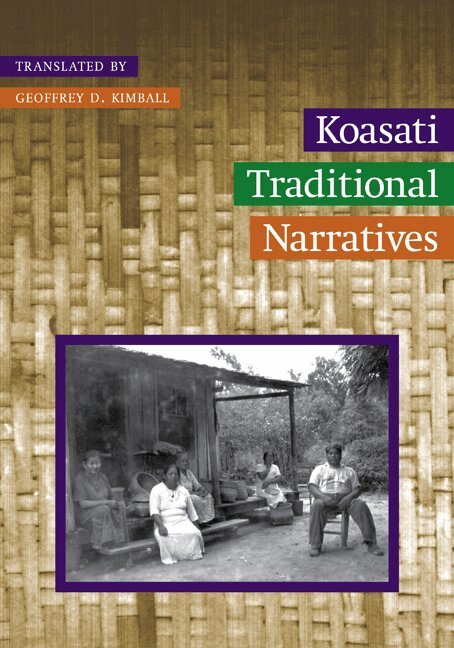
Koasati Traditional Narratives is the first published collection of oral literature of the Koasati Indians, who at the time of first contact with the West lived in the upper Tennessee River valley but now predominantly reside in western Louisiana. The works were gathered from several narrators between 1910 and 1992 by John R. Swanton, Mary R. Haas, Geoffrey D. Kimball, and others, and are presented in the original Koasati verse and in English translation. Because the Koasatis were full participants in the high civilization of the Mississippian period, with a complex aristocratic society, their oral literature exhibits considerable sophistication. The narratives are at turns serious, humorous, frightening, ironic, fantastic, and satiric, and serve both as a window to the mythohistoric past of the Koasatis and as a guide to their present. Encounters with Europeans, African slaves, and other Indian groups enabled Koasati narrators to engage their adaptive genius, and many of their tales derive from, among others, the Tunicas, the fables of La Fontaine, and the Book of Genesis. Part 1 includes mythological narratives, including Trickster rabbit stories, origin tales, monster stories, animal tales, medicine origin tales, and Christian tales. Part 2 features semihistorical narratives, including encounter stories and war stories, among others. Multiple renditions of some narratives are included, for traditional narratives were not set texts that were memorized but rather set plot elements through which narrators could display their verbal skills.
723 kr
Skickas inom 10-15 vardagar
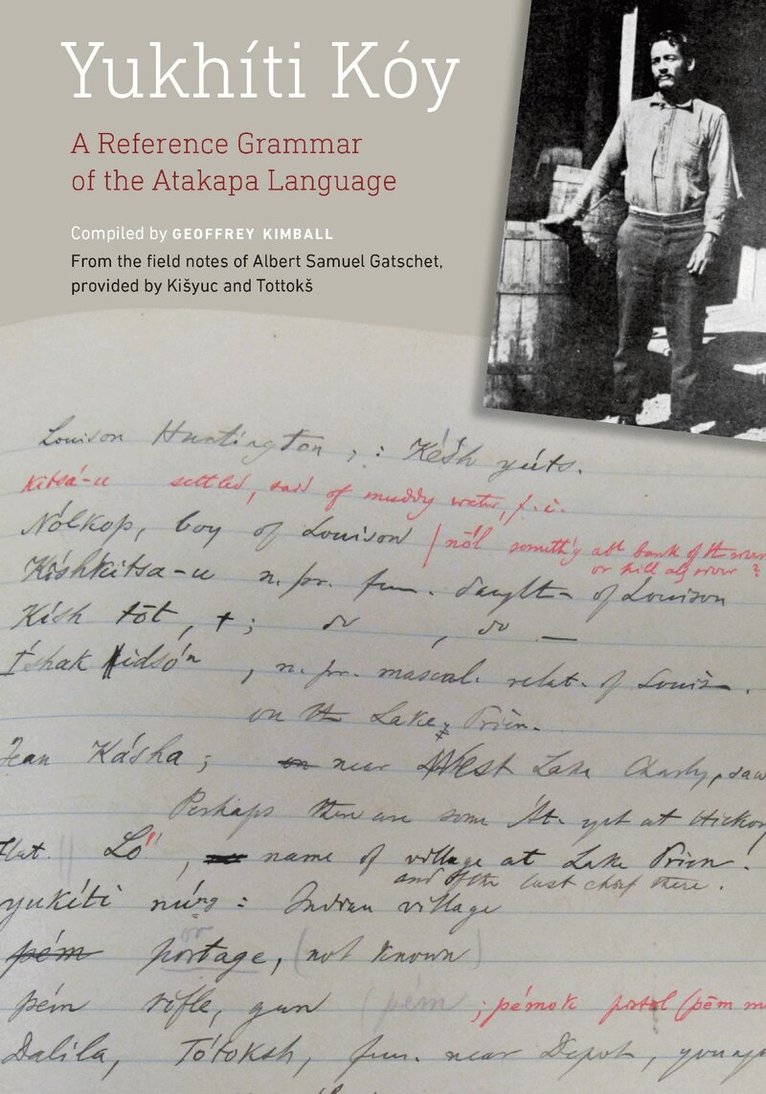
Geoffrey Kimball presents the first grammar of the American Indian language YukhÍti KÓy, better known in English as Atakapa, once spoken in coastal southwestern Louisiana and coastal eastern Texas. The late eighteenth and early nineteenth centuries saw a drastic fall in the Atakapa population, and by the first decades of the twentieth century the Atakapa language ceased to be spoken.The grammar is based on the field notes collected by Albert Samuel Gatschet in January of 1885, with additional material collected by John R. Swanton in 1907–8. Gatschet worked with two speakers of the language, KiŠyuc, also known as Yoyot, and her cousin TottokŠ, whose English names were Louison Huntington and Delilah Moss, respectively. John R. Swanton wrote a grammatical sketch of Atakapa in 1929 based on Gatschet’s notes and in 1932 published the texts Gatschet had gathered, as well as a dictionary.The materials, originally written phonetically, have been phonemicized, and the nature of the grammar has been elucidated. The nine surviving texts in YukhÍti have been phonemicized, analyzed, and translated, and the parallels between them and other traditional oral literatures of Native American languages of the Southeast are discussed. This reference grammar includes a vocabulary of all words contained in the field notes.
888 kr
Skickas inom 10-15 vardagar
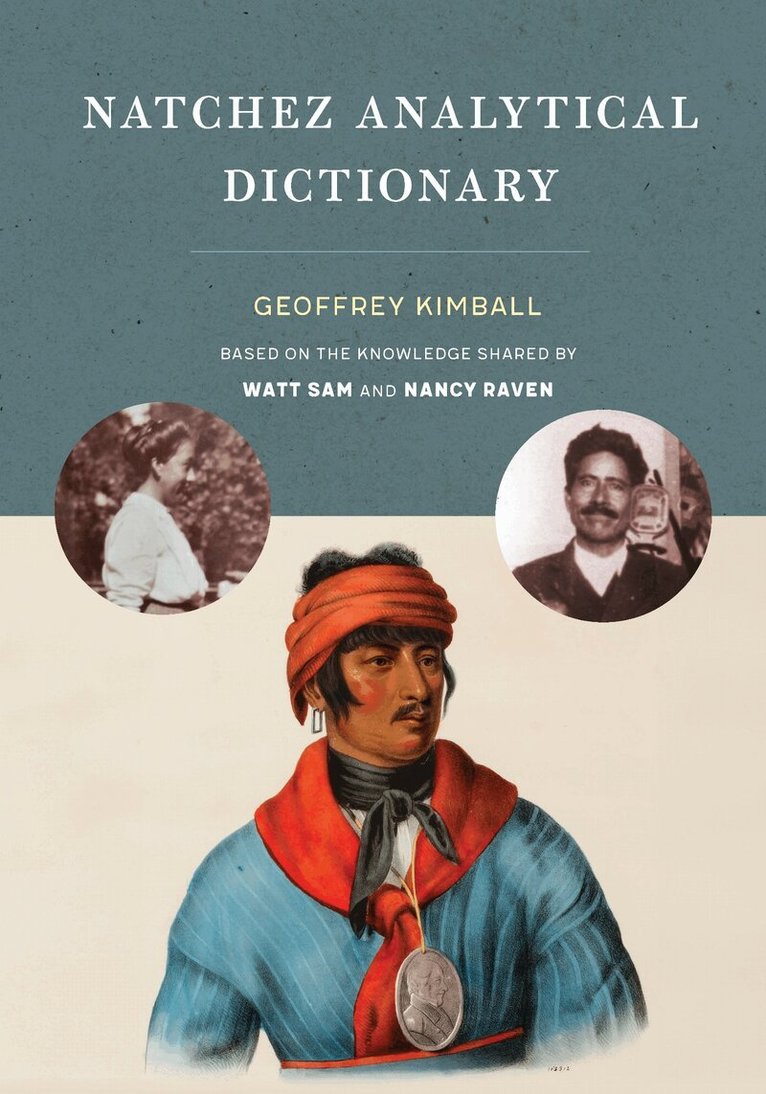
In Natchez Analytical Dictionary Geoffrey Kimball offers the first comprehensive dictionary of the Natchez language, a now extinct Native American language originally spoken in the region surrounding Natchez, Mississippi, and finally in the Cherokee Nation of Oklahoma. Based primarily on the extensive fieldwork of world-renowned linguist Mary R. Haas, the dictionary also contains material collected earlier by linguists and anthropologists such as Victor Riste, John R. Swanton, Albert S. Gatschet, Ann Eliza Worcester Robertson, Albert Pike, and Albert S. Gallatin.The Natchez language-whose lack of accurate available lexical material has perplexed modern linguists-has long been thought to be related to the Muskogean languages. Kimball’s Natchez Analytical Dictionary fills this critical gap for comparative, historical linguistics.