Georg Oswald – författare
Visar alla böcker från författaren . Handla med fri frakt och snabb leverans.
3 produkter
3 produkter
Häftad, Engelska, 2025
1 036 kr
Skickas inom 3-6 vardagar
E-bok
PDF, Engelska, 2010177 kr
Läs direkt efter köp
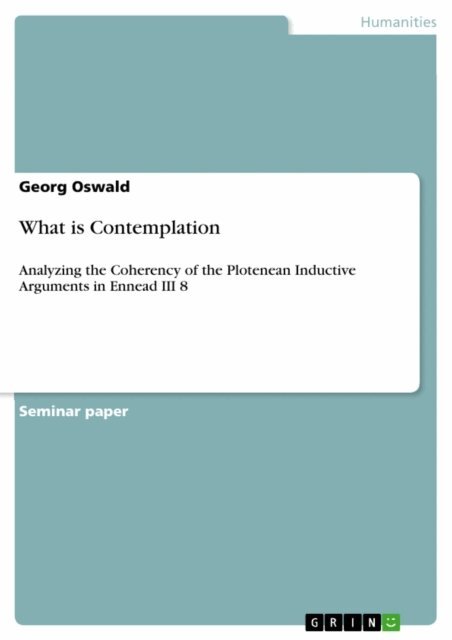
Seminar paper from the year 2009 in the subject Philosophy - Philosophy of the Ancient World, grade: 1,5, University of Cambridge (Faculty of Divinity), language: English, abstract: Plotinus' metaphysical ideas are usually described as a descent from the highest principle, the One, to its lower forms, Nous and Soul. 1 Introduction In contrast to this, I want to examine the different ontological manifestations of his thought, beginning with the lowest individual forms. The reason for this reversal is simply to illuminate the complex systematic account Plotinus provides us with. From this point of departure, we will be in a position to discuss and clarify problematic questions with regard to Plotinean research, which itself can only become meaningful when we address such problems in relation to our own realm, i.e. the realm of sensible concrete being. When Plotinus speaks of more advanced domains such as soul, nous and the one it is important to understand where he developed these categories from. If we claim that Plotinus s systematic framework is coherent, his inductive method must match his deduction from the One, in order to be logical and consistent. It would otherwise become evident thatPlotinus operates with presuppositions, which we can or cannot agree with. Indeed, if we look at Plotinean metaphysics from a procedural perspective, beginning with the lowest domain, two aspects of his philosophy must be borne in mind. Firstly, Plotinus himself must provide us with the means of deriving advanced categories from the onset. Secondly, there must be some kind of paradigm by which we can measure whether Plotinus s thoughts are in contradiction with one another. As regards the first point, we might best elucidate the problem by taking Plotinus s understanding of contemplation in Ennead III 8. Here, plotinus demonstrates that contemplation is an inductive derivation ofmore advanced categories, beginning with the lowest domain. The second aspect must only imply that derived categories explicate what was previously implicit. We shall focus on contemplation and its transition from one domain to another and make explicit what arguments and presuppositions Plotinus uses in order to validate his transition. The analysis of Ennead III 8 is to provide an accurate account of whether contemplation is logically consistent in its transition and to what extent we must assume a terminologically weighted conceptual framework at the backbone of his arguments. However, this essay does not claimto decode the entire complexity of Plotinean metaphysics, but rather to point out core problems of his thought exemplified in Ennead III 8.
E-bok
PDF, Tyska, 2020907 kr
Läs direkt efter köp
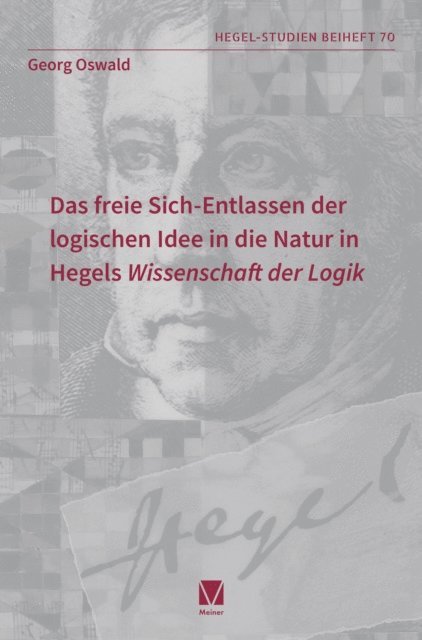
Das Problem, das in dieser Arbeit behandelt wird, ist kein geringeres als die Frage nach dem spekulativen Übergang der (spekulativ gedachten) Logik in die Natur, wie sie von Hegel in den letzten beiden Absätzen seiner "Wissenschaft der Logik" aufgeworfen wird. Die Tatsache, dass Hegel diesen Übergang dabei nur andeutet, wirft interpretatorische Fragen auf, die auf ein generelles Interpretationsproblem der hegelschen Philosophie hinweisen. Im Zentrum der Untersuchung steht der für die Auflösung der Übergangsproblematik virulente Gedanke der Idee im weiten Sinn und der Gedanke der endlichen, logischen und absoluten Idee im engen Sinn.