George Emery – författare
Visar alla böcker från författaren George Emery. Handla med fri frakt och snabb leverans.
8 produkter
8 produkter
E-bok
PDF, Engelska, 19931 005 kr
Läs direkt efter köp
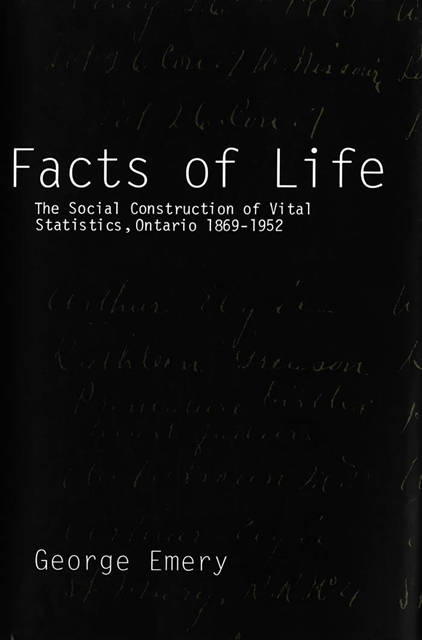
Emery''s central argument is that scholars must recognize the social historical character of the statistics before using them as a basis for research. He defines "social" broadly to include both an external component (the ideologies, concerns, and processes in society that influenced civil registration officials) and an internal component (the complex way officials organized civil registration, which greatly affected the statistics). Thus he treats statutes, regulations, the content of registration forms, and definition of significant terms as part of the social history of the statistics, not as technical background material. The issues treated include the incomplete registration of vital events, the influence of different definitions of "live birth" on statistics for infant deaths, the nature of statistics for death by cause, and the problem of "residence" - the difference between vital events occurring in a municipality and those involving its residents. Emery places Ontario''s vital statistics in the context of the international statistics movement and the development of the province''s registration system. He then provides empirical illustrations of how aspects of definition influence the data and suggests strategies for responding to such problems. The chapter providing a case study of the completeness of mortality registrations for 1869 to 1972 was prepared in collaboration with Kevin McQuillan.
E-bok
PDF, Engelska, 19991 005 kr
Läs direkt efter köp
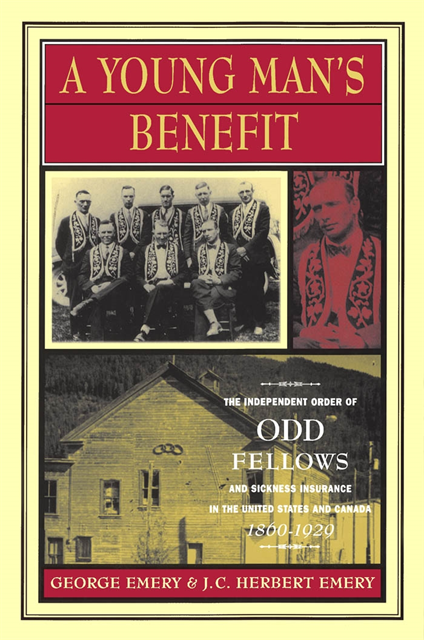
Using cliometric methods and records from six grand-lodge archives, A Young Man''s Benefit rejects the conventional wisdom about friendly societies and sickness insurance, arguing that IOOF lodges were financially sound institutions, were more efficient than commercial insurers, and met a market demand headed by young men who lacked alternatives to market insurance, not older men who had an above-average risk of sickness disability. Emery and Emery show that many young men joined the Odd Fellows for sickness insurance and quit the society once self-insurance - savings - or family insurance - secondary incomes from older children - made it feasible for them. The older men, who valued the social benefits of membership and did not need the sick benefit, gradually became a majority and dismantled the IOOF''s insurance provisions.
E-bok
PDF, Engelska, 20011 005 kr
Läs direkt efter köp
The Methodist Church met the challenge with a centralized polity and a cross-class, gender-variegated, evolving religious culture. It relied on wealthy laymen to raise special funds, while small gifts fed its regular funds. Young bachelors from Ontario and Britain filled the pastorate, although low pay, inexperience, and poor supervision caused many to quit. Membership growth was slow due to low population density and church-resistant elements in the Methodist population (bachelors, immigrant co-religionists, and transients), and missions to non-Anglo-Saxon immigrants in Winnipeg, Edmonton, and rural Alberta spread Methodist values but gained few members. In The Methodist Church on the Prairies, 1896-1914, the first scholarly study of church history in the prairie region, George Emery uses quantitative methods and social interpretation to show that the Methodist Church was a cross-class institution with a dynamic evangelical culture, not a middle-class institution whose culture was undergoing secularization. He demonstrates that the Methodist''s achievement on the prairies was impressive and compared favourably with what Presbyterians and Anglicans achieved.
E-bok
PDF, Engelska, 2015523 kr
Läs direkt efter köp
Redistributing electoral ridings alters their number, revises their boundaries, or does both at the same time. Ostensibly, the purpose of redistribution is to adjust parliamentary representation for population changes - the growth or decline of population, or shifts in its territorial distribution and social composition. Before an arm''s-length commission, headed by a judge, took control of electoral redistribution in the 1960s, parliament - effectively, the majority party - controlled redistribution, raising the possibility that the governing party would adjust the ridings for its own advantage, a practice known as gerrymandering. Providing detailed analyses of parliamentary redistribution in Ontario that preceded the province’s commissioned ridings of the 1960s, George Emery''s Principles and Gerrymanders unravels the mechanisms, operational strategies, and exposure to partisanship of parliamentary redistribution and its influence on general election outcomes. Using quantitative research methods, Emery identifies gerrymanders and demonstrates empirically whether or not these worked. He closes with a discussion of the transition to commissioned ridings, what has changed in redistribution, and what continues from the era when parliament redrew ridings. Contextualized with detailed maps and political cartoons, Principles and Gerrymanders is a pioneering study and a major contribution to the literature on Canadian and Ontario political history.
E-bok
Engelska, 2015523 kr
Läs direkt efter köp
Redistributing electoral ridings alters their number, revises their boundaries, or does both at the same time. Ostensibly, the purpose of redistribution is to adjust parliamentary representation for population changes - the growth or decline of population, or shifts in its territorial distribution and social composition. Before an arm''s-length commission, headed by a judge, took control of electoral redistribution in the 1960s, parliament - effectively, the majority party - controlled redistribution, raising the possibility that the governing party would adjust the ridings for its own advantage, a practice known as gerrymandering. Providing detailed analyses of parliamentary redistribution in Ontario that preceded the province’s commissioned ridings of the 1960s, George Emery''s Principles and Gerrymanders unravels the mechanisms, operational strategies, and exposure to partisanship of parliamentary redistribution and its influence on general election outcomes. Using quantitative research methods, Emery identifies gerrymanders and demonstrates empirically whether or not these worked. He closes with a discussion of the transition to commissioned ridings, what has changed in redistribution, and what continues from the era when parliament redrew ridings. Contextualized with detailed maps and political cartoons, Principles and Gerrymanders is a pioneering study and a major contribution to the literature on Canadian and Ontario political history.
E-bok
PDF, Engelska, 2016739 kr
Läs direkt efter köp
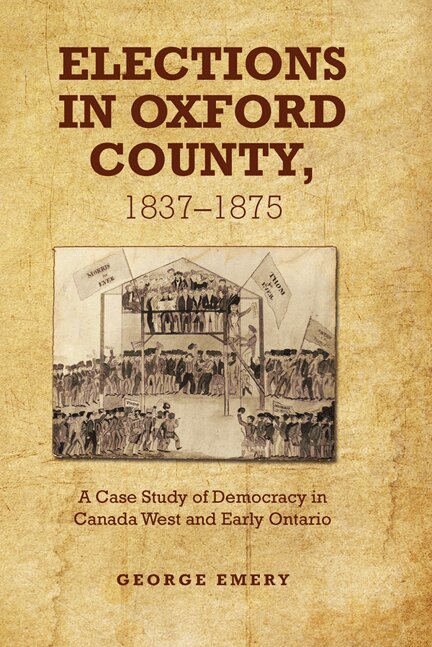
Elections in Oxford County, 1837-75 is a unique exploration of the forms, practices, and issues of democracy in a mid-nineteenth-century colonial setting. In this case study of thirty-eight elections in Oxford County — first as part of the United Province of Canada, then in early Ontario — George Emery delves into the advances, setbacks, and flaws of a partially democratic system. Emery demonstrates that while its forms and issues evolved, the net amount of democracy remained stable over time.Elections in Oxford County, 1837-75 breaks new ground with its detailed treatment of the county's voice-vote method of election, which ended with the adoption of the secret ballot in 1874. Employing an idealized parliamentary democracy as an explanatory model, Emery captures both geographically specific details and general features of this era's electoral process to enrich current understandings of nineteenth-century Canadian democracy.
E-bok
Engelska, 2012739 kr
Läs direkt efter köp
Elections in Oxford County, 1837-75 is a unique exploration of the forms, practices, and issues of democracy in a mid-nineteenth-century colonial setting. In this case study of thirty-eight elections in Oxford County — first as part of the United Province of Canada, then in early Ontario — George Emery delves into the advances, setbacks, and flaws of a partially democratic system. Emery demonstrates that while its forms and issues evolved, the net amount of democracy remained stable over time.Elections in Oxford County, 1837-75 breaks new ground with its detailed treatment of the county's voice-vote method of election, which ended with the adoption of the secret ballot in 1874. Employing an idealized parliamentary democracy as an explanatory model, Emery captures both geographically specific details and general features of this era's electoral process to enrich current understandings of nineteenth-century Canadian democracy.
Häftad, Engelska, 2024
295 kr
Skickas inom 5-8 vardagar