George Englebretsen – författare
2 269 kr
Skickas inom 10-15 vardagar
394 kr
Skickas inom 3-6 vardagar
714 kr
Skickas inom 10-15 vardagar
811 kr
Läs direkt efter köp
841 kr
Läs direkt efter köp
807 kr
Läs direkt efter köp
807 kr
Läs direkt efter köp
410 kr
Skickas inom 10-15 vardagar
1 676 kr
Skickas inom 10-15 vardagar
195 kr
Skickas inom 5-8 vardagar
319 kr
Skickas inom 5-8 vardagar
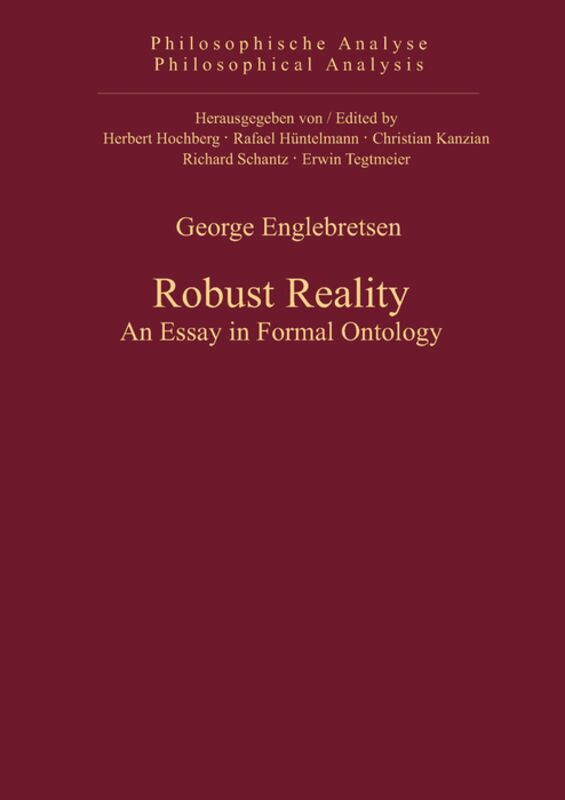
Robust Reality
An Essay in Formal Ontology
1 708 kr
Skickas inom 5-8 vardagar
1 724 kr
Läs direkt efter köp
Contemporary analytic philosophy can generally be characterized by the following tendencies: commitment to first-order predicate logic as the only viable formal logic; rejection of correspondence theories of truth; a view of existence as something expressed by the existential quantifier; a metaphysics that doesn’t give the world as a whole its due. This book seeks to offer an alternative analytic theory, one that provides a unified account of what there is, how we speak about it, the underlying logic of our language, how the truth of what we say is determined, and the central role of the real world in all of this. The result is a robust account of reality. The inspiration for many of the ideas that constitute this overall theory comes from such sources as Aristotle, Leibniz, Ryle, and Sommers.
1 579 kr
Läs direkt efter köp
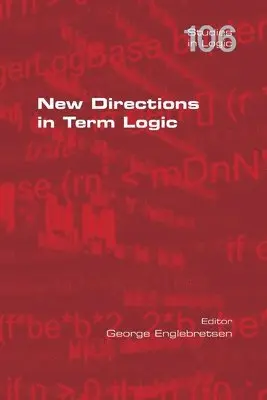
While post-Fregean logicians tend to ignore or even denigrate the traditional logic of Aristotle and the Scholastics, new work in recent years has shown the viability of a renewed, extended, and strengthened logic of terms that shares fundamental features of the old syllogistic. A number of logicians, following the lead of Fred Sommers, have built just such a term logic. It is a system of formal logic that not only matches the expressive and inferential powers of today’s standard logic, but surpasses it and is far simpler and more natural. This book aims to substantiate this claim by exhibiting just how the term logic can shed need light on a variety of challenges that face any system of formal logic.
1 579 kr
Läs direkt efter köp
While post-Fregean logicians tend to ignore or even denigrate the traditional logic of Aristotle and the Scholastics, new work in recent years has shown the viability of a renewed, extended, and strengthened logic of terms that shares fundamental features of the old syllogistic. A number of logicians, following the lead of Fred Sommers, have built just such a term logic. It is a system of formal logic that not only matches the expressive and inferential powers of today’s standard logic, but surpasses it and is far simpler and more natural. This book aims to substantiate this claim by exhibiting just how the term logic can shed need light on a variety of challenges that face any system of formal logic.
1 565 kr
Skickas inom 5-8 vardagar
1 739 kr
Skickas inom 5-8 vardagar
1 759 kr
Läs direkt efter köp
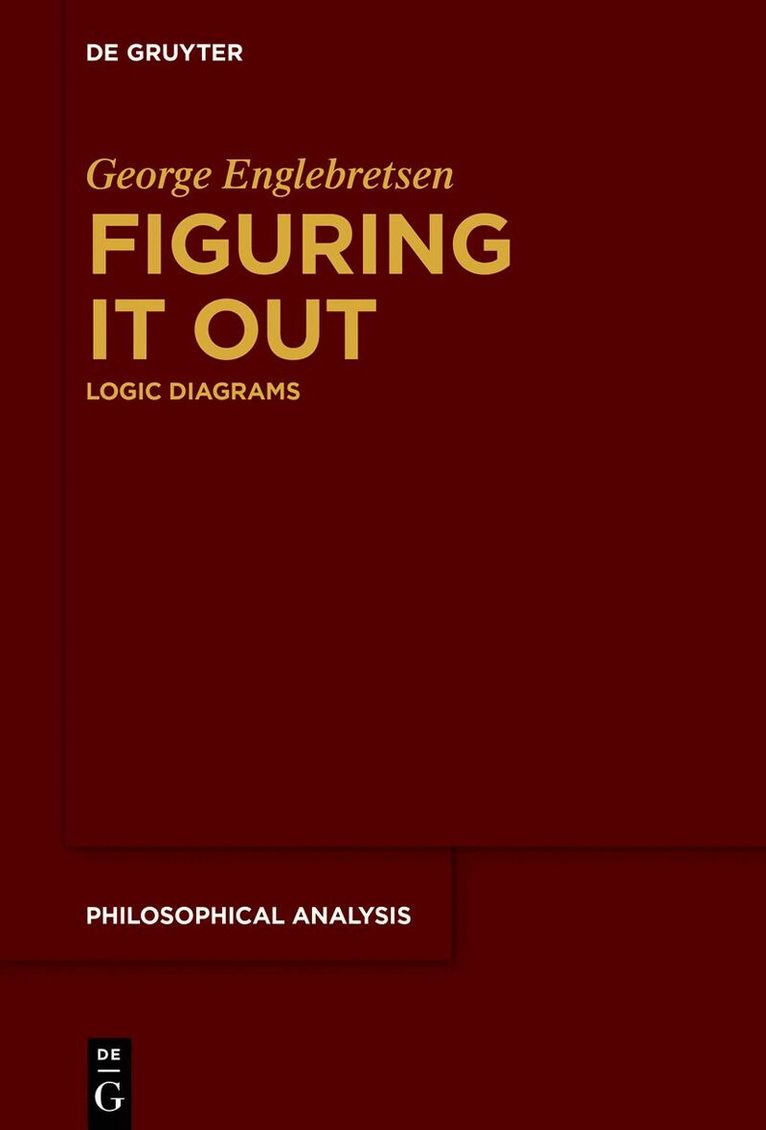
The book begins with an extensive survey of the history of logic diagrams, including looking at possible diagrams from Aristotle, the development of both linear and closed figure diagrams by Leibniz, Lambert, Euler, Venn’s new system, Peirce’s Existential Graphs, and Frege’s two-dimensional notation as a kind of logic diagram system. During most of the 20th century, there was little regard for efforts to construct logic diagrams. However, since the 1980s there has been an increasing interest in such diagrams. Ever larger numbers of philosophers, logicians, mathematicians, computational scientists, and cognitive scientists have turned their attention to building, analyzing, using, or exploring in other ways systems of logic diagrams. The system offered here makes use of line segments and points and it enjoys a number of important advantages: it is simple, natural, and both expressively and inferentially powerful. It can be used to analyze syllogisms (including those involving relational terms) and arguments involving unanalyzed statements. Understanding such a system can shed valuable light on how ordinary people naturally reason.
1 759 kr
Läs direkt efter köp
The book begins with an extensive survey of the history of logic diagrams, including looking at possible diagrams from Aristotle, the development of both linear and closed figure diagrams by Leibniz, Lambert, Euler, Venn’s new system, Peirce’s Existential Graphs, and Frege’s two-dimensional notation as a kind of logic diagram system. During most of the 20th century, there was little regard for efforts to construct logic diagrams. However, since the 1980s there has been an increasing interest in such diagrams. Ever larger numbers of philosophers, logicians, mathematicians, computational scientists, and cognitive scientists have turned their attention to building, analyzing, using, or exploring in other ways systems of logic diagrams. The system offered here makes use of line segments and points and it enjoys a number of important advantages: it is simple, natural, and both expressively and inferentially powerful. It can be used to analyze syllogisms (including those involving relational terms) and arguments involving unanalyzed statements. Understanding such a system can shed valuable light on how ordinary people naturally reason.
Figuring It Out
Logic Diagrams
306 kr
Skickas inom 5-8 vardagar