George Gratzer – författare
880 kr
Läs direkt efter köp
"Gratzer’s book is a solution."
-European Mathematical Society Newsletter
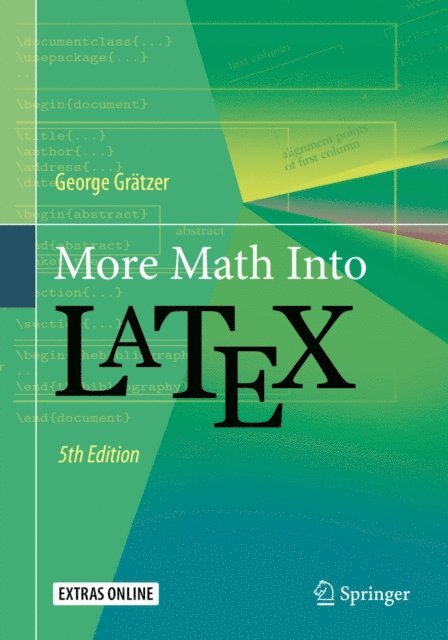
For close to two decades, Math into Latex has been the standard introduction and complete reference for writing articles and books containing mathematical formulas. In this fourth edition, the reader is provided with important updates on articles and books. An important new topic is discussed: transparencies (computer projections).
Key features of More Math into Latex, 4th edition:
- Installation instructions for PC and Mac users
- An example-based, visual approach and a gentle introduction with the Short Course
- A detailed exposition of multiline math formulas with a Visual Guide
- A unified approach to Tex, Latex, and the AMS enhancements
- A quick introduction to creating presentations with computer projections
From earlier reviews of Math into Latex:
"There are several Latex guides, but this one wins hands down for the elegance of its approach and breadth of coverage."
-Amazon.com Best of 2000, Editor’s choice
"A novice reader will be able to learn the most essential features of Latex sufficient to begin typesetting papers within a few hours of time…An experienced Tex user, on the other hand, will find a systematic and detailed discussion of Latex features."
-Report on Mathematical Physics
"A very helpful and useful tool for all scientists and engineers."
-Review of Astronomical Tools
1 179 kr
Läs direkt efter köp
Universal Algebra heralded as ". . . the standard reference in a field notorious for the lack of standardization . . .", has become the most authoritative, consistently relied on text in a field with applications in other branches of algebra and other fields such as combinatorics, geometry, and computer science.
Each chapter is followed by an extensive list of exercises and problems. The "state of the art" account also includes new appendices (with contributions from B. Jónsson, R. Quackenbush, W. Taylor, and G. Wenzel) and a well selected additional bibliography of over 1250 papers and books which makes this an indispensable new edition for students, faculty, and workers in the field.
"This book will certainly be, in the years to come, the basic reference to the subject." The American Mathematical Monthly (First Edition)
"In this reviewer''s opinion [the author] has more than succeeded in his aim. The problems at the end of each chapter are well-chosen; there are more than 650 of them. The book is especially suitable for self-study, as the author frequently provides ample explanation not only of what he is proving, but also of how and why he is proving it. As a reference work for the specialist or a text for the student, the book is highly recommended." Mathematical Reviews (First Edition)
"Since the first day of its appearance in 1968, this book has been the standard reference in universal algebra, and no book since has reached its quality." Journal of Symbolic Logic (Second Edition)
2 617 kr
Skickas inom 3-6 vardagar
523 kr
Läs direkt efter köp
1 288 kr
Läs direkt efter köp
1 140 kr
Läs direkt efter köp
359 kr
Läs direkt efter köp
608 kr
Skickas inom 10-15 vardagar
870 kr
Läs direkt efter köp
784 kr
Skickas inom 10-15 vardagar
978 kr
Läs direkt efter köp
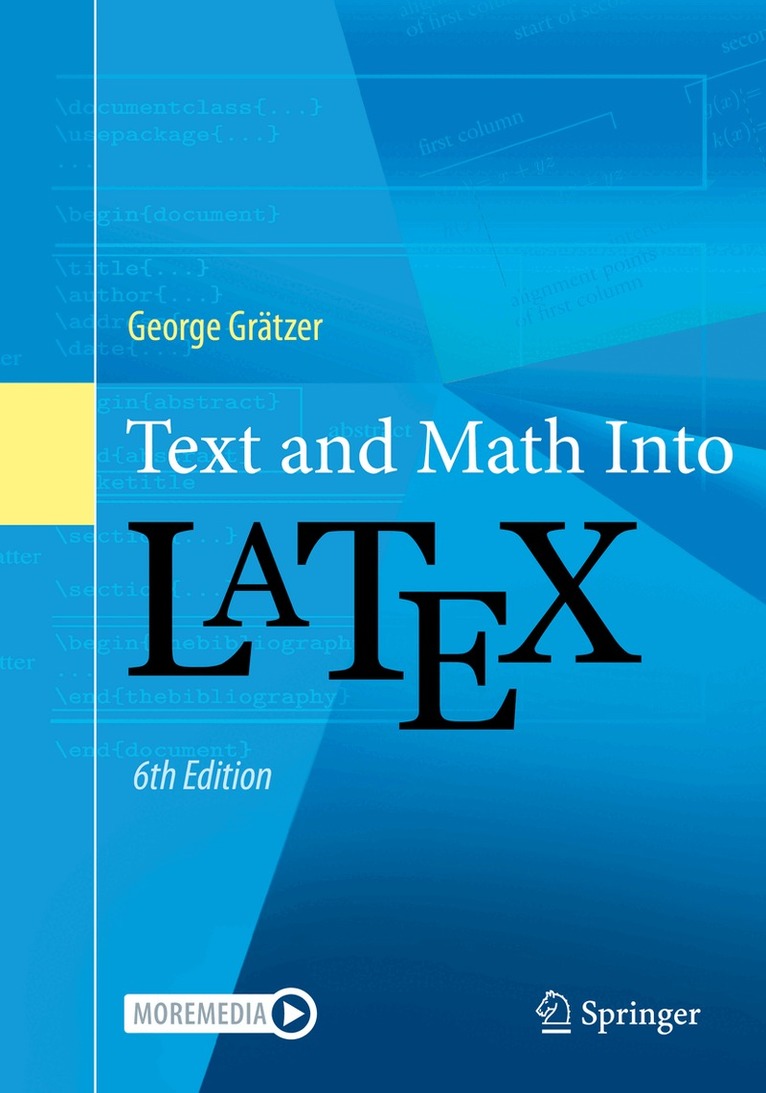
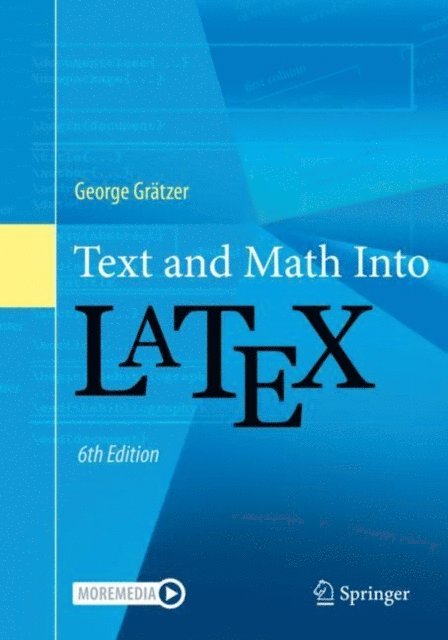
For more than 30 years, this comprehensive manual has been the standard introduction and complete reference for writing articles and books containing mathematical formulas. This sixth edition uses a slightly changed title, Text and Math into LaTeX, to emphasize the importance of text in mathematical/scientific composition. Sections that contained commands no longer much needed (such as \includeonly) and the introductory sections to PDF (now ubiquitous) have been omitted. Many sections are now enhanced with discussion of new and useful packages. An occasional encouragement for the reader to consult ChatGPT for confirmation on various points illustrates the positive relationship between ChatGPT and LaTeX.
The new Chapter 17 describes recent developments that enhance, or replace, BibTeX and the new Appendix C, introduces the reader to ChatGPT.
Key features:
An example-based, visual approach and agentle introduction with the Short CourseA detailed exposition of multiline math formulas with a Visual GuideA unified approach to TeX, LaTeX, and the AMS enhancementsA quick introduction to creating presentations with formulasA detailed approach to creating illustrationsExtras are provided on SpringerLink for the following chapters: 1, 2, 3, 4, 6, 7, 10, 11, 13, 14, 15, 16, 17, 18 and Appendices A, B. Readers must visit the HTML version of each chapter and access the Electronic Supplementary Material.
Extras for Appendices A & B can be found in Extras for Chapter 18.
475 kr
Läs direkt efter köp
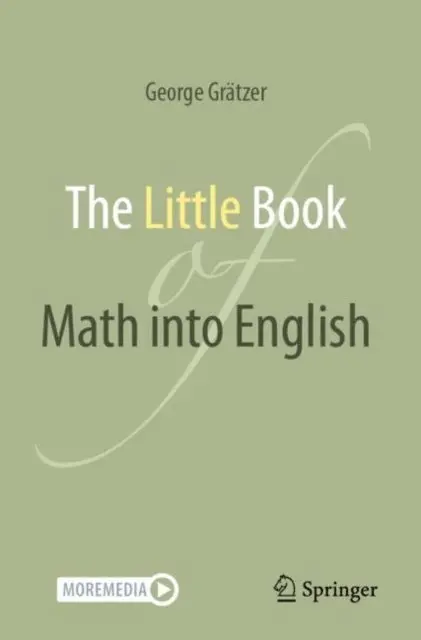
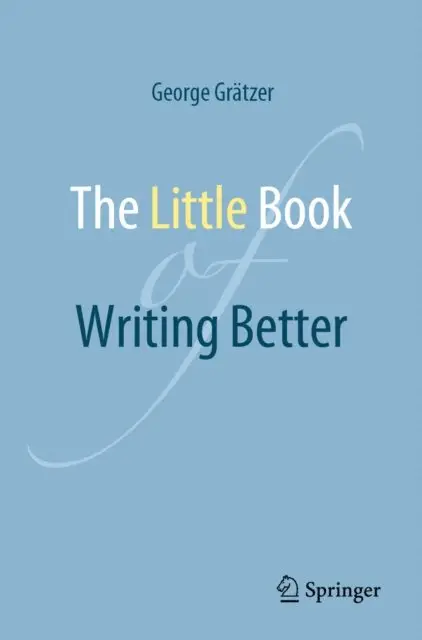
This colorful and concise little book is uniquely tailored for those who write mathematical texts at any level and are eager to improve their English writing skills. The easy-to-read guide focuses on helping the writer avoid common English mistakes in mathematical writing. With just a few minutes of engaging, light reading each day, the reader will learn to create clearer, more readable, math texts.
The book covers 23 crucial topics, ranging from correct article and preposition usage to proper usage of dashes, conjunctions, and prepositions. It also addresses the construction of direct sentences, effective introductory phrases for formulas, and more. As a bonus to the reader, ‘Practice makes perfect’ exercises relating to each topic are freely accessible on this book’s Springer website.
Appendix A gives a quick tutorial on grammatical terms and constructs. Appendix B looks at ChatGPT and the positive aspects of its powerful capabilities. Additionally, Paul Halmos’s article on ‘How to write mathematics’ is included in Appendix C. It deals with the mathematical aspects of writing.
354 kr
Läs direkt efter köp
This colorful and concise little book is tailored to a general readership. A sister to the recently published The Little Book of Math into English, this accessible guide avoids lengthy lessons and complex grammatical jargon. Instead, the reader is provided with key insights that are directly relevant and easily applicable. By following the straightforward recommendations and working the exercises (640 in number), readers can count on significantly reducing their writing errors and learn to create clearer, more readable, pieces of writing.
Topics are divided into four parts. Part I is labeled Crucial and contains five topics that lay the foundations of writing by covering the most essential elements of grammar and sentence construction. Part II is Very Important and contains six slightly more advanced topics that assist with refining writing and ensuring clarity. Part III is Important and also contains six topics addressing common issues that help to master the art of polishing a writing piece even further. Part IV, And Some More, contains four nuanced topics that are useful for additional fine-tuning. Each topic concludes with a section called Practice Makes Perfect, offering exercises and hints. Solutions then follow.
Appendix A gives a quick tutorial on grammatical terms and constructs. Appendix B looks at ChatGPT and the positive aspects of its powerful capabilities. Appendix C provides a bonus Gold Rush of additional exercises, each of which is referenced to specific sections of the book.
1 179 kr
Läs direkt efter köp
1 416 kr
Läs direkt efter köp
570 kr
Läs direkt efter köp
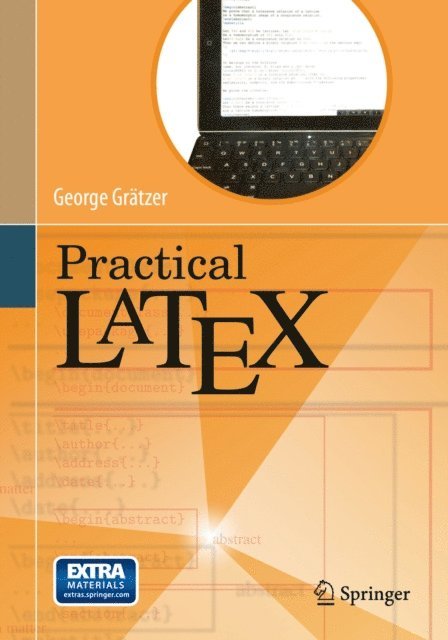
Practical LaTeX covers the material that is needed for everyday LaTeX documents. This accessible manual is friendly, easy to read, and is designed to be as portable as LaTeX itself.
A short chapter, Mission Impossible, introduces LaTeX documents and presentations. Read these 30 pages; you then should be able to compose your own work in LaTeX. The remainder of the book delves deeper into the topics outlined in Mission Impossible while avoiding technical subjects. Chapters on presentations and illustrations are a highlight, as is the introduction of LaTeX on an iPad.Students, faculty, and professionals in the worlds of mathematics and technology will benefit greatly from this new, practical introduction to LaTeX. George Grätzer, author of More Math into LaTeX (now in its 4th edition) and First Steps in LaTeX, has been a LaTeX guru for over a quarter of century.From the reviews of More Math into LaTeX:``There are several LaTeX guides, but this one wins hands down for the elegance of its approach and breadth of coverage.''''
—Amazon.com, Best of 2000, Editors Choice``A very helpful and useful tool for all scientists and engineers.''''
—Review of Astronomical Tools``A novice reader will be able to learn the most essential features of LaTeX sufficient to begin typesetting papers within a few hours of time…An experienced TeX user, on the other hand, will find a systematic and detailed discussion of all LaTeX features, supporting software, and many other advanced technical issues.''''
—Reports on Mathematical Physics1 214 kr
Läs direkt efter köp
For over two decades, this comprehensive manual has been the standard introduction and complete reference for writing articles and books containing mathematical formulas. If the reader requires a streamlined approach to learning LaTeX for composing everyday documents, Grätzer’s © 2014 Practical LaTeX may also be a good choice.
In this carefully revised fifth edition, the Short Course has been brought up to date and reflects a modern and practical approach to LaTeX usage. New chapters have been added on illustrations and how to use LaTeX on an iPad.
Key features:
An example-based, visual approach and a gentle introduction with the Short CourseA detailed exposition of multiline math formulas with a Visual GuideA unified approach to TeX, LaTeX, and the AMS enhancementsA quick introduction to creating presentations with formulasFrom earlier reviews:
Grätzer’s book is a solution.
—European Mathematical Society Newsletter
There are several LaTeX guides, but this one wins hands down for the elegance of its approach and breadth of coverage.
—Amazon.com, Best of 2000, Editor’s choice
A novice reader will be able to learn the most essential features of LaTeX sufficient to begin typesetting papers within a few hours of time… An experienced TeX user, on the other hand, will find a systematic and detailed discussion of LaTeX fea
tures.—Report on Mathematical Physics
A very helpful and useful tool for all scientists and engineers. —Review of Astronomical Tools
687 kr
Läs direkt efter köp
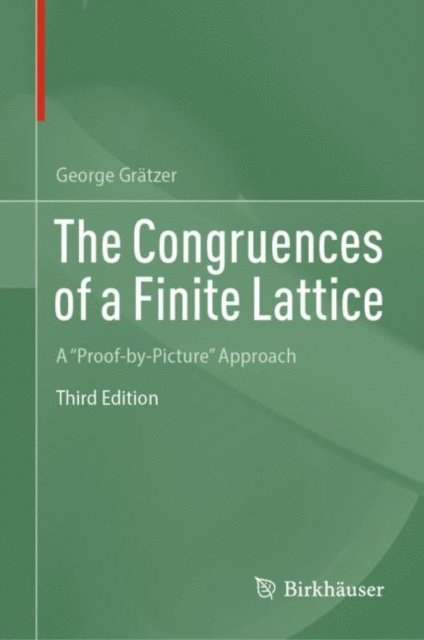
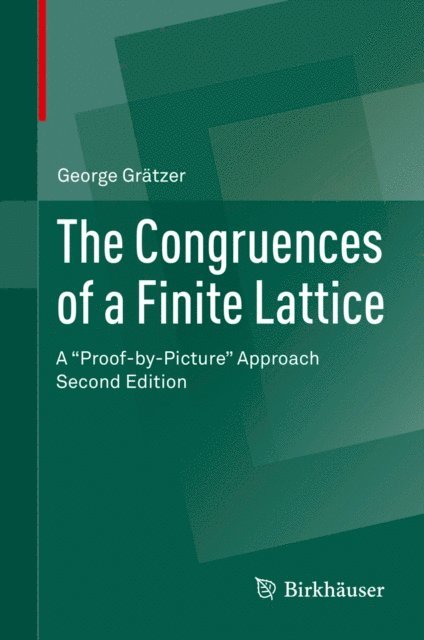
This is a self-contained exposition by one of the leading experts in lattice theory, George Grätzer, presenting the major results of the last 70 years on congruence lattices of finite lattices, featuring the author''s signature Proof-by-Picture method.
Key features:
* Insightful discussion of techniques to construct "nice" finite lattices with given congruence lattices and "nice" congruence-preserving extensions
* Contains complete proofs, an extensive bibliography and index, and over 140 illustrations
* This new edition includes two new parts on Planar Semimodular Lattices and The Order of Principle Congruences, covering the research of the last 10 yearsThe book is appropriate for a one-semester graduate course in lattice theory, and it is a practical reference for researchers studying lattices.
Reviews of the first edition:
"There exist a lot of interesting results in this area of lattice theory, and some of them are presented inthis book. [This] monograph…is an exceptional work in lattice theory, like all the contributions by this author. … The way this book is written makes it extremely interesting for the specialists in the field but also for the students in lattice theory. Moreover, the author provides a series of companion lectures which help the reader to approach the Proof-by-Picture sections." (Cosmin Pelea, Studia Universitatis Babes-Bolyai Mathematica, Vol. LII (1), 2007)
"The book is self-contained, with many detailed proofs presented that can be followed step-by-step. [I]n addition to giving the full formal details of the proofs, the author chooses a somehow more pedagogical way that he calls Proof-by-Picture, somehow related to the combinatorial (as opposed to algebraic) nature of many of the presented results. I believe that this book is a much-needed tool for any mathematician wishing a gentle introduction to the field of congruences representations offinite lattices, with emphasis on the more ''geometric'' aspects." —Mathematical Reviews
1 741 kr
Läs direkt efter köp
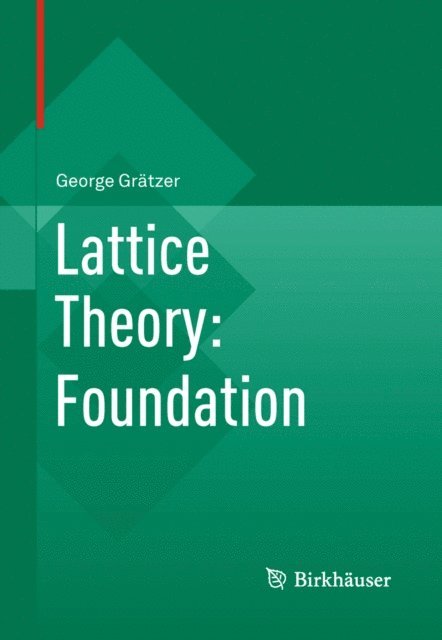
George Grätzer''s Lattice Theory: Foundation is his third book on lattice theory (General Lattice Theory, 1978, second edition, 1998). In 2009, Grätzer considered updating the second edition to reflect some exciting and deep developments. He soon realized that to lay the foundation, to survey the contemporary field, to pose research problems, would require more than one volume and more than one person.
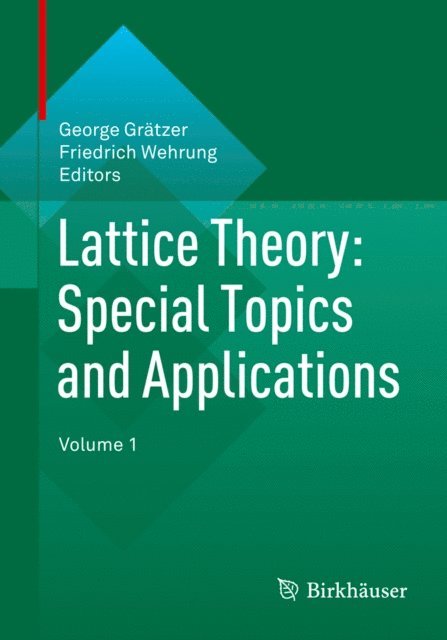
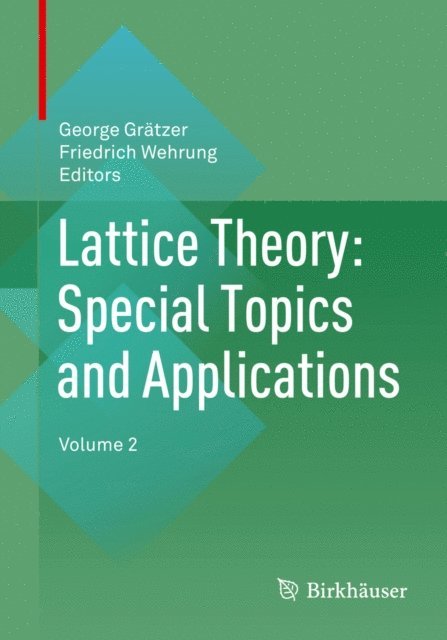
So Lattice Theory: Foundation provided the foundation. Now we complete this project with Lattice Theory: Special Topics and Applications, in two volumes, written by a distinguished group of experts, to cover some of the vast areas not in Foundation.
This second volume is divided into ten chapters contributed by K. Adaricheva, N. Caspard, R. Freese, P. Jipsen, J.B. Nation, N. Reading, H. Rose, L. Santocanale, and F. Wehrung.
53 kr
Läs direkt efter köp
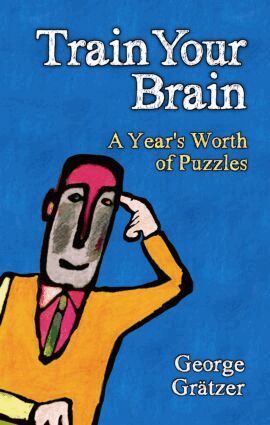
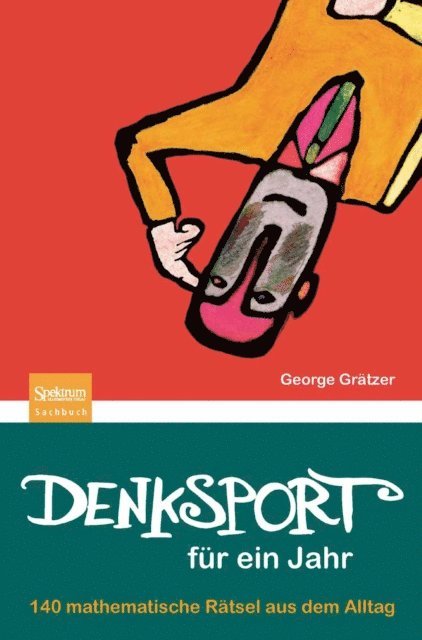
Manche beginnen den Tag mit Gymnastik, um den Körper zu entrosten und beweglich zu halten. Leider kümmern sich aber nur wenige um das Training ihres Gehirns, also des Organs, das uns zum Menschen macht. Dieses Buch versorgt Sie mit Denksportaufgaben und hilft Ihnen beim ganzjährigen Hirnjogging.
Angesprochen sindSchüler ab 14 Jahren, die ihren Verstand durch geeignetes Training schärfen möchten, Erwachsene, denen das Lösen von Kreuzworträtseln nicht reicht, ältere Menschen, die geistig fit bleiben möchten.Sie alle werden sehen, dass sich Ihr Denkorgan beim Lösen der Aufgaben entschlackt und flexibler wird. Lesen Sie jede Woche einige Rätsel, denken Sie darüber nach und versuchen Sie sich an den Lösungen. Das schärft das Denkvermögen und Sie werden an jedem Schritt Ihre Freude haben.
Sollten Sie die Aufgabe nicht innerhalb von ein bis zwei Tagen lösen, dann sehen Sie in den Hinweisen nach und versuchen, damit weiter zu kommen. Es ist ein großes Erlebnis, wenn man nach Stunden oder Tagen des Kampfes sagen kann: „Heureka, ich hab’s gefunden!“
Stimmen zum Buch:
„Dieses Buch war eine meiner Lieblingslektüren als Mittel- und Oberstufen-Schüler. Es ist von einem führenden Mathematiker in einem angenehmen Stil geschrieben und enthält sehr interessante Rätsel und mathematische Probleme, die mit großer Sorgfalt angeordnet sind. László Lovász, Präsident der International Mathematical Union und Verfasser von „Combinatorial Problems and Exercises“.