George J. Dvorak – författare
Visar alla böcker från författaren George J. Dvorak. Handla med fri frakt och snabb leverans.
5 produkter
5 produkter
E-bok
PDF, Engelska, 20062 840 kr
Läs direkt efter köp
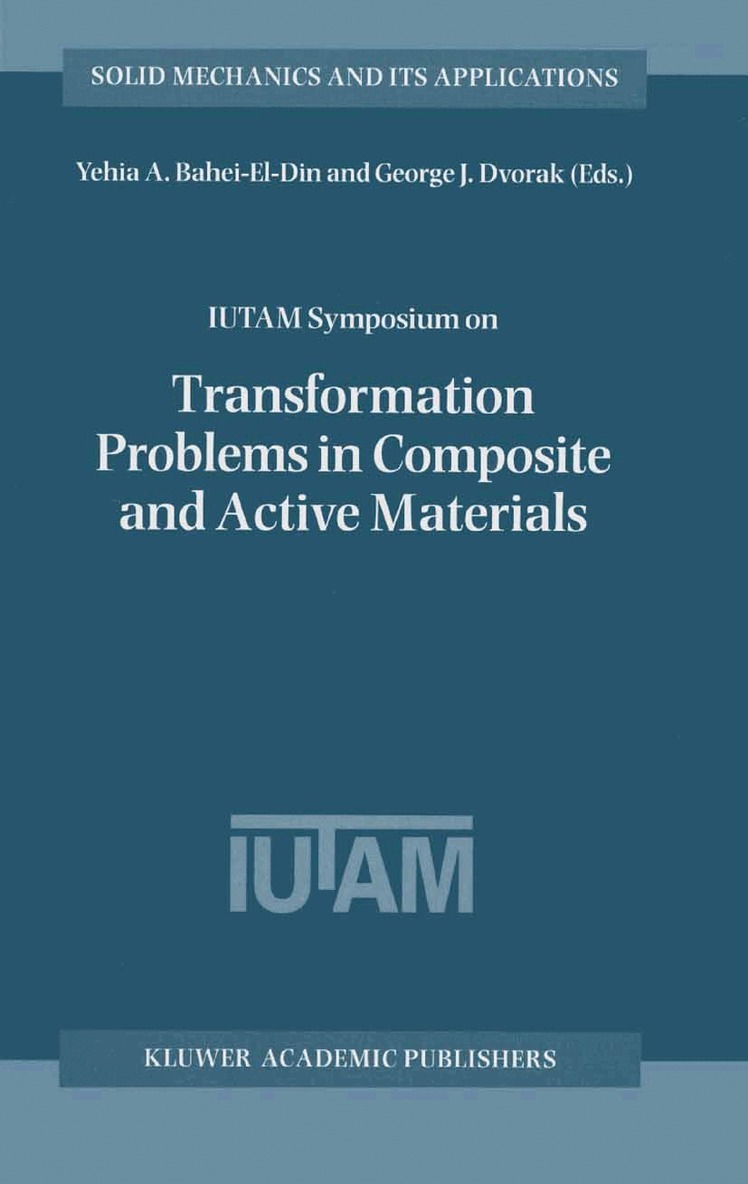
The field of composite materials has seen substantial development in the past decade, New composite systems are being continually developed for various applications. Among such systems are metal, intermetallic, and superalloy matrix composites, carbon-carbon composites as well as polymer matrix composites. At the same time, a new discipline has emerged of active or smart materials, which are often constructed as composite or heterogeneous media and structures. One unifying theme in these diverse systems is the influence that uncoupled and coupled eigenfields or transformation fields exert on the various types of overall response, as well as on the respective phase responses. Problems of this kind are currently considered by different groups which may not always appreciate the similarities of the problems involved. The purpose of the IUTAM Symposium on Transformation Problems in Composite and Active Materials held in Cairo, Egypt from March 10 to 12, 1997 was to bring together representatives of the different groups so that they may interact and explore common aspects of these seemingly different problem areas. New directions in micromechanics research in both composite and active materials were also explored in the symposium. Specifically, invited lectures in the areas of inelastic behavior of composite materials, shape memory effects, functionally graded materials, transformation problems in composite structures, and adaptive structures were delivered and discussed during the three-day meeting. This book contains the printed contributions to the IUTAM Symposium.
Inbunden, Engelska, 1998
2 161 kr
Skickas inom 10-15 vardagar
These proceedings address uncoupled and coupled transformation problems in composite and smart materials and their structures. The text covers: inelastic behaviour of composite materials, shape memory effects, functionally graded materials, transformation problems in composite structures, adaptive structures, and elasticity issues. Although the field of composite materials has seen substantial development in the past two decades, new composite systems are continually being developed for various applications. Among such systems are metal, intermetallic, and superalloy matrix composites, carbon-carbon composites, and polymer matrix composites. The field of smart materials, on the other hand, is relatively new, but has also seen important developments recently. These two seemingly different fields have often been addressed in separate books, journals, and technical meetings.
E-bok
PDF, Engelska, 20121 416 kr
Läs direkt efter köp
Polymer composites were introduced for the aerospace industry as light, strong, stiff materials, and adopted by the construction and automobile industries, among others. Meanwhile, composite materials have been introduced to fulfill the uses that these conventional materials could not, such as in extreme environments. The research for new composites includes not only new polymer systems, but metals, ceramics and intermetallic systems as well. This volume contains a selection of recent work by leading researchers in micromechanics on the topics of prediction of overall properties of elastic, perfectly bonded systems, problems associated with inelastic deformation of the phase, debonding at interfaces and growth of distributed damage. Many familiar aspects of mechanical behavior, such as fatigue, fracture, strength and buckling, etc. have been reexamined and adapted for these new systems.
Häftad, Engelska, 2011
1 079 kr
Skickas inom 10-15 vardagar
Polymer composites were introduced for the aerospace industry as light, strong, stiff materials, and adopted by the construction and automobile industries, among others. Meanwhile, composite materials have been introduced to fulfill the uses that these conventional materials could not, such as in extreme environments. The research for new composites includes not only new polymer systems, but metals, ceramics and intermetallic systems as well. This volume contains a selection of recent work by leading researchers in micromechanics on the topics of prediction of overall properties of elastic, perfectly bonded systems, problems associated with inelastic deformation of the phase, debonding at interfaces and growth of distributed damage. Many familiar aspects of mechanical behavior, such as fatigue, fracture, strength and buckling, etc. have been reexamined and adapted for these new systems.
Häftad, Engelska, 2010
2 161 kr
Skickas inom 10-15 vardagar
The field of composite materials has seen substantial development in the past decade, New composite systems are being continually developed for various applications. Among such systems are metal, intermetallic, and superalloy matrix composites, carbon-carbon composites as well as polymer matrix composites. At the same time, a new discipline has emerged of active or smart materials, which are often constructed as composite or heterogeneous media and structures. One unifying theme in these diverse systems is the influence that uncoupled and coupled eigenfields or transformation fields exert on the various types of overall response, as well as on the respective phase responses. Problems of this kind are currently considered by different groups which may not always appreciate the similarities of the problems involved. The purpose of the IUTAM Symposium on Transformation Problems in Composite and Active Materials held in Cairo, Egypt from March 10 to 12, 1997 was to bring together representatives of the different groups so that they may interact and explore common aspects of these seemingly different problem areas. New directions in micromechanics research in both composite and active materials were also explored in the symposium. Specifically, invited lectures in the areas of inelastic behavior of composite materials, shape memory effects, functionally graded materials, transformation problems in composite structures, and adaptive structures were delivered and discussed during the three-day meeting. This book contains the printed contributions to the IUTAM Symposium.