George Krause - Böcker
Visar alla böcker från författaren George Krause. Handla med fri frakt och snabb leverans.
3 produkter
3 produkter
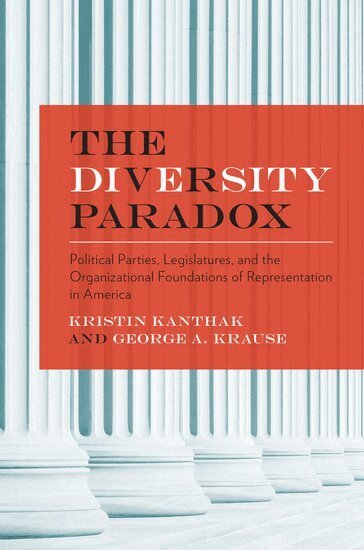
The Diversity Paradox
Parties, Legislatures, and the Organizational Foundations of Representation in America
Inbunden, Engelska, 2012
1 932 kr
Skickas inom 5-8 vardagar
Majority-minority group relations are central to the proper functioning of any organization, but these relationships are especially important in democratically-elected legislatures. In legislatures, for example, group dynamics affect how the legislature operates, who is valued enough to play a critical decision-making role, and what voices matter in determining policy outcomes. In The Diversity Paradox, George Krause and Kristin Kanthak explore the nature of these relationships, particularly their effect on both the valuation of minority group legislators and the ideological stability of the legislature in general. Interestingly, they demonstrate that an increase in a minority group's size within a legislature actually leads to the devaluation of individual minority group members. They call this the 'diversity paradox': In fact, representative institutions such as legislatures face a 'diversity paradox': when the size of a minority group increases beyond mere 'tokenism' in representative institutions such as legislatures, it tends to create an unintended backlash toward the minority group's members that emanates from both majority and fellow minority group members. Representative institutions, therefore, can only fulfill the promise of adequate representation of minority group interests only by conquering this paradox. They can accomplish this through jointly attaining sufficient 'numbers' and overcoming the coordination problems those numbers create. This is no small task and no small issue: the inclusion of minority group voices in representative institutions is critical in a wide range of political decisions, ranging from legislative gender quotas in the new Iraqi constitution to attempts in the U.S. to increase minority representation through redistricting. The question of whether or not an increase in descriptive representation (numbers) has an impact on substantive representation (policy) is central to such efforts, and therefore The Diversity Paradox has important ramifications for all students interested in democratic representation.
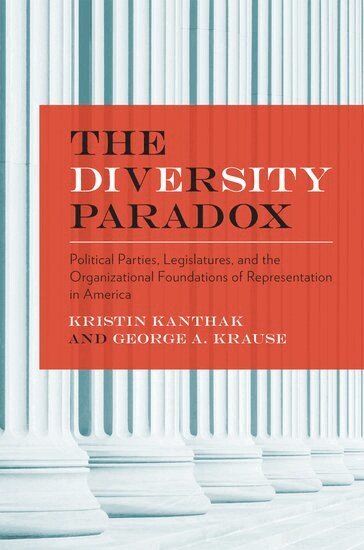
The Diversity Paradox
Parties, Legislatures, and the Organizational Foundations of Representation in America
Häftad, Engelska, 2012
433 kr
Skickas inom 5-8 vardagar
Majority-minority group relations are central to the proper functioning of any organization, but these relationships are especially important in democratically-elected legislatures. In legislatures, for example, group dynamics affect how the legislature operates, who is valued enough to play a critical decision-making role, and what voices matter in determining policy outcomes. In The Diversity Paradox, George Krause and Kristin Kanthak explore the nature of these relationships, particularly their effect on both the valuation of minority group legislators and the ideological stability of the legislature in general. Interestingly, they demonstrate that an increase in a minority group's size within a legislature actually leads to the devaluation of individual minority group members. They call this the 'diversity paradox': In fact, representative institutions such as legislatures face a 'diversity paradox': when the size of a minority group increases beyond mere 'tokenism' in representative institutions such as legislatures, it tends to create an unintended backlash toward the minority group's members that emanates from both majority and fellow minority group members. Representative institutions, therefore, can only fulfill the promise of adequate representation of minority group interests only by conquering this paradox. They can accomplish this through jointly attaining sufficient 'numbers' and overcoming the coordination problems those numbers create. This is no small task and no small issue: the inclusion of minority group voices in representative institutions is critical in a wide range of political decisions, ranging from legislative gender quotas in the new Iraqi constitution to attempts in the U.S. to increase minority representation through redistricting. The question of whether or not an increase in descriptive representation (numbers) has an impact on substantive representation (policy) is central to such efforts, and therefore The Diversity Paradox has important ramifications for all students interested in democratic representation.
Politics, Policy, and Organizations
Frontiers in the Scientific Study of Bureaucracy
Häftad, Engelska, 2005
375 kr
Skickas inom 7-10 vardagar
The bureaucracy is the fourth branch of government, often receiving attention in times of emergency or when it is the object of criticism from the media or politicians. Less understood is how bureaucratic institutions function in a democracy, both from an organizational perspective and as institutional participants within the political arena. Drawing on rational choice approaches, computationally intensive data and modeling techniques, and systematic empirical inquiry, this original collection of essays highlights the important role bureaucracies play in shaping public policy-making. The editors of and contributors to this volume demonstrate not only the constraints political officials face in harnessing the bureaucracy but, more important, how bureaucracies function as organizational entities in diverse contexts. George A. Krause is Associate Professor of Political Science, University of South Carolina. Kenneth J. Meier is Charles Puryear Professor of Liberal Arts and Professor of Political Science, Texas A&M University.