George P. Malanson - Böcker
Visar alla böcker från författaren George P. Malanson. Handla med fri frakt och snabb leverans.
3 produkter
3 produkter
Del 12 - Developments in Earth Surface Processes
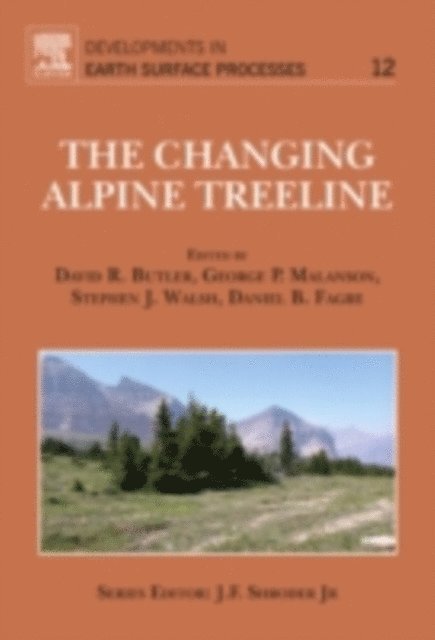
The Changing Alpine Treeline
The Example of Glacier National Park, MT, USA
Inbunden, Engelska, 2009
1 947 kr
Skickas inom 7-10 vardagar
The alpine treeline ecotone (ATE) is an area of transition high on mountains where closed canopy forests from lower elevations give way to the open alpine tundra and rocky expanses above. Alpine tundra is an island biome and its ecotone with forest is subject to change, and like oceanic islands, alpine tundra is subject to invasion - or the upward advance of treeline. The invasion of tundra by trees will have consequences for the tundra biome as invasion does for other island flora and fauna. To examine the invasibility of tundra we take a plant's-eye-view, wherein the local conditions become extremely important. Among these local conditions, we find geomorphology to be exceptionally important. We concentrate on aspects of microtopography (and microgeomorphology) and microclimate because these are the factors that matter: from the plant's-eye-view, but we pay attention to multiple scales. At coarse scales, snow avalanches and debris flows are widespread and create "disturbance treelines� whose elevation is well below those controlled by climate. At medium scales, turf-banked terraces create tread-and-riser topography that is a difficult landscape for a tree seedling to survive upon because of exposure to wind, dryness, and impenetrable surfaces. At fine scales, turf exfoliation of the fronts of turf-banked risers, and boulders, offer microsites where tree seedlings may find shelter and are able to gain a foothold in the alpine tundra; conversely, however, surfaces of needle-ice pans and frost heaving associated with miniature patterned ground production are associated with sites inimical to seedling establishment or survival. We explicitly consider how local scale processes propagate across scales into landscape patterns. The objective of this book is to examine the controls on change at alpine treeline. All the papers are focused on work done in Glacier National Park, Montana, USA. Although any one place is limiting, we are able to examine the alpine treeline here in some detail - and an advantage is that the treeline ecotone in Glacier National Park is quite variable in itself due to the underlying variability in geomorphology at multiple scales. This book will provide insights into an important ecological phenomenon with a distinctly geomorphic perspective. The editors collectively have over 100 years of experience in working in geomorphology, biogeography, and ecology. They also have each worked on research in Glacier National Park for several decades. The book will be a reference for a variety of professionals and students, both graduate and undergraduate, with interests in Physical Geography, Geomorphology, Ecology, and Environmental Science. Because of the importance of the alpine treeline ecotone for recreation and aesthetic interests in mountain environments, wildland and park managers will also use this book.Subject matter: geomorphology at alpine treelineExpertise of contributors: each editor brings over 25 years of experience in studies of ecotones and geomorphology, and collectively over 100 years of experience in Glacier National ParkChanging alpine treeline examines climate change
1 758 kr
Skickas inom 7-10 vardagar
Riparian Landscapes examines the ecological systems of streamside and floodplain areas from the perspective of landscape ecology. The specific spatial pattern of riparian vegetation is seen as a result of, and a control on, the ecological, geomorphological, and hydrological processes that operate along rivers. Riparian structures are controlled by the spatial dynamics of channels, flooding and soil moisture. These dynamics are part of integrated cascades of water, sediment, nutrients and carbon, to which animal and plant species respond in ways that illuminate community structure and competition. The role of the riparian zone in controlling species distribution and abundance is discussed. Intelligent management of these valuable ecological resources is highlighted. The potential for linking hydrological, geomorphological and ecological simulation models is also explored.
665 kr
Skickas inom 7-10 vardagar
Riparian Landscapes examines the ecological systems of streamside and floodplain areas from the perspective of landscape ecology. The specific spatial pattern of riparian vegetation is seen as a result of, and a control on, the ecological, geomorphological, and hydrological processes that operate along rivers. Riparian structures are controlled by the spatial dynamics of channels, flooding and soil moisture. These dynamics are part of integrated cascades of water, sediment, nutrients and carbon, to which animal and plant species respond in ways that illuminate community structure and competition. The role of the riparian zone in controlling species distribution and abundance is discussed. Intelligent management of these valuable ecological resources is highlighted. The potential for linking hydrological, geomorphological and ecological simulation models is also explored.