Georgios Chalkiadakis – författare
Visar alla böcker från författaren Georgios Chalkiadakis. Handla med fri frakt och snabb leverans.
4 produkter
4 produkter
Del 12520 - Lecture Notes in Computer Science
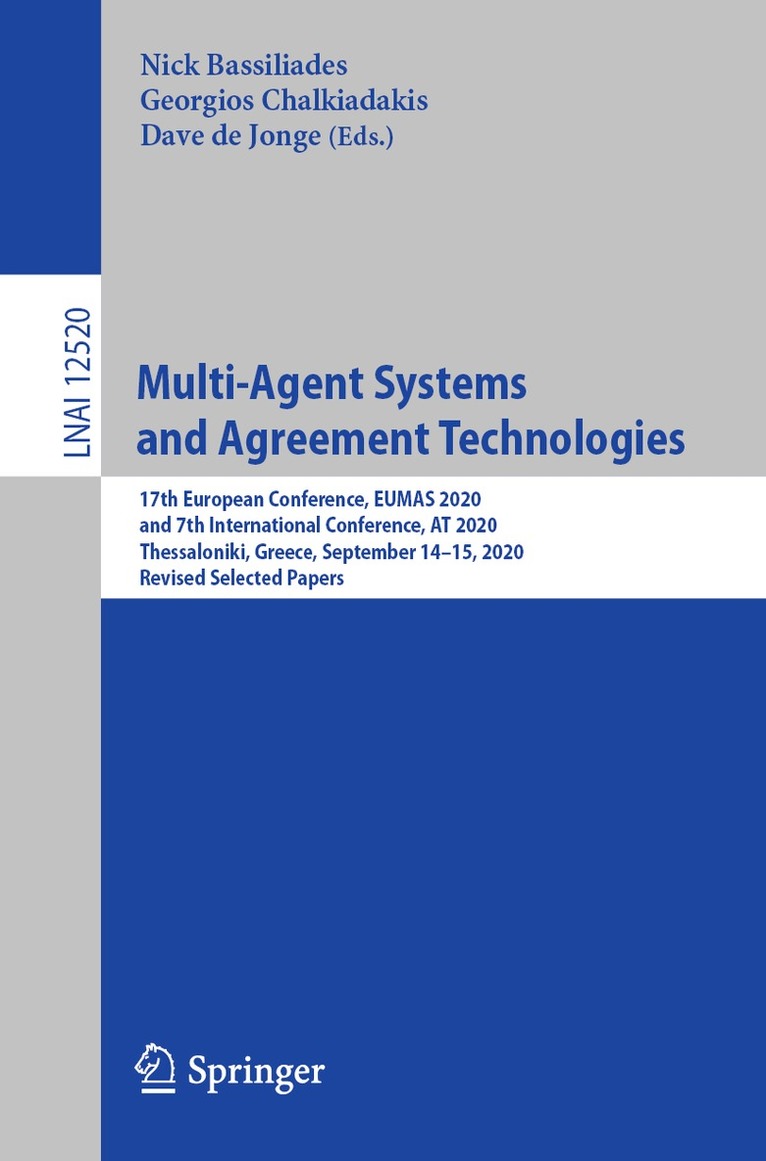
Multi-Agent Systems and Agreement Technologies
17th European Conference, EUMAS 2020, and 7th International Conference, AT 2020, Thessaloniki, Greece, September 14-15, 2020, Revised Selected Papers
Häftad, Engelska, 2021
565 kr
Skickas inom 10-15 vardagar
This book constitutes the revised post-conference proceedings of the 17th European Conference on Multi-Agent Systems, EUMAS 2020, and the 7th International Conference on Agreement Technologies, AT 2020, which were originally planned to be held as a joint event in Thessaloniki, Greece, in April 2020. Due to COVID-19 pandemic the conference was postponed to September 2020 and finally became a fully virtual conference. The 38 full papers presented in this volume were carefully reviewed and selected from a total of 53 submissions. The papers report on both early and mature research and cover a wide range of topics in the field of autonomous agents and multi-agent systems.
708 kr
Läs direkt efter köp
This book constitutes the revised post-conference proceedings of the 17th European Conference on Multi-Agent Systems, EUMAS 2020, and the 7th International Conference on Agreement Technologies, AT 2020, which were originally planned to be held as a joint event in Thessaloniki, Greece, in April 2020. Due to COVID-19 pandemic the conference was postponed to September 2020 and finally became a fully virtual conference. The 38 full papers presented in this volume were carefully reviewed and selected from a total of 53 submissions. The papers report on both early and mature research and cover a wide range of topics in the field of autonomous agents and multi-agent systems.
Häftad, Engelska, 2011
386 kr
Skickas inom 10-15 vardagar
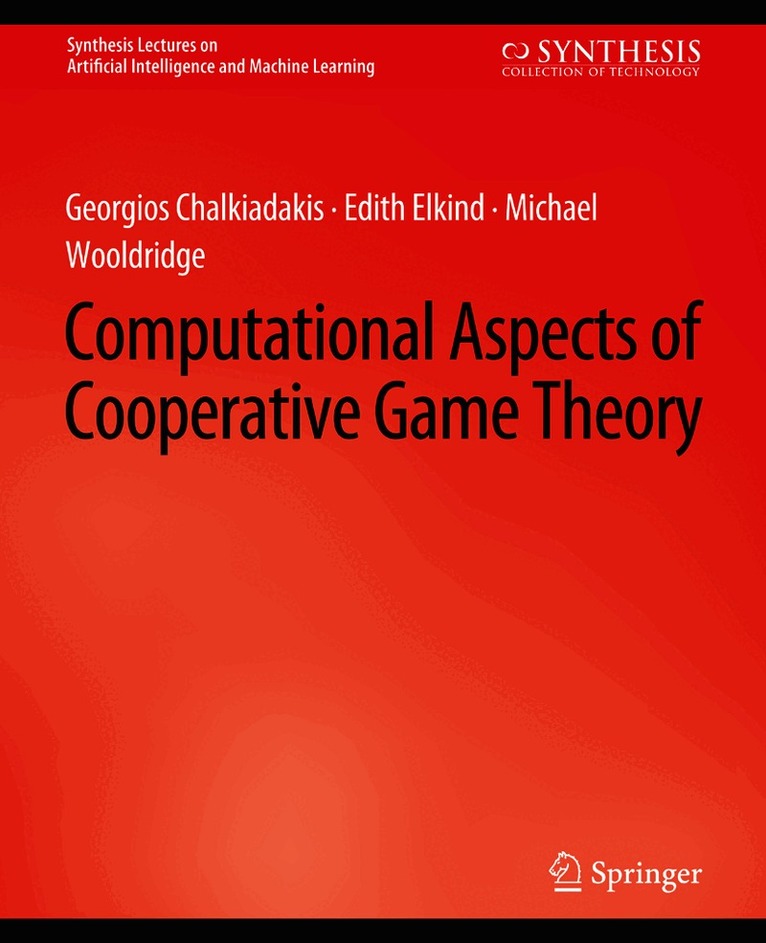
Cooperative game theory is a branch of (micro-)economics that studies the behavior of self-interested agents in strategic settings where binding agreements among agents are possible. Our aim in this book is to present a survey of work on the computational aspects of cooperative game theory. We begin by formally defining transferable utility games in characteristic function form, and introducing key solution concepts such as the core and the Shapley value. We then discuss two major issues that arise when considering such games from a computational perspective: identifying compact representations for games, and the closely related problem of efficiently computing solution concepts for games. We survey several formalisms for cooperative games that have been proposed in the literature, including, for example, cooperative games defined on networks, as well as general compact representation schemes such as MC-nets and skill games. As a detailed case study, we consider weighted voting games:a widely-used and practically important class of cooperative games that inherently have a natural compact representation. We investigate the complexity of solution concepts for such games, and generalizations of them. We briefly discuss games with non-transferable utility and partition function games. We then overview algorithms for identifying welfare-maximizing coalition structures and methods used by rational agents to form coalitions (even under uncertainty), including bargaining algorithms. We conclude by considering some developing topics, applications, and future research directions.
E-bok
PDF, Engelska, 2022475 kr
Läs direkt efter köp
Cooperative game theory is a branch of (micro-)economics that studies the behavior of self-interested agents in strategic settings where binding agreements among agents are possible. Our aim in this book is to present a survey of work on the computational aspects of cooperative game theory. We begin by formally defining transferable utility games in characteristic function form, and introducing key solution concepts such as the core and the Shapley value. We then discuss two major issues that arise when considering such games from a computational perspective: identifying compact representations for games, and the closely related problem of efficiently computing solution concepts for games. We survey several formalisms for cooperative games that have been proposed in the literature, including, for example, cooperative games defined on networks, as well as general compact representation schemes such as MC-nets and skill games. As a detailed case study, we consider weighted voting games:a widely-used and practically important class of cooperative games that inherently have a natural compact representation. We investigate the complexity of solution concepts for such games, and generalizations of them. We briefly discuss games with non-transferable utility and partition function games. We then overview algorithms for identifying welfare-maximizing coalition structures and methods used by rational agents to form coalitions (even under uncertainty), including bargaining algorithms. We conclude by considering some developing topics, applications, and future research directions.