Gerald M. Edelman - Böcker
Visar alla böcker från författaren Gerald M. Edelman. Handla med fri frakt och snabb leverans.
7 produkter
7 produkter
Mindful Brain
Cortical Organization and the Group-Selective Theory of Higher Brain Function
Häftad, Engelska, 1982
439 kr
Skickas inom 5-8 vardagar
141 kr
Skickas inom 7-10 vardagar
A renowned neuroscientist explains how our brains and bodies give rise to knowledge, creativity, and mental experienceBurgeoning advancements in brain science are opening up new perspectives on how we acquire knowledge. Indeed, it is now possible to explore consciousness—the very center of human concern—by scientific means. In this illuminating book, Dr. Gerald M. Edelman offers a new theory of knowledge based on striking scientific findings about how the brain works. And he addresses the related compelling question: Does the latest research imply that all knowledge can be reduced to scientific description?Edelman’s brain-based approach to knowledge has rich implications for our understanding of creativity, of the normal and abnormal functioning of the brain, and of the connections among the different ways we have of knowing. While the gulf between science and the humanities and their respective views of the world has seemed enormous in the past, the author shows that their differences can be dissolved by considering their origins in brain functions. He foresees a day when brain-based devices will be conscious, and he reflects on this and other fascinating ideas about how we come to know the world and ourselves.
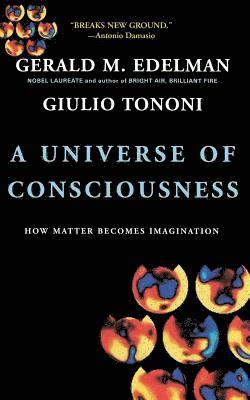
Universe Of Consciousness How Matter Becomes Imagination
How Matter Becomes Imagination
Häftad, Engelska, 2001
373 kr
In A Universe of Consciousness, Gerald Edelman builds on the radical ideas he introduced in his monumental trilogy-Neural Darwinism, Topobiology, and The Remembered Present-to present for the first time an empirically supported full-scale theory of consciousness. He and the neurobiolgist Giulio Tononi show how they use ingenious technology to detect the most minute brain currents and to identify the specific brain waves that correlate with particular conscious experiences. The results of this pioneering work challenge the conventional wisdom about consciousness.
180 kr
Skickas inom 5-8 vardagar
If you had a complete copy of a dinosaur's DNA and the genetic code, you still would not be able to make a dinosaur,or even determine what one looked like. Why? How do animals get their shape and how does shape evolve? In this important book, Nobel laureate Gerald M. Edelman challenges the notion that an understanding of the genetic code and of cell differentiation is sufficient to answer these questions. Rather, he argues, a trio of related issues must also be investigated,the development of form, the evolution of form, and the morphological and functional bases of behaviour. Topobiology presents an introduction to molecular embryology and describes a comprehensive hypothesis to account for the evolution and development of animal form.
705 kr
Skickas inom 10-15 vardagar
One of the vastly exciting areas in modern science involves the study of the brain. Recent research focuses not only on how the brain works but how it is related to what we normally call the mind, and throws new light on human behavior. Progress has been made in researching all that relates to interior man, why he thinks and feels as he does, what values he chooses to adopt, and what practices to scorn. All of these attributes make us human and help to explain art, philosophy, and religions. Motion, sight, and memory, as well as emotions and the sentiments common to humans, are all given new meaning by what we have learned about the brain. In an introductory essay, Vernon B. Mountcastle traces the progress made in brain science during this century. Gerald M. Edelman touches upon features of the brain that challenge the picture of the brain as a machine. Semir Zeki discusses artists and artistic expression as an extension of the function of the brain. Richard S. J. Frackowiak probes the functional architecture of the brain. Mark F. Bear and Leon N Cooper explore whether complex neural systems can be illuminated by theoretical structures. Jean-Pierre Changeux sheds light on the knowledge gained in recent years concerning the neurobiology and pharmacology of drug action and addiction. Alexander A. Borbuly and Giulio Tononi ponder the quest for the essence of sleep, illuminating its complex dynamic process. George L. Gabor Miklos examines variations in neuroanatomies and sensory systems between individuals of the same species as well as variations across the evolutionary spectrum. Emilio Bizzi and Ferdinando A. Mussa-Ivaldi explain how scientists have approached the study of movement, the problems encountered, and the solutions proposed. Marcel Kinsbourne explores the unity and diversity in the human brain. In the concluding essay, Andy Clark points to recent work in neuroscience, robotics, and psychology that stresses the unexpected intimacy of brain, body, and world, supporting his belief that the mind is best understood as a brain at home in its proper bodily cultural and environmental niche. The breadth and scope of subjects covered in this volume attest to the extraordinary progress taking place in the study of the brain. This brilliant collection of essays by those at the forefront of research in this area will be of interest to all those interested in human behavior. Gerald M. Edelman is director of the Neurosciences Institute and chairman of the Department of Neurobiology at the Scripps Research Institute. Jean-Pierre Changeux is professor at the Collbge de France and the Institute Pasteur.
2 088 kr
Skickas inom 10-15 vardagar
One of the vastly exciting areas in modern science involves the study of the brain. Recent research focuses not only on how the brain works but how it is related to what we normally call the mind, and throws new light on human behavior. Progress has been made in researching all that relates to interior man, why he thinks and feels as he does, what values he chooses to adopt, and what practices to scorn. All of these attributes make us human and help to explain art, philosophy, and religions. Motion, sight, and memory, as well as emotions and the sentiments common to humans, are all given new meaning by what we have learned about the brain. In an introductory essay, Vernon B. Mountcastle traces the progress made in brain science during this century. Gerald M. Edelman touches upon features of the brain that challenge the picture of the brain as a machine. Semir Zeki discusses artists and artistic expression as an extension of the function of the brain. Richard S. J. Frackowiak probes the functional architecture of the brain. Mark F. Bear and Leon N Cooper explore whether complex neural systems can be illuminated by theoretical structures. Jean-Pierre Changeux sheds light on the knowledge gained in recent years concerning the neurobiology and pharmacology of drug action and addiction. Alexander A. Borbuly and Giulio Tononi ponder the quest for the essence of sleep, illuminating its complex dynamic process. George L. Gabor Miklos examines variations in neuroanatomies and sensory systems between individuals of the same species as well as variations across the evolutionary spectrum. Emilio Bizzi and Ferdinando A. Mussa-Ivaldi explain how scientists have approached the study of movement, the problems encountered, and the solutions proposed. Marcel Kinsbourne explores the unity and diversity in the human brain. In the concluding essay, Andy Clark points to recent work in neuroscience, robotics, and psychology that stresses the unexpected intimacy of brain, body, and world, supporting his belief that the mind is best understood as a brain at home in its proper bodily cultural and environmental niche. The breadth and scope of subjects covered in this volume attest to the extraordinary progress taking place in the study of the brain. This brilliant collection of essays by those at the forefront of research in this area will be of interest to all those interested in human behavior. Gerald M. Edelman is director of the Neurosciences Institute and chairman of the Department of Neurobiology at the Scripps Research Institute. Jean-Pierre Changeux is professor at the Collbge de France and the Institute Pasteur.
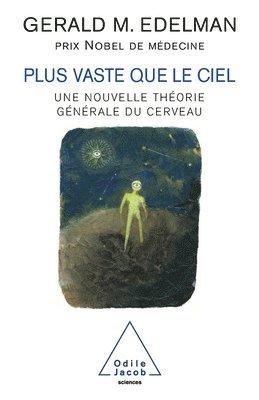
Wider than the Sky / Plus vaste que le ciel: Une nouvelle théorie générale du cerveau
Häftad, Franska, 2004
527 kr
Skickas inom 3-6 vardagar