Gerd Bendz – författare
Visar alla böcker från författaren Gerd Bendz. Handla med fri frakt och snabb leverans.
3 produkter
3 produkter
E-bok
PDF, Engelska, 2013672 kr
Läs direkt efter köp
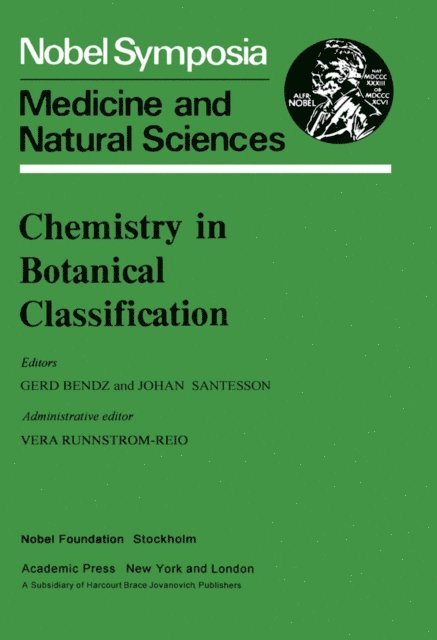
Medicine and Natural Sciences: Chemistry in Botanical Classification contains the proceedings of the Twenty-Fifth Nobel Symposium held in Sodergarn, Sweden, on August 20-25, 1973. The papers explore the chemical approach to plant classification and cover topics ranging from chemosystematics and applications of special classes of compounds to insects and plant chemotaxonomy. Biosynthetic pathways in chemical phylogeny and some aspects of organic geochemistry are also discussed. This book is comprised of 32 chapters divided into five sections. The first chapter provides an overview of the chemical approach to botanical classification, with special reference to the higher taxa of Magnoliophyta. The reader is then introduced to chemosystematics and the construction of phylogenetic schemes, as well as the use of a chemical character for the classification of living organisms. The following chapters focus on The chemistry of disjunct taxa; homology of biosynthetic routes; and applications of special classes of compounds such as flavonoids. The systematic distribution of ellagitannins in relation to the phylogeny and classification of the angiosperms is also considered. The final chapter describes phytochemical and biological procedures for screening of plant materials. This monograph will be of value to botanists, plant taxonomists, and chemists.
E-bok
PDF, Engelska, 20131 367 kr
Läs direkt efter köp
Silicon chemistry was initiated in 1823 by Berzelius who prepared elemental silicon. In many ways silicon was considered a typical opposite of carbon, although the two elements are closely related as to their electronic structure, both having four valence electrons. The properties of their compounds are, however, extreme ly different. Both form extended structures, but in different ways - carbon by covalent carbon-carbon bonds; silicon by polar silicon- -oxygen-silicon bonds. The complex carbon compounds are integral parts of all living matter, plants and animals. The corresponding silicon compounds build up a major part of dead matter, soils and minerals. As recently as twenty years ago the title of this Symposium, "BiOChemistry of Silicon", would have been considered as contradictio in adjecto. However, the development in the field has, during the past fifteen years, been overwhelming and has convinced us that silicon is a necessary element in the life processes, for animals as well as for plants. Interesting therapeutical uses have been suggested, but we have also become increasingly aware of serious occupational diseases - asbestosis and silicosis - and of possible cancerogenic effects. It is our hope that this volume will give some idea about various aspects of silicon compounds which were discussed during the Symposium.
Häftad, Engelska, 2013
1 091 kr
Skickas inom 10-15 vardagar
Silicon chemistry was initiated in 1823 by Berzelius who prepared elemental silicon. In many ways silicon was considered a typical opposite of carbon, although the two elements are closely related as to their electronic structure, both having four valence electrons. The properties of their compounds are, however, extreme ly different. Both form extended structures, but in different ways - carbon by covalent carbon-carbon bonds; silicon by polar silicon- -oxygen-silicon bonds. The complex carbon compounds are integral parts of all living matter, plants and animals. The corresponding silicon compounds build up a major part of dead matter, soils and minerals. As recently as twenty years ago the title of this Symposium, "BiOChemistry of Silicon", would have been considered as contradictio in adjecto. However, the development in the field has, during the past fifteen years, been overwhelming and has convinced us that silicon is a necessary element in the life processes, for animals as well as for plants. Interesting therapeutical uses have been suggested, but we have also become increasingly aware of serious occupational diseases - asbestosis and silicosis - and of possible cancerogenic effects. It is our hope that this volume will give some idea about various aspects of silicon compounds which were discussed during the Symposium.