Gerd Schon – författare
Visar alla böcker från författaren Gerd Schon. Handla med fri frakt och snabb leverans.
4 produkter
4 produkter
E-bok
PDF, Engelska, 2004712 kr
Läs direkt efter köp
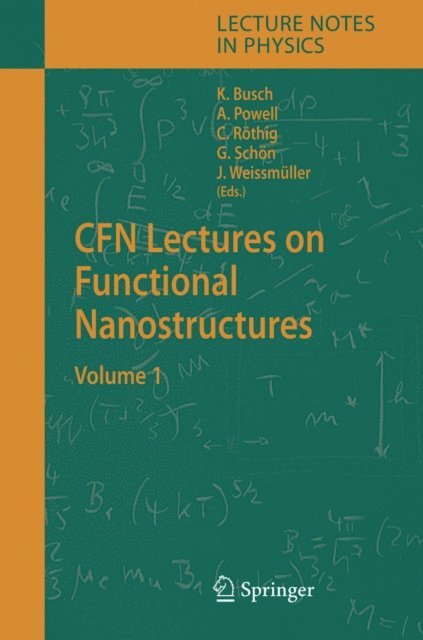
This book contains a selection of lectures from the first Summer School organized by the Center for Functional nanostructures (CFN) at the University of Karlsruhe. The mission of the CFN is to carry out research in the following areas: nanophotonics, nanoelectronics, molecular nanostructures and nanostructured materials. The aim of the summer schools is mainly to exchange new ideas and illustrate emerging research methodologies through a series of lectures. This is reflected by both the selection of topics addressed in the present volume as well as the tutorial aspect of the contributions.
E-bok
PDF, Engelska, 2011489 kr
Läs direkt efter köp
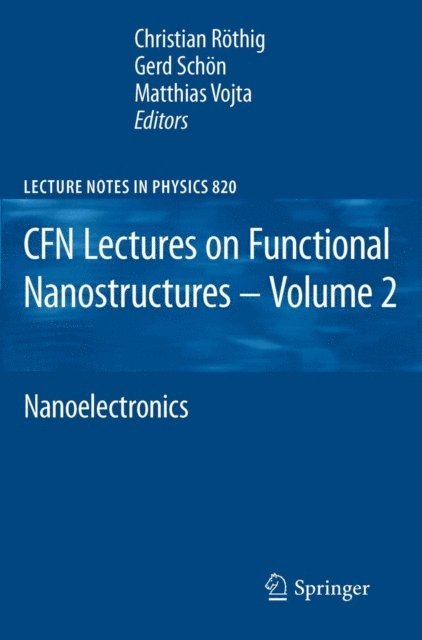
This series of books contains selected and edited lectures from summer schools organized by the Center for Functional nanostructures (CFN) at the University of Karlsruhe. The mission of the CFN is to carry out research in the following areas: nanophotonics, nanoelectronics, molecular nanostructures and nanostructured materials. The aim of the summer schools is mainly to exchange new ideas and illustrate emerging research methodologies through a series of topical, introductory lectures. This is reflected by both the selection of topics addressed in the present volume, nanoelectronics, as well as the tutorial aspect of the contributions.
E-bok
PDF, Engelska, 20123 809 kr
Läs direkt efter köp
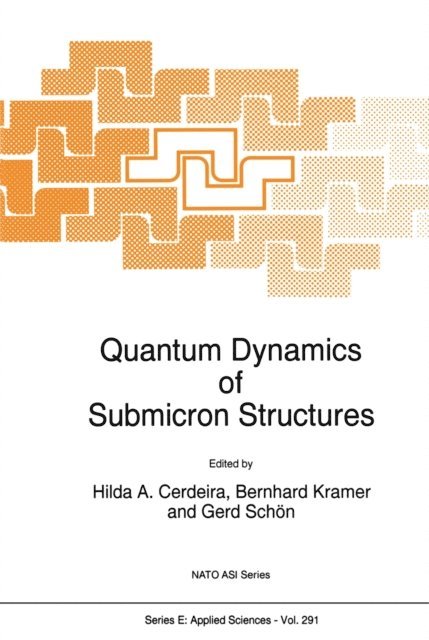
Techniques for the preparation of condensed matter systems have advanced considerably in the last decade, principally due to the developments in microfabrication technologies. The widespread availability of millikelvin temperature facilities also led to the discovery of a large number of new quantum phenomena. Simultaneously, the quantum theory of small condensed matter systems has matured, allowing quantitative predictions. The effects discussed in Quantum Dynamics of Submicron Structures include typical quantum interference phenomena, such as the Aharonov-Bohm-like oscillations of the magnetoresistance of thin metallic cylinders and rings, transport through chaotic billiards, and such quantization effects as the integer and fractional quantum Hall effect and the quantization of the conductance of point contacts in integer multiples of the `conductance quantum''. Transport properties and tunnelling processes in various types of normal metal and superconductor tunnelling systems are treated. The statistical properties of the quantum states of electrons in spatially inhomogeneous systems, such as a random, inhomogeneous magnetic field, are investigated. Interacting systems, like the Luttinger liquid or electrons in a quantum dot, are also considered. Reviews are given of quantum blockade mechanisms for electrons that tunnel through small junctions, like the Coulomb blockade and spin blockade, the influence of dissipative coupling of charge carriers to an environment, and Andreev scattering. Coulomb interactions and quantization effects in transport through quantum dots and in double-well potentials, as well as quantum effects in the motion of vortices, as in the Aharonov-Casher effect, are discussed. The status of the theory of the metal-insulator and superconductor-insulator phase transitions in ordered and disordered granular systems are reviewed as examples in which such quantum effects are of greatimportance.
E-bok
PDF, Engelska, 20136 862 kr
Läs direkt efter köp
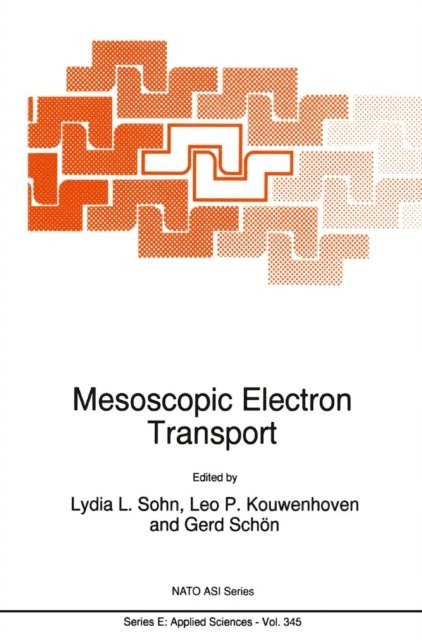
Ongoing developments in nanofabrication technology and the availability of novel materials have led to the emergence and evolution of new topics for mesoscopic research, including scanning-tunnelling microscopic studies of few-atom metallic clusters, discrete energy level spectroscopy, the prediction of Kondo-type physics in the transport properties of quantum dots, time dependent effects, and the properties of interacting systems, e.g. of Luttinger liquids. The overall understanding of each of these areas is still incomplete; nevertheless, with the foundations laid by studies in the more traditional systems there is no doubt that these new areas will advance mesoscopic electron transport to a new phenomenological level, both experimentally and theoretically. Mesoscopic Electron Transport highlights selected areas in the field, provides a comprehensive review of such systems, and also serves as an introduction to the new and developing areas of mesoscopic electron transport.