Gerhard Czack – författare
Visar alla böcker från författaren Gerhard Czack. Handla med fri frakt och snabb leverans.
8 produkter
8 produkter
E-bok
PDF, Engelska, 20131 140 kr
Läs direkt efter köp
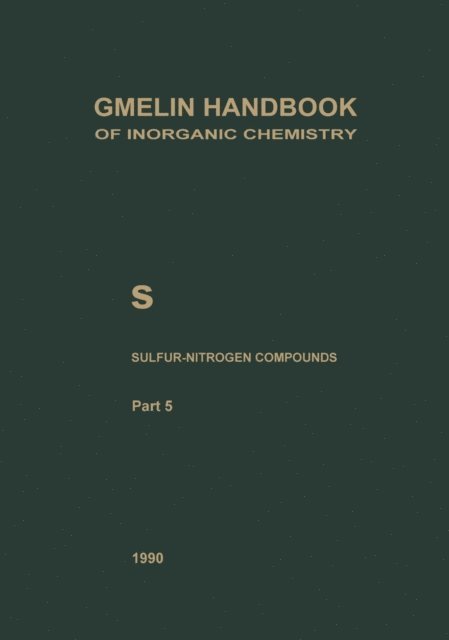
The present volume is the first of a series describing acyclic sulfur-nitrogen compounds with sulfur of oxidation number IV. The acyclic sw-N compounds are arranged according to the coordination number of the sulfur. Neutral compounds are described before ions and complex compounds. The preceding series "Sulfur-Nitrogen Compounds" Parts 2, 3, and 4 covers the cyclic sw-N compounds. In this volume, the first section deals with sulfur-nitrogen compounds with 1-coordinate sulfur and begins with the sulfur nitride {thiazyl) radical, SN. This transient molecule was observed in its electronic ground state and several electronically excited states. The descrip tions of the sulfur nitride (thiazyl) ions SN+ and SW follow. The SN+ ionwas studied in the gas phase as weil as in the solid state where it forms salts. Thionitrosyl complexes containing the SN Iigand as a terminal linear unit are described at the end of the first section. The second section concerns Sulfur-nitrogen compounds with 2-coordinate sulfur and starts with the description of poly(sulfur nitride), (SNlx· The preparation, crystal structure, and metallic and superconducting properties of (SN)x, which were extensively studied, fill a !arge part of the volume. Halogen-modified poly(sulfur nitride) such as the widely studied (SNBr )x 04 and Na-modified poly(sulfur nitride) are dealt with in the following chapters.
E-bok
PDF, Engelska, 2013712 kr
Läs direkt efter köp
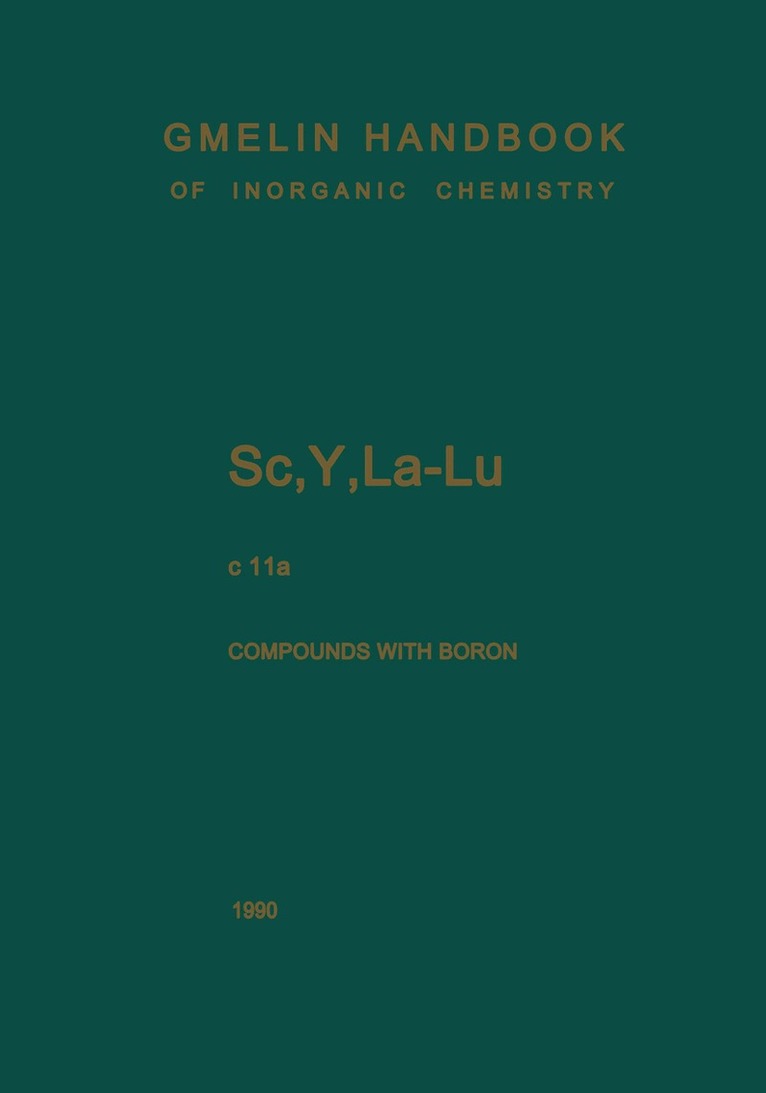
The volume "Rare Earth Elements" C 11 deals with the compounds and systems of the rare earth elements with boron, Le., borides, borates, and associated alkali double compounds. As in all earlier volumes of "Rare Earth Elements" Se ries C ("Seltenerdelemente" Reihe Cl, comparative data are presented in sections preceding treatment of the individual compounds and systems. Topics of the present volume C 11 aare the comparative data on the borides and the indi vidual sections on the systems and borides containing Sc, Y, and La. The individual sections for the systems and borides with Ce to Lu can be found in the following volume C 11 b together with the borates, their alkali double compounds, and other compounds containing Ce to Lu, boron and elements related by the Gmelin system. The most extensively studied borides treated in the comparative sections are of the type MB. These rare earth hexaborides are refractory compounds and so me of them, especially e LaBe, are good thermionic emissive materials or exhibit other interesting physical properties.
Häftad, Engelska, 2013
813 kr
Skickas inom 10-15 vardagar
The volume "Rare Earth Elements" C 11 deals with the compounds and systems of the rare earth elements with boron, Le., borides, borates, and associated alkali double compounds. As in all earlier volumes of "Rare Earth Elements" Se ries C ("Seltenerdelemente" Reihe Cl, comparative data are presented in sections preceding treatment of the individual compounds and systems. Topics of the present volume C 11 aare the comparative data on the borides and the indi vidual sections on the systems and borides containing Sc, Y, and La. The individual sections for the systems and borides with Ce to Lu can be found in the following volume C 11 b together with the borates, their alkali double compounds, and other compounds containing Ce to Lu, boron and elements related by the Gmelin system. The most extensively studied borides treated in the comparative sections are of the type MB. These rare earth hexaborides are refractory compounds and so me of them, especially e LaBe, are good thermionic emissive materials or exhibit other interesting physical properties.
E-bok
PDF, Engelska, 20131 140 kr
Läs direkt efter köp
E-bok
PDF, Engelska, 20131 416 kr
Läs direkt efter köp
Häftad, Engelska, 2013
1 617 kr
Skickas inom 5-8 vardagar
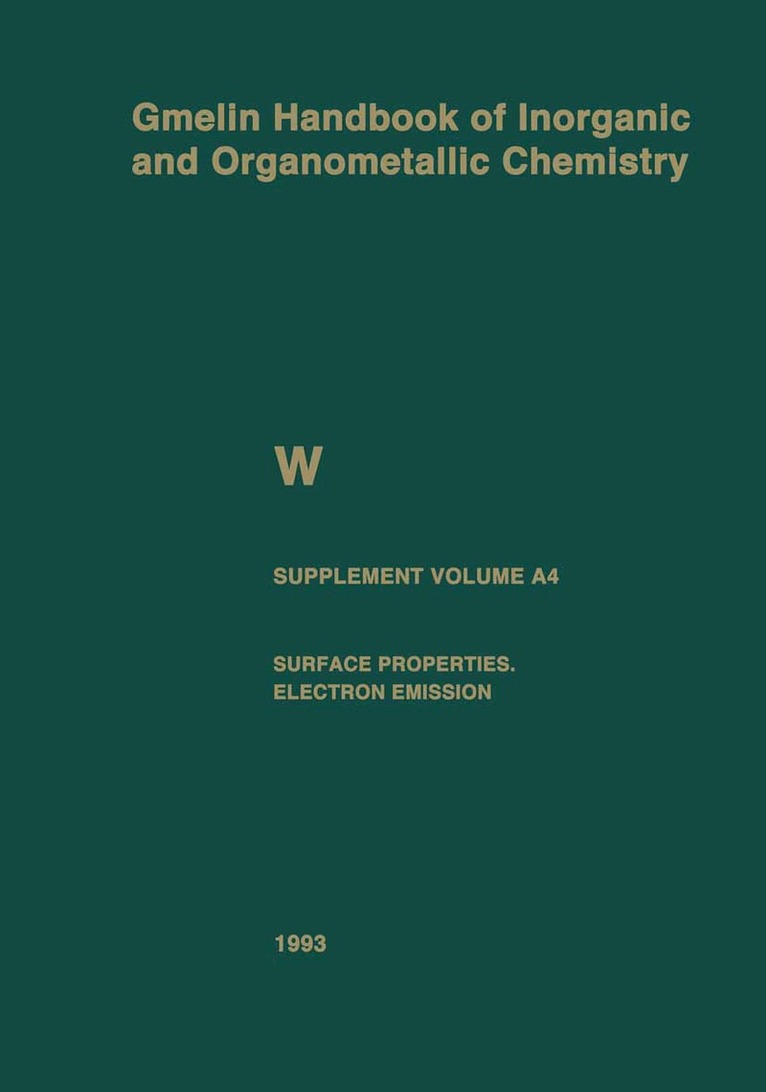
This voLume continues the description of the physicaL properties of tungsten metaL and covers specificaLLy surface properties, eLectron emission, and fieLd evaporation. Tungsten surfaces are probabLy the most extensiveLy studied metaL surfaces. RecentLy, experimentaLists and theorists have focused their interest on the atomic structure, Lattice dynamics, and eLectronic properties of the W(100) surface. WhiLe the structure of the recon- structed Low-temperature surface is weLL estabLished, there are still unresoLved probLems concerning the structure at and above room temperature, the nature of the phase transition, and the driving force for the reconstruction. Other Low-index tungsten surfaces have been studied in much Less detail. There are numerous and partLy confLicting data on the surface energy, the seit-diffusion parameters, and the work function of singLe-crystaL and poLycrystaL tungsten surfaces. ELec- tron emission, which is of fundamentaL importance for many appLications, comprises therm- ionic, fieLd, photofieLd, and photoeLectric emission as weLL as emission induced by impinging eLectrons, atoms, or ions.Pioneering work in areas Like thermionic or fieLd emission is comprehensiveLy discussed. Very recent studies of vaLence-band and core-LeveL spectra moreover provide detaiLed information on intrinsic surface properties. FieLd evaporation phenomena are treated at the end of this voLume. Frankfurt am Main Woltgang HuisL November 1993 fable of Contents Page 1 Atomic Structure, LaHice Dynamies, and Electronic Structure of Tungsten Surfaces 1 1.1 W(100) ...1.1.1 Atomic Structure. Reconstruction and Relaxation Survey ...
E-bok
PDF, Engelska, 2013687 kr
Läs direkt efter köp
The present Supplement Volume Beryllium A 3 continues and completes the description of the physical properties of the element, begun in Supplement Volume A 2, 1991, and also treats the electrochemical behavior of the metal. The unique combination of the Be properties, which was pointed out in Supplement Volume A 2, is also demonstrated in the following chapters of this Volume A 3: 13. Electrical Properties 14. Electronic Properties 15. Optical Properties. Emission and Impact Phenomena 16. Electrochemical Behavior Starting with the electrical properties, Be isarather good electrical conductor in centrast to what might be expected. Superconductivity was studied, especially on films. Quantum effects, which are more pronounced in Be than in most other metals, are the reason for numerous in vestigations of the magnetoresistance and the magnetic-breakdown effect. The basis for many of the characteristic properties is the unique nature of bonding in Be as a consequence of its peculiar electronic structure and the special shape of its Fermi surface which also gave rise to further numerous studies. Detailed cluster calculations were per formed to better understand the bonding in the metal. Regarding the optical properties, the high reflectivity of Be, particularly in the infrared region, makes it attractive for the fabrication of precision optical surfaces (mirrors); it is also useful for solar-collector surfaces in spacecraft applications. Emission and electron-and ion impact phenomena as well as neutron optics are also discussed.
Häftad, Engelska, 2013
813 kr
Skickas inom 10-15 vardagar
The present Supplement Volume Beryllium A 3 continues and completes the description of the physical properties of the element, begun in Supplement Volume A 2, 1991, and also treats the electrochemical behavior of the metal. The unique combination of the Be properties, which was pointed out in Supplement Volume A 2, is also demonstrated in the following chapters of this Volume A 3: 13. Electrical Properties 14. Electronic Properties 15. Optical Properties. Emission and Impact Phenomena 16. Electrochemical Behavior Starting with the electrical properties, Be isarather good electrical conductor in centrast to what might be expected. Superconductivity was studied, especially on films. Quantum effects, which are more pronounced in Be than in most other metals, are the reason for numerous in vestigations of the magnetoresistance and the magnetic-breakdown effect. The basis for many of the characteristic properties is the unique nature of bonding in Be as a consequence of its peculiar electronic structure and the special shape of its Fermi surface which also gave rise to further numerous studies. Detailed cluster calculations were per formed to better understand the bonding in the metal. Regarding the optical properties, the high reflectivity of Be, particularly in the infrared region, makes it attractive for the fabrication of precision optical surfaces (mirrors); it is also useful for solar-collector surfaces in spacecraft applications. Emission and electron-and ion impact phenomena as well as neutron optics are also discussed.