German Sierra - Böcker
Visar alla böcker från författaren German Sierra. Handla med fri frakt och snabb leverans.
6 produkter
6 produkter
995 kr
Skickas inom 7-10 vardagar
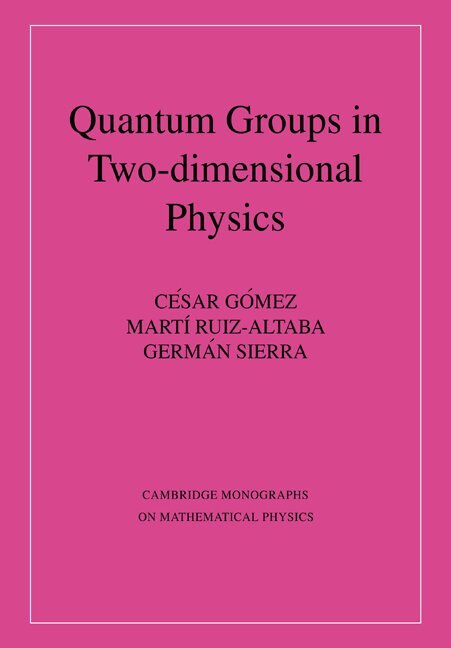
This 1996 book is an introduction to integrability and conformal field theory in two dimensions using quantum groups. The book begins with a brief introduction to S-matrices, spin chains and vertex models as a prelude to the study of Yang-Baxter algebras and the Bethe ansatz. The basic ideas of integrable systems are then introduced, giving particular emphasis to vertex and face models. Special attention is given to explaining the underlying mathematical tools, including braid groups, knot invariants and towers of algebra. The book then goes on to give a detailed introduction to quantum groups as a prelude to chapters on integrable models, two-dimensional conformal field theories and superconformal field theories. The book contains many diagrams and exercises to illustrate key points in the text.
2 258 kr
Skickas inom 7-10 vardagar
This 1996 book is an introduction to integrability and conformal field theory in two dimensions using quantum groups. The book begins with a brief introduction to S-matrices, spin chains and vertex models as a prelude to the study of Yang-Baxter algebras and the Bethe ansatz. The basic ideas of integrable systems are then introduced, giving particular emphasis to vertex and face models. Special attention is given to explaining the underlying mathematical tools, including braid groups, knot invariants and towers of algebra. The book then goes on to give a detailed introduction to quantum groups as a prelude to chapters on integrable models, two-dimensional conformal field theories and superconformal field theories. The book contains many diagrams and exercises to illustrate key points in the text.
169 kr
Skickas inom 5-8 vardagar
206 kr
Skickas inom 5-8 vardagar
Del 38 - Lecture Notes in Physics Monographs
Quantum Electron Liquids and High-Tc Superconductivity
Häftad, Engelska, 2014
538 kr
Skickas inom 10-15 vardagar
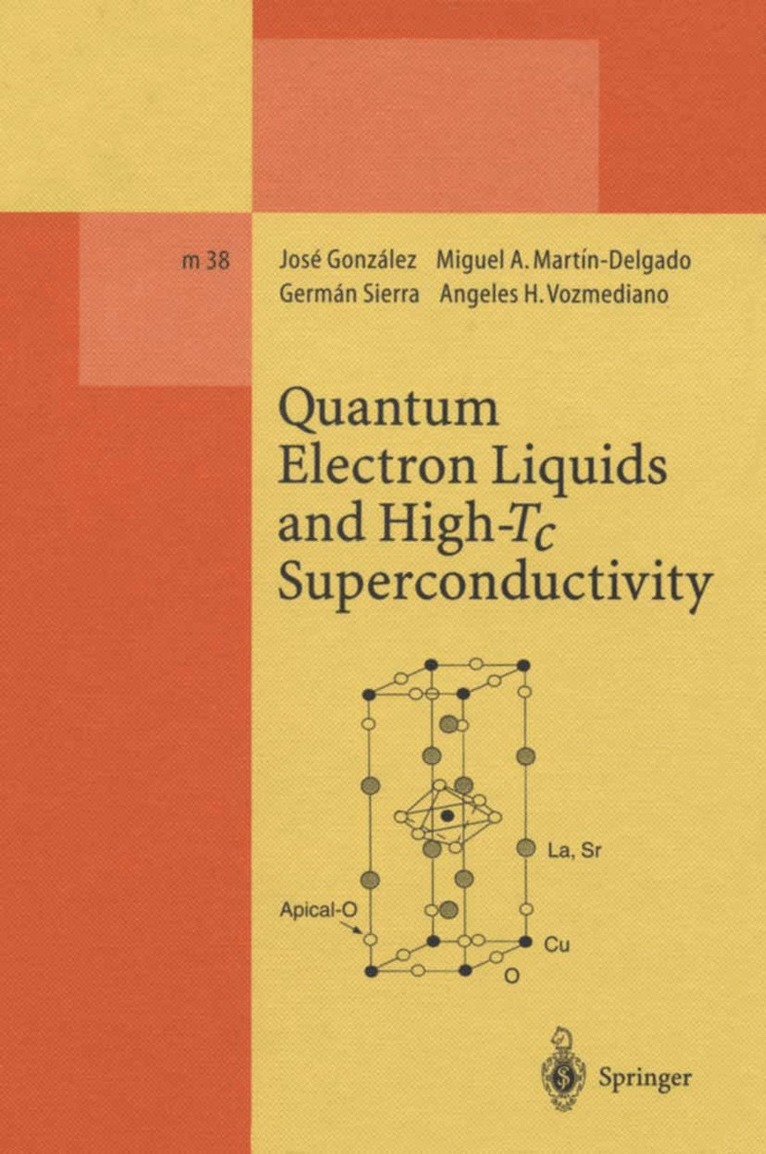
This book originated from a course given at the Univcrsidad Aut6noma of Madrid in the Spring of 1994 and in the Universidad Complutense of Madrid in 1995. The goal of these courses is to give the non-specialist an introduction to some old and new ideas in the field of strongly correlated systems, in particular the problems posed by the high-1~ superconducting materials. As theoretical physicists, our starting viewpoint to address the problem of strongly correlat ed ferlnion systems and related issues of modern condensed matter physics ·is the renormalization group approach applied both to quantU111 field theory and statistical physics. In recent years this has become not only a powerful tool for retrieving the essential physics of interacting systems but also a link between theoretical physics and modern condensed matter physics. Furthermore, once we have this common background for dealing with apparently different prob lems, we discuss more specific topics and even phenomenological aspects of the field. In doing so we have tried to make the exposition clear and simple, with out entering into technical details but focusing ill the fundamental physics of the phenomena under study. Therefore ,ve expect that our experience ll1ay have some value to other people entering this fascinating field. We have divided these notes into three parts and each part into chapters, which correspond roughly to one or two lectures. Part I, Chaps. 1-2 (A. H. V.
Strongly Correlated Magnetic and Superconducting Systems
Proceedings of the El Escorial Summer School Held in Madrid, Spain, 15–19 July 1996
Häftad, Engelska, 2014
538 kr
Skickas inom 10-15 vardagar
This volume, intended as a contribution to the 10th birthday of high Tc-superconductivity, conveys the essential ideas of the field and addresses researchers as well as graduate students. A special feature is the pedagogical treatment of a variety of modern computational methods to deal with non-pertubative effects in strongly correlated systems. Among the topics treated are the Hubbard models, real space renormalization group methods, quantum phase transitions, the non-linear sigma model, spin ladders and layers, and the quantum Hall effect.