Gianluca Moro – författare
Visar alla böcker från författaren Gianluca Moro. Handla med fri frakt och snabb leverans.
15 produkter
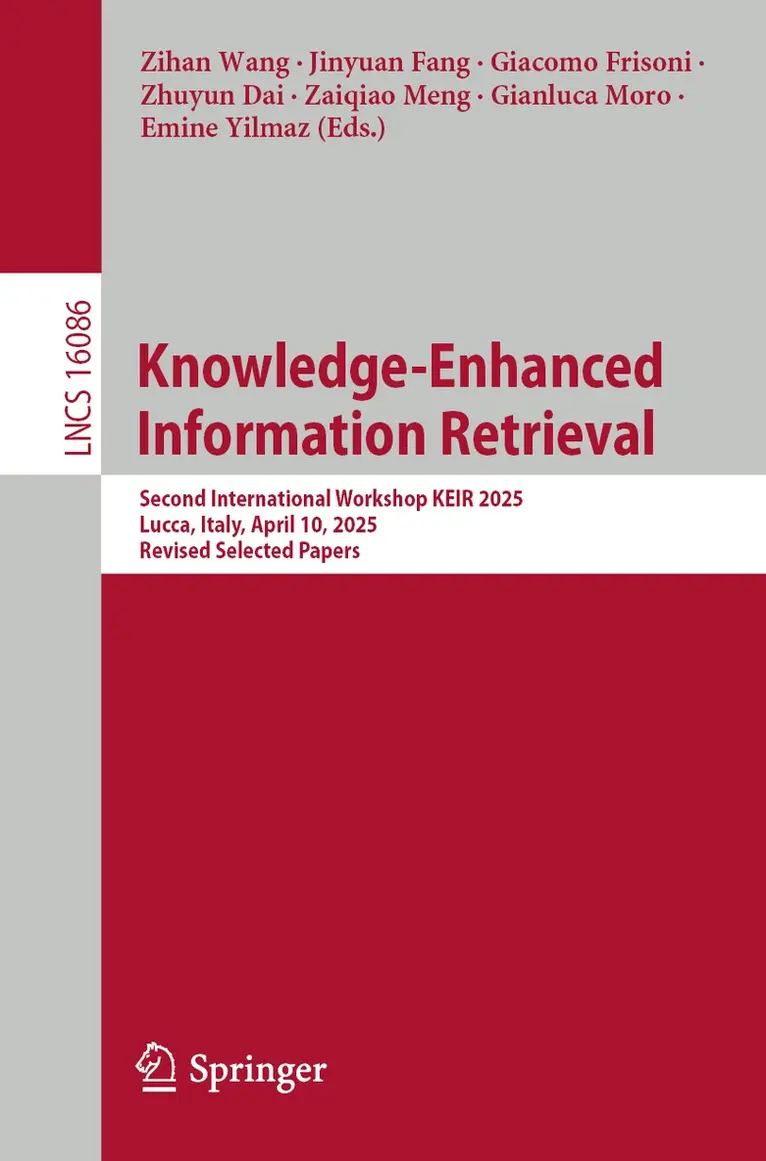
Knowledge-Enhanced Information Retrieval
Second International Workshop, KEIR 2025, Lucca, Italy, April 10, 2025, Revised Selected Papers
Av Zihan Wang, Jinyuan Fang m. fl.
Häftad, 2025
654 kr
Lägg i varukorg
This book constitutes the revised selected papers of the 2nd International Workshop on Knowledge-Enhanced Information Retrieval, KEIR 2025, held in Lucca, Italy, during April 10, 2025.The 4 full papers presented together with 4 invited papers in this volume were carefully reviewed and selected from …
Knowledge-Enhanced Information Retrieval
Second International Workshop, KEIR 2025, Lucca, Italy, April 10, 2025, Revised Selected Papers
Av Emine Yilmaz, Gianluca Moro m. fl.
E-bok, 2025
815 kr
Lägg i varukorg
This book constitutes the revised selected papers of the 2nd International Workshop on Knowledge-Enhanced Information Retrieval, KEIR 2025, held in Lucca, Italy, during April 10, 2025.The 4 full papers presented together with 4 invited papers in this volume were carefully reviewed and selected from …
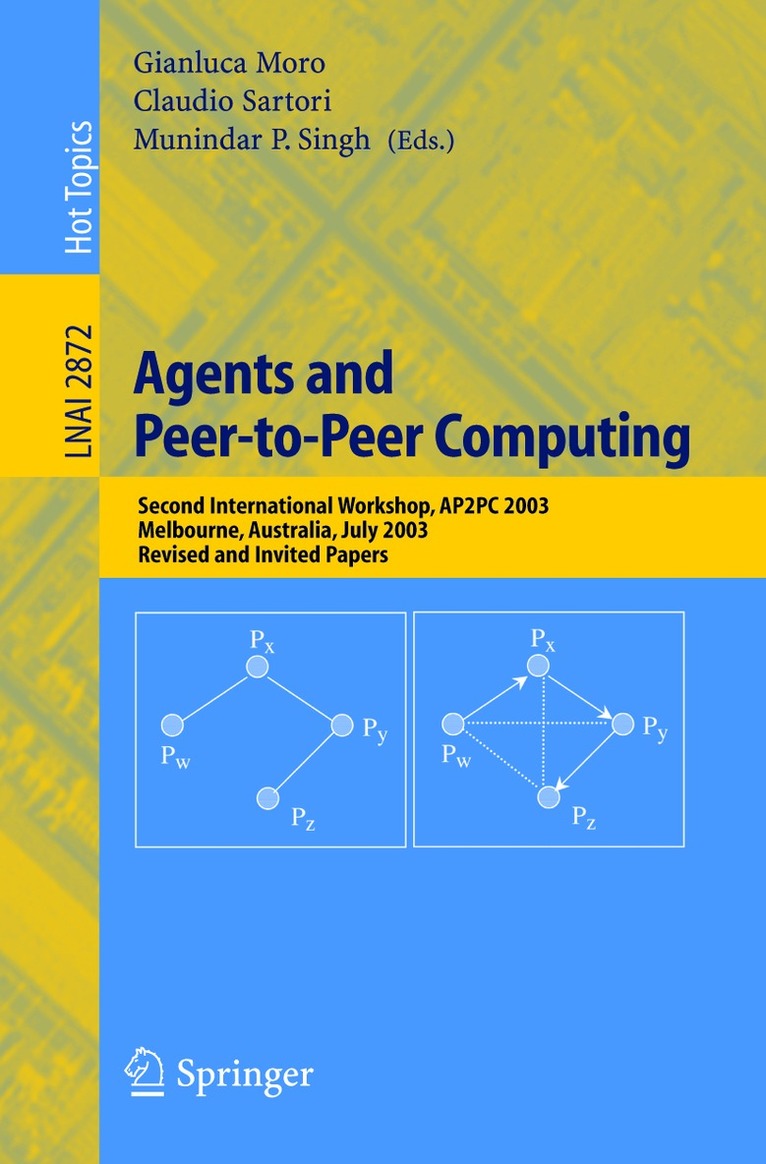
Agents and Peer-to-Peer Computing
Second International Workshop, AP2PC 2003, Melbourne, Australia, July 14, 2003, Revised and Invited Papers
Av Gianluca Moro, Claudio Sartori m. fl.
Häftad, 2004
564 kr
Lägg i varukorg
Peer-to-peer (P2P) computing is currently attracting enormous public attention, spurred by the popularity of file-sharing systems such as Napster, Gnutella, Morpheus, Kaza, and several others. In P2P systems, a very large number of autonomous computing nodes, the peers, rely on each other for …
Agents and Peer-to-Peer Computing
Second International Workshop, AP2PC 2003, Melbourne, Australia, July 14, 2003, Revised and Invited Papers
Av Munindar P. Singh, Claudio Sartori m. fl.
E-bok, 2004
739 kr
Lägg i varukorg
Peer-to-peer (P2P) computing is currently attracting enormous public attention, spurred by the popularity of file-sharing systems such as Napster, Gnutella, Morpheus, Kaza, and several others. In P2P systems, a very large number of autonomous computing nodes, the peers, rely on each other for …
Agents and Peer-to-Peer Computing
Third International Workshop, AP2PC 2004, New York, NY, USA, July 19, 2004, Revised and Invited Papers
Av Gianluca Moro, Sonia Bergamaschi m. fl.
Häftad, 2005
564 kr
Lägg i varukorg
Peer-to-peer (P2P) computing is attracting enormous media attention, spurred by the popularity of file sharing systems such as Napster, Gnutella, and Morpheus. The peers are autonomous, or as some call them, first-class citizens. P2P networks are emerging as a new distributed computing paradigm for …
Agents and Peer-to-Peer Computing
Third International Workshop, AP2PC 2004, New York, NY, USA, July 19, 2004, Revised and Invited Papers
Av Karl Aberer, Sonia Bergamaschi m. fl.
E-bok, 2005
739 kr
Lägg i varukorg
Peer-to-peer (P2P) computing is attracting enormous media attention, spurred by the popularity of file sharing systems such as Napster, Gnutella, and Morpheus. The peers are autonomous, or as some call them, first-class citizens. P2P networks are emerging as a new distributed computing paradigm for …
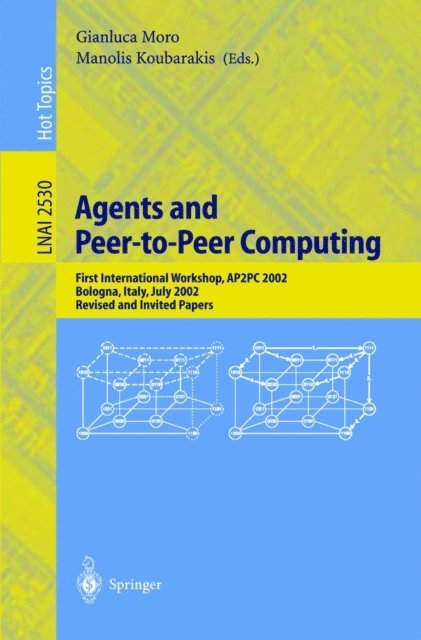
Agents and Peer-to-Peer Computing
First International Workshop, AP2PC 2002, Bologna, Italy, July, 2002, Revised and Invited Papers
Av Gianluca Moro, Manolis Koubarakis
Häftad, 2003
531 kr
Lägg i varukorg
Peer-to-peer (P2P) computing is currently attracting enormous public attention, spurred by the popularity of file-sharing systems such as Napster, Gnutella, and Morpheus. In P2P systems a very large number of autonomous computing nodes, the peers, rely on each other for services. P2P networks are …
Agents and Peer-to-Peer Computing
First International Workshop, AP2PC 2002, Bologna, Italy, July, 2002, Revised and Invited Papers
Av Manolis Koubarakis, Gianluca Moro
E-bok, 2003
722 kr
Lägg i varukorg
Peer-to-peer (P2P) computing is currently attracting enormous public attention, spurred by the popularity of file-sharing systems such as Napster, Gnutella, and Morpheus. In P2P systems a very large number of autonomous computing nodes, the peers, rely on each other for services. P2P networks are …
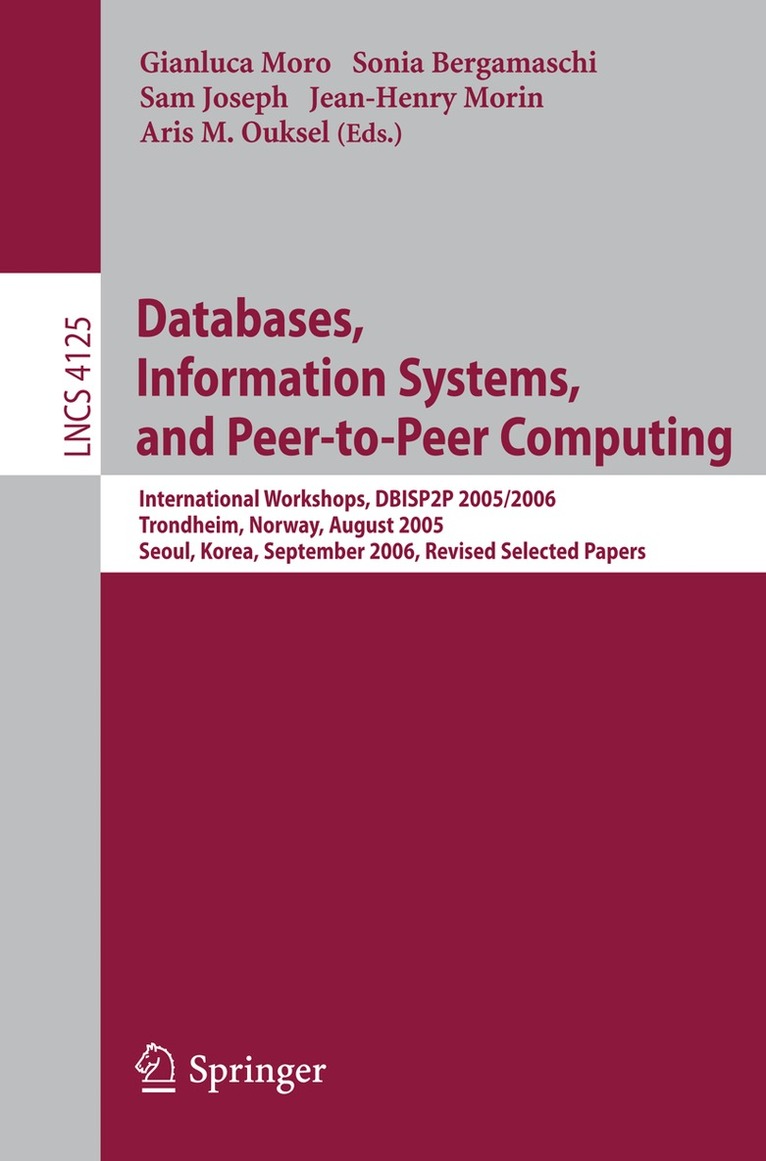
Databases, Information Systems, and Peer-to-Peer Computing
International Workshops, DBISP2P 2005/2006, Trondheim, Norway, August 28-29, 2006, Revised Selected Papers
Av Gianluca Moro, Sonia Bergamaschi m. fl.
Häftad, 2007
564 kr
Lägg i varukorg
The aim of the International Workshop on Databases, Information Systems and P2P Computing was to explore the promise of P2P to o?er exciting new p- sibilities in distributed information processing and database technologies. The realization of this promise lies fundamentally in the availability of …
Databases, Information Systems, and Peer-to-Peer Computing
International Workshops, DBISP2P 2005/2006, Trondheim, Norway, August 28-29, 2006, Revised Selected Papers
Av Aris M. Ouksel, Jean-Henry Morin m. fl.
E-bok, 2007
739 kr
Lägg i varukorg
The aim of the International Workshop on Databases, Information Systems and P2P Computing was to explore the promise of P2P to o?er exciting new p- sibilities in distributed information processing and database technologies. The realization of this promise lies fundamentally in the availability of …
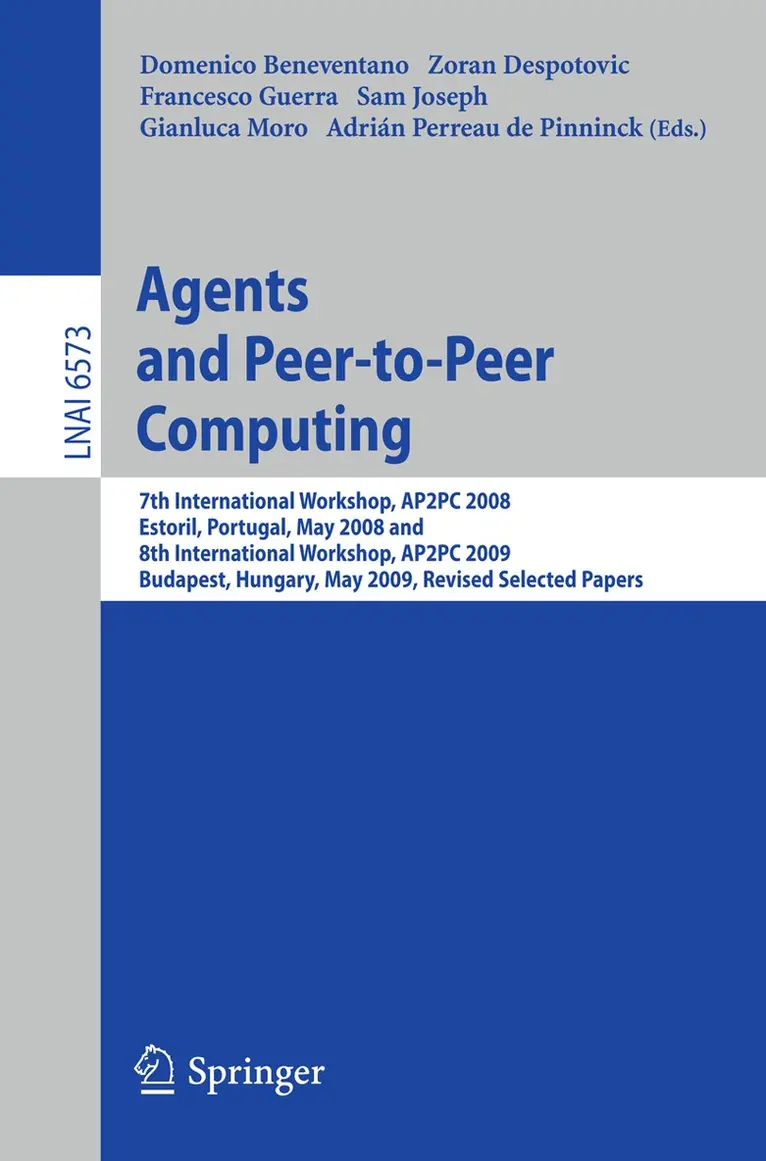
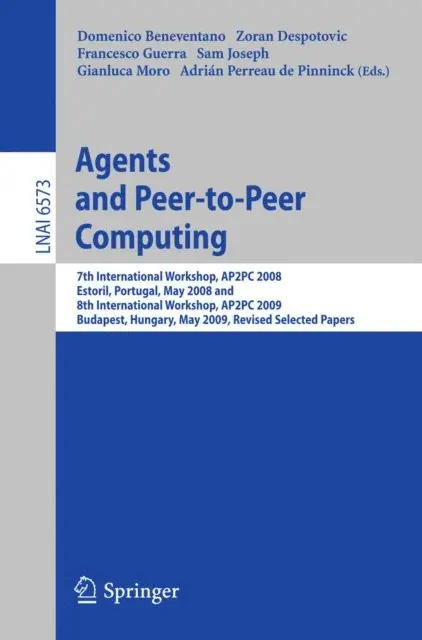
Agents and Peer-to-Peer Computing
7th International Workshop, AP2PC 2008, Estoril, Portugal, May 13, 2008 and 8th International Workshop, AP2PC 2009, Budapest, Hungary, May 11, 2009. Revised Selected Papers
Av Domenico Beneventano, Zoran Despotovic m. fl.
Häftad, 2012
520 kr
Lägg i varukorg
This book constitutes the thoroughly refereed post-workshop proceedings of the 7th International Workshop on Agents and Peer-to-Peer Computing, AP2PC 2008, held in Estoril, Portugal, in May 2008 and the 8th International Workshop on Agents and Peer-to-Peer Computing, AP2PC 2009, held in Budapest, …
Agents and Peer-to-Peer Computing
7th International Workshop, AP2PC 2008, Estoril, Portugal, May 13, 2008 and 8th International Workshop, AP2PC 2009, Budapest, Hungary, May 11, 2009. Revised Selected Papers
Av Adrian Perreau de Pinninck, Gianluca Moro m. fl.
E-bok, 2012
690 kr
Lägg i varukorg
This book constitutes the thoroughly refereed post-workshop proceedings of the 7th International Workshop on Agents and Peer-to-Peer Computing, AP2PC 2008, held in Estoril, Portugal, in May 2008 and the 8th International Workshop on Agents and Peer-to-Peer Computing, AP2PC 2009, held in Budapest, …