Gianpaolo Vitale – Författare
Visar alla böcker från författaren Gianpaolo Vitale. Handla med fri frakt och snabb leverans.
4 produkter
4 produkter
1 569 kr
Skickas inom 10-15 vardagar
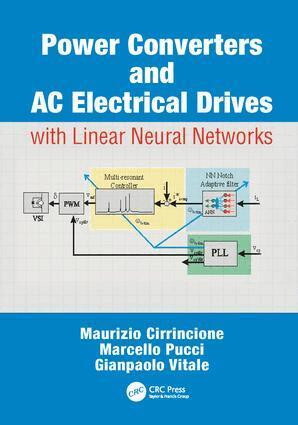
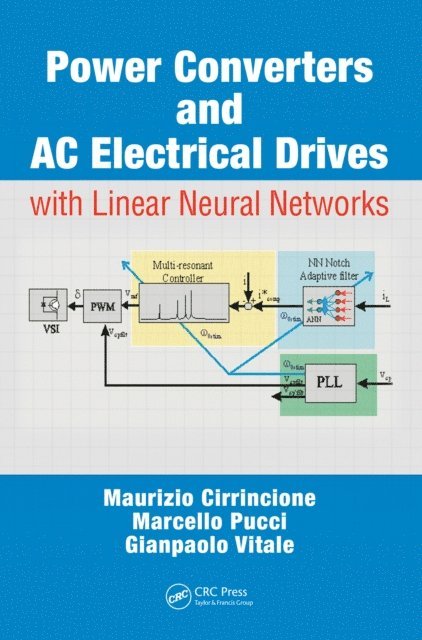
The first book of its kind, Power Converters and AC Electrical Drives with Linear Neural Networks systematically explores the application of neural networks in the field of power electronics, with particular emphasis on the sensorless control of AC drives. It presents the classical theory based on space-vectors in identification, discusses control of electrical drives and power converters, and examines improvements that can be attained when using linear neural networks.The book integrates power electronics and electrical drives with artificial neural networks (ANN). Organized into four parts, it first deals with voltage source inverters and their control. It then covers AC electrical drive control, focusing on induction and permanent magnet synchronous motor drives. The third part examines theoretical aspects of linear neural networks, particularly the neural EXIN family. The fourth part highlights original applications in electrical drives and power quality, ranging from neural-based parameter estimation and sensorless control to distributed generation systems from renewable sources and active power filters. Simulation and experimental results are provided to validate the theories.Written by experts in the field, this state-of-the-art book requires basic knowledge of electrical machines and power electronics, as well as some familiarity with control systems, signal processing, linear algebra, and numerical analysis. Offering multiple paths through the material, the text is suitable for undergraduate and postgraduate students, theoreticians, practicing engineers, and researchers involved in applications of ANNs.
3 743 kr
Skickas inom 10-15 vardagar
The first book of its kind, Power Converters and AC Electrical Drives with Linear Neural Networks systematically explores the application of neural networks in the field of power electronics, with particular emphasis on the sensorless control of AC drives. It presents the classical theory based on space-vectors in identification, discusses control of electrical drives and power converters, and examines improvements that can be attained when using linear neural networks.The book integrates power electronics and electrical drives with artificial neural networks (ANN). Organized into four parts, it first deals with voltage source inverters and their control. It then covers AC electrical drive control, focusing on induction and permanent magnet synchronous motor drives. The third part examines theoretical aspects of linear neural networks, particularly the neural EXIN family. The fourth part highlights original applications in electrical drives and power quality, ranging from neural-based parameter estimation and sensorless control to distributed generation systems from renewable sources and active power filters. Simulation and experimental results are provided to validate the theories.Written by experts in the field, this state-of-the-art book requires basic knowledge of electrical machines and power electronics, as well as some familiarity with control systems, signal processing, linear algebra, and numerical analysis. Offering multiple paths through the material, the text is suitable for undergraduate and postgraduate students, theoreticians, practicing engineers, and researchers involved in applications of ANNs.
1 589 kr
Skickas inom 10-15 vardagar
Modeling of photovoltaic sources and their emulation by means of power electronic converters are challenging issues. The former is tied to the knowledge of the electrical behavior of the PV generator; the latter consists in its realization by a suitable power amplifier. This extensive introduction to the modeling of PV generators and their emulation by means of power electronic converters will aid in understanding and improving design and set up of new PV plants. The main benefit of reading Photovoltaic Sources is the ability to face the emulation of photovoltaic generators obtained by the design of a suitable equipment in which voltage and current are the same as in a real source. This is achieved according to the following steps: the source electrical behavior modeling, the power converter design, including its control, for the laboratory emulator. This approach allows the reader to cope with the creation of an indoor virtual photovoltaic plant, in which the environmental conditions can be imposed by the user, for testing real operation including maximum power point tracking, partial shading, control for the grid or load interfacing, etc.Photovoltaic Sources is intended to meet the demands of postgraduate level students, and should prove useful to professional engineers and researchers dealing with the problems associated with modeling and emulation of photovoltaic sources.
1 589 kr
Skickas inom 10-15 vardagar
Modeling of photovoltaic sources and their emulation by means of power electronic converters are challenging issues. The former is tied to the knowledge of the electrical behavior of the PV generator; the latter consists in its realization by a suitable power amplifier. This extensive introduction to the modeling of PV generators and their emulation by means of power electronic converters will aid in understanding and improving design and set up of new PV plants. The main benefit of reading Photovoltaic Sources is the ability to face the emulation of photovoltaic generators obtained by the design of a suitable equipment in which voltage and current are the same as in a real source. This is achieved according to the following steps: the source electrical behavior modeling, the power converter design, including its control, for the laboratory emulator. This approach allows the reader to cope with the creation of an indoor virtual photovoltaic plant, in which the environmental conditions can be imposed by the user, for testing real operation including maximum power point tracking, partial shading, control for the grid or load interfacing, etc.Photovoltaic Sources is intended to meet the demands of postgraduate level students, and should prove useful to professional engineers and researchers dealing with the problems associated with modeling and emulation of photovoltaic sources.