Gil G. Noam – författare
339 kr
Läs direkt efter köp
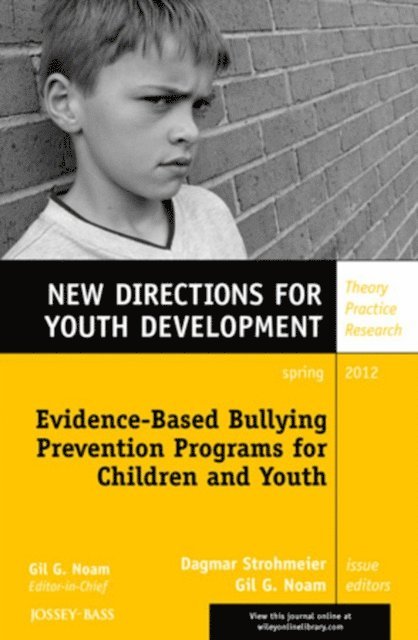
Bullying is a hot topic at schools across the nation. Chronic involvement in bullying is associated with many intrapersonal, interpersonal, and academic problems, and even sporadic experiences of bullying are harmful. During the last two decades, several prevention and intervention programs have been developed by research teams all over the world. Many of these programs have been adopted in the United States.
This volume introduces five evidence-based anti-bullying programs developed in European countries, where much of the early innovations and adaptations have occurred. Based on state-of-the-art knowledge, This volume answers:
How can educators detect that bullying is going on in their school? How can educators respond competently in acute bullying situations? How can educators prevent bullying in their schools in the long run?This is the 133rd volume of New Directions for Youth Development, the Jossey-Bass quarterly report series dedicated to bringing together everyone concerned with helping young people, including scholars, practitioners, and people from different disciplines and professions.
339 kr
Läs direkt efter köp
Bullying is a hot topic at schools across the nation. Chronic involvement in bullying is associated with many intrapersonal, interpersonal, and academic problems, and even sporadic experiences of bullying are harmful. During the last two decades, several prevention and intervention programs have been developed by research teams all over the world. Many of these programs have been adopted in the United States.
This volume introduces five evidence-based anti-bullying programs developed in European countries, where much of the early innovations and adaptations have occurred. Based on state-of-the-art knowledge, This volume answers:
How can educators detect that bullying is going on in their school? How can educators respond competently in acute bullying situations? How can educators prevent bullying in their schools in the long run?This is the 133rd volume of New Directions for Youth Development, the Jossey-Bass quarterly report series dedicated to bringing together everyone concerned with helping young people, including scholars, practitioners, and people from different disciplines and professions.
735 kr
Läs direkt efter köp
How do people develop in their important relationships? How do two people come together to form a new, close relationship? How do relationships affect or determine who we are and who we become?
These questions should be central to the study of mind and development, but most researchers neglect relationships and focus instead on analyses of individuals, as if people were basically alone, experiencing occasional fleeting moments with other people. Research based on this individualist assumption has dominated the behavioral and clinical sciences, but there are other voices, and they are growing. In this book, many of the scholars who are moving relationships and attachments back to the center of human development outline their central concepts, findings, and perspectives.
People are fundamentally social, and relationships are part of the fabric of being human, forming an essential foundation that molds each person''s mind and action. A mind does not reside in one person but in relationships and communities, composed of many people''s interconnected minds, which mutually support and define each other. From the start and throughout life, each person develops strengths and vulnerabilities in important relationships in communities and cultures. Those relationships are so central to each person''s activity and experience that without them, no scientific explanation can even begin to analyze mind and action. There is no mind without other people. There is no psychological vulnerability that does not involve others.
The contributors to this book aim to establish a firm foundation for the role of relationships in human activity and health and to promote strong research by bringing together in one place most of the best research and theory on development and relationships. Their goal is to stimulate a more radical inclusion of relationships in mind, an ecological focus on the ways that relationships constitute action, feeling, and thought.
735 kr
Läs direkt efter köp
How do people develop in their important relationships? How do two people come together to form a new, close relationship? How do relationships affect or determine who we are and who we become?
These questions should be central to the study of mind and development, but most researchers neglect relationships and focus instead on analyses of individuals, as if people were basically alone, experiencing occasional fleeting moments with other people. Research based on this individualist assumption has dominated the behavioral and clinical sciences, but there are other voices, and they are growing. In this book, many of the scholars who are moving relationships and attachments back to the center of human development outline their central concepts, findings, and perspectives.
People are fundamentally social, and relationships are part of the fabric of being human, forming an essential foundation that molds each person''s mind and action. A mind does not reside in one person but in relationships and communities, composed of many people''s interconnected minds, which mutually support and define each other. From the start and throughout life, each person develops strengths and vulnerabilities in important relationships in communities and cultures. Those relationships are so central to each person''s activity and experience that without them, no scientific explanation can even begin to analyze mind and action. There is no mind without other people. There is no psychological vulnerability that does not involve others.
The contributors to this book aim to establish a firm foundation for the role of relationships in human activity and health and to promote strong research by bringing together in one place most of the best research and theory on development and relationships. Their goal is to stimulate a more radical inclusion of relationships in mind, an ecological focus on the ways that relationships constitute action, feeling, and thought.
712 kr
Läs direkt efter köp
546 kr
Skickas inom 10-15 vardagar
163 kr
Läs direkt efter köp
163 kr
Läs direkt efter köp