Gildea Spike Gildea – författare
Visar alla böcker från författaren Gildea Spike Gildea. Handla med fri frakt och snabb leverans.
4 produkter
4 produkter
E-bok
Engelska, 20181 384 kr
Läs direkt efter köp
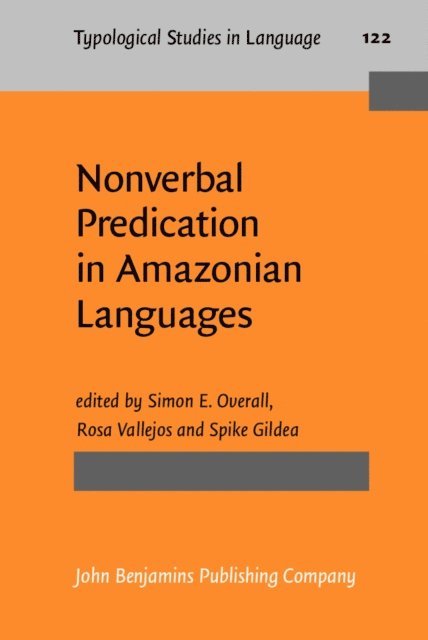
This volume explores typological variation within nonverbal predication in Amazonian languages. Using abundant data, generally from original and extensive fieldwork on under-described languages, it presents a far more detailed picture of nonverbal predication constructions than previously published grammatical descriptions. On the one hand, it addresses the fact that current typologies of nonverbal predication are less developed than those of verbal predication; on the other, it provides a wealth of new data and analyses of Amazonian languages, which are still poorly represented in existing typologies. Several contributions offer historical insights, either reconstructing the sources of innovative nonverbal predicate constructions, or describing diachronic pathways by which constructions used for nonverbal predication spread to other functions in the grammar. The introduction provides a modern typological overview, and also proposes a new diachronic typology to explain how distinct types of nonverbal predication arise.
E-bok
PDF, Engelska, 20151 258 kr
Läs direkt efter köp
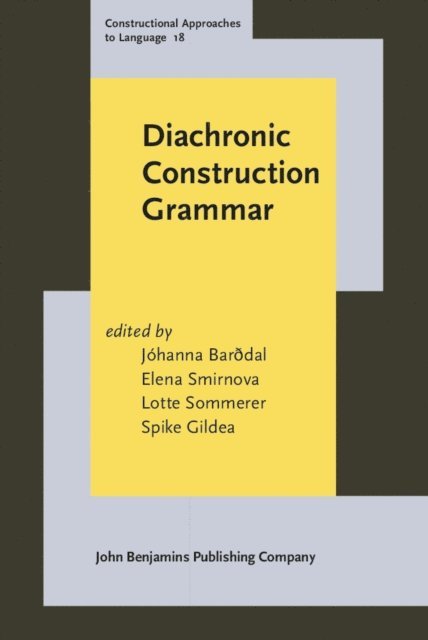
Construction Grammar as a framework offers a new perspective on traditional historical questions in diachronic linguistics and language change: how do new constructions arise, how should competition in diachronic variation be accounted for, how do constructions fall into disuse, and how do constructions change in general, formally and/or semantically, and with what implications for the language system as a whole? This volume offers a broad introduction to the confluence of Construction Grammar and historical syntax, and also detailed case studies of various instances of syntactic change modeled within Construction Grammar. The volume demonstrates that Construction Grammar as a theory is particularly well suited for modeling historical changes in morphosyntax, and it also documents challenging new phenomena that require a theoretical account within any competing framework of syntactic change.
E-bok
PDF, Engelska, 20101 384 kr
Läs direkt efter köp
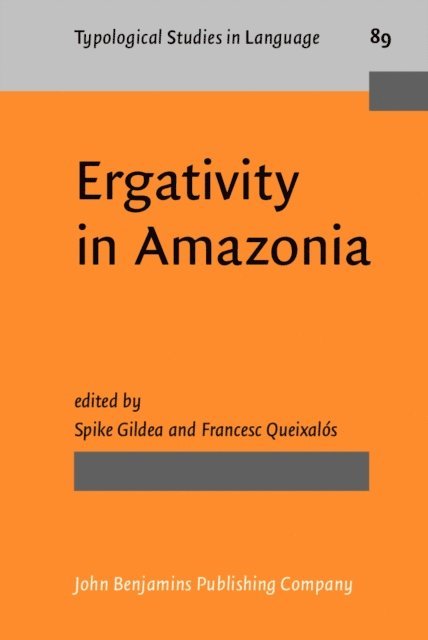
This volume presents a typological/theoretical introduction plus eight papers about ergative alignment in 16 Amazonian languages. All are written by linguists with years of fieldwork and comparative experience in the region, all describe details of the synchronic systems, and several also provide diachronic insight into the evolution of these systems. The five papers in Part I focus on languages from four larger families with ergative patterns primarily in morphology. The typological contribution is in detailed consideration of unusual splits, changes in ergative patterns, and parallels between ergative main clauses and nominalizations. The three papers in Part II discuss genetically isolated languages. Two present dominant ergative patterns in both morphology and syntax, the other a syntactic inverse system that is predominantly ergative in discourse. In each, the authors demonstrate that identification of traditional grammatical relations is problematic. These data will figure in all future typological and theoretical debates about grammatical relations.
E-bok
PDF, Engelska, 20001 588 kr
Läs direkt efter köp
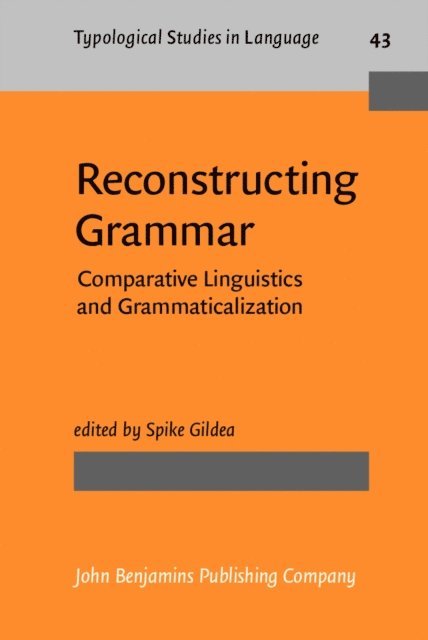
Comparative linguistics and grammaticalization theory both belong to the broader category of historical linguistics, yet few linguists practice both. The methods and goals of each group seem largely distinct: comparative linguists have by and large avoided reconstructing grammar, while grammaticalization theoreticians have either focused on explaining attested historical change or used internal reconstruction to formulate hypotheses about processes of change. In this collection, some of the leading voices in grammaticalization theory apply their methods to comparative data (largely drawn from indigenous languages of the Americas), showing not only that grammar can be reconstructed, but that the process of reconstructing grammar can yield interesting theoretical and typological insights.