Giulia D’Ercole – författare
Visar alla böcker från författaren Giulia D’Ercole. Handla med fri frakt och snabb leverans.
3 produkter
3 produkter
Del 96 - Cambridge Monographs in African Archaeology
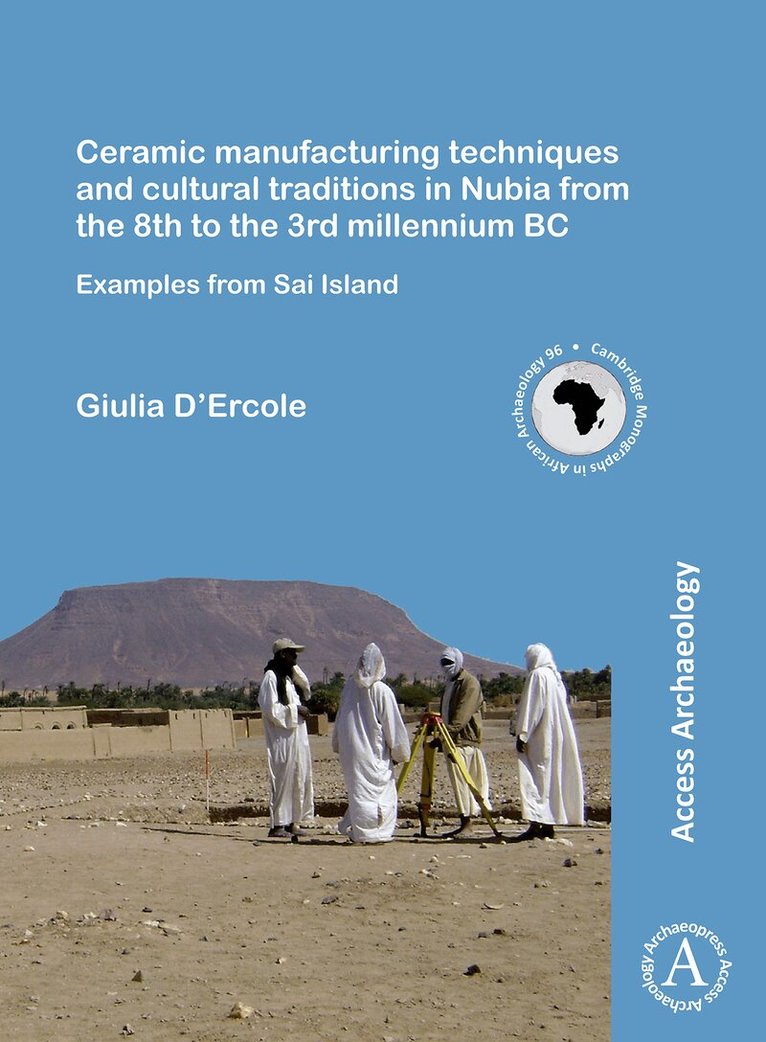
Ceramic manufacturing techniques and cultural traditions in Nubia from the 8th to the 3rd millennium BC
Examples from Sai Island
Häftad, Engelska, 2017
597 kr
Tillfälligt slut
In Sudan the first ceramic containers appeared at the beginning of the 9th millennium BC, with the earliest dates c. 8700 BC from Sorourab 2, in Central Sudan, and c. 8600 BC from the district of Amara West, in Northern Sudan.This book presents a comprehensive critical analysis of diverse ceramic assemblages from Sai Island, in the Middle Nile Valley of Northern Sudan, on the border between ancient Upper and Lower Nubia. The assemblages included in this study cover about five millennia, spanning the period c. 8000 to c. 2500 BC. They go from the initial appearance of ceramic technology within hunting-fishing-gathering communities living in permanent or semi-permanent settlements (locally named ‘Khartoum Variant’ or ‘Mesolithic’ horizon: c. 7600–4800 BC), through the ceramic productions of the first ‘Neolithic’ pastoral societies (Abkan horizon: c. 5550−3700 BC), to those of the Pre-Kerma Nubian culture (c. 3600−2500 BC). A thorough stylistic macroscopic observation of the finds is integrated with a solid technological approach by means of archaeometric petrographic (OM), mineralogical (XRPD) and chemical (XRF) analyses. Data are discussed and compared across a broad geographical area, including Lower and Upper Nubia, Central Sudan and the Egyptian Western Desert. They provide an original synthesis and interpretation of the ceramic traditions in Nubia and Sudan and propose a critical review of the debate on the invention of pottery and the functional and cultural reasons for the emergence of the ceramic technology.
Early Pottery Technologies among Foragers in Global Perspective
Cultural Transformations through Material Practice
Inbunden, Engelska, 2024
1 321 kr
Skickas inom 10-15 vardagar
This book presents up-to-date perspectives on pre-farming innovations through material practices, resource intensification, and emerging technologies, particularly pottery manufacture. It includes original studies on the earliest pottery productions among foragers from different parts of the world based on first-hand excavations and laboratory analyses. Its broad geographic scope includes Northern and Central Europe, Eastern Asia (different regions in China), Northern, Western, and Southern Africa, and southeastern North America, comprising parts of the world previously ignored (different regions in Africa) and extending beyond the Old World, i.e., North America. It also takes into account the differing chronologies of the emergence of pottery before food production, which are not limited to the late Pleistocene and early Holocene, but extend as late as the middle Holocene (e.g., in Southern Africa).This volume offers a fresh and still unexplored, global intercultural and interactive discussion on the emergence of pottery. By mapping the latest findings and variety of methodological approaches, it intends to capture both variability and common denominators of the cultural processes between the end of the Pleistocene and the early/mid-Holocene in which the production and use of pottery played a significant role among hunter-gatherers. This book is a fundamental contribution to the understanding of the role of material practices in cultural transformations in late prehistory worldwide and to the debate on how local narratives mirror different social identities, meanings, and/or functions depending on the specific economic context, settlement system, and cultural landscape. It emphasizes how transformative technologies can potentially create radical changes in the way human populations live and interact with each other. Ultimately, this volume contains valuable reflections and expectations for the future of worldwide pottery research among foragers.
Early Pottery Technologies among Foragers in Global Perspective
Cultural Transformations through Material Practice
Häftad, Engelska, 2025
1 321 kr
Skickas inom 10-15 vardagar
This book presents up-to-date perspectives on pre-farming innovations through material practices, resource intensification, and emerging technologies, particularly pottery manufacture. It includes original studies on the earliest pottery productions among foragers from different parts of the world based on first-hand excavations and laboratory analyses. Its broad geographic scope includes Northern and Central Europe, Eastern Asia (different regions in China), Northern, Western, and Southern Africa, and southeastern North America, comprising parts of the world previously ignored (different regions in Africa) and extending beyond the Old World, i.e., North America. It also takes into account the differing chronologies of the emergence of pottery before food production, which are not limited to the late Pleistocene and early Holocene, but extend as late as the middle Holocene (e.g., in Southern Africa).This volume offers a fresh and still unexplored, global intercultural and interactive discussion on the emergence of pottery. By mapping the latest findings and variety of methodological approaches, it intends to capture both variability and common denominators of the cultural processes between the end of the Pleistocene and the early/mid-Holocene in which the production and use of pottery played a significant role among hunter-gatherers. This book is a fundamental contribution to the understanding of the role of material practices in cultural transformations in late prehistory worldwide and to the debate on how local narratives mirror different social identities, meanings, and/or functions depending on the specific economic context, settlement system, and cultural landscape. It emphasizes how transformative technologies can potentially create radical changes in the way human populations live and interact with each other. Ultimately, this volume contains valuable reflections and expectations for the future of worldwide pottery research among foragers.