Glenn D. Considine – författare
Visar alla böcker från författaren Glenn D. Considine. Handla med fri frakt och snabb leverans.
4 produkter
4 produkter
Inbunden, Engelska, 1987
2 152 kr
Skickas inom 10-15 vardagar
The authors and editors of this Handbook have attempted to fill a serious gap in the professional literature on industrial automation. Much past attention has been directed to the general concepts and philosophy of automation as a way to convince owners and managers of manufacturing facilities that automation is indeed one of the few avenues available to increase productivity and improve competitive position. Seventy-three contributors share their knowledge in this Handbook. Less attention has been given to the "What" and "How" of automation. To the extent feasible and practical within the confines of the pages allowed, this Handbook concentrates on the implementation of automation. Once the "Go" signal has been given by management, concrete details-not broad definitions and philosophical discussions-are required. To be found in this distinctly different book in the field are detailed parameters for designing and specifying equipment, the options available with an evaluation of their relative advantages and limitations, and insights for engineers and production managers on the operation and capabilities of present-generation automation system components, subsystems, and total systems. In a number of instances, the logical extension of current technology into the future is given. A total of 445 diagrams and photos and 57 tables augments detailed discussions. In addition to its use as a ready reference for technical and management personnel, the book has wide potential for training and group discussions at the college and university level and for special education programs as may be provided by consultants or by "in-house" training personnel.
Häftad, Engelska, 2012
2 152 kr
Skickas inom 10-15 vardagar
The authors and editors of this Handbook have attempted to fill a serious gap in the professional literature on industrial automation. Much past attention has been directed to the general concepts and philosophy of automation as a way to convince owners and managers of manufacturing facilities that automation is indeed one of the few avenues available to increase productivity and improve competitive position. Seventy-three contributors share their knowledge in this Handbook. Less attention has been given to the "What" and "How" of automation. To the extent feasible and practical within the confines of the pages allowed, this Handbook concentrates on the implementation of automation. Once the "Go" signal has been given by management, concrete details-not broad definitions and philosophical discussions-are required. To be found in this distinctly different book in the field are detailed parameters for designing and specifying equipment, the options available with an evaluation of their relative advantages and limitations, and insights for engineers and production managers on the operation and capabilities of present-generation automation system components, subsystems, and total systems. In a number of instances, the logical extension of current technology into the future is given. A total of 445 diagrams and photos and 57 tables augments detailed discussions. In addition to its use as a ready reference for technical and management personnel, the book has wide potential for training and group discussions at the college and university level and for special education programs as may be provided by consultants or by "in-house" training personnel.
E-bok
PDF, Engelska, 20122 840 kr
Läs direkt efter köp
The authors and editors of this Handbook have attempted to fill a serious gap in the professional literature on industrial automation. Much past attention has been directed to the general concepts and philosophy of automation as a way to convince owners and managers of manufacturing facilities that automation is indeed one of the few avenues available to increase productivity and improve competitive position. Seventy-three contributors share their knowledge in this Handbook. Less attention has been given to the "What" and "How" of automation. To the extent feasible and practical within the confines of the pages allowed, this Handbook concentrates on the implementation of automation. Once the "Go" signal has been given by management, concrete details-not broad definitions and philosophical discussions-are required. To be found in this distinctly different book in the field are detailed parameters for designing and specifying equipment, the options available with an evaluation of their relative advantages and limitations, and insights for engineers and production managers on the operation and capabilities of present-generation automation system components, subsystems, and total systems. In a number of instances, the logical extension of current technology into the future is given. A total of 445 diagrams and photos and 57 tables augments detailed discussions. In addition to its use as a ready reference for technical and management personnel, the book has wide potential for training and group discussions at the college and university level and for special education programs as may be provided by consultants or by "in-house" training personnel.
E-bok
PDF, Engelska, 20131 140 kr
Läs direkt efter köp
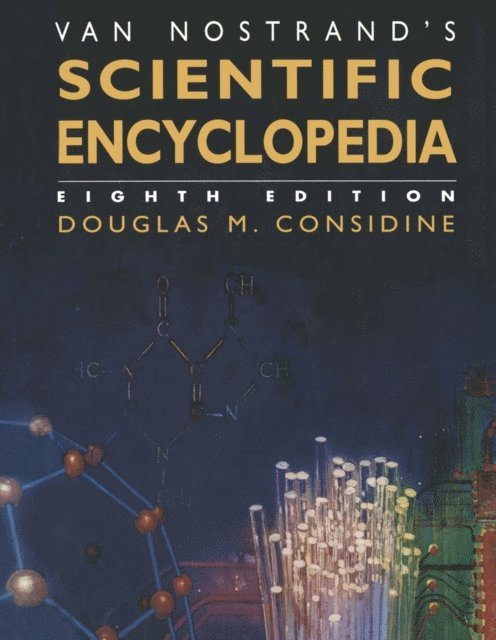
Advancements in science and engineering have occurred at a surprisingly rapid pace since the release of the seventh edition of this encyclopedia. Large portions of the reference have required comprehensive rewriting and new illustrations. Scores of new topics have been included to create this thoroughly updated eighth edition. The appearance of this new edition in 1994 marks the continuation of a tradition commenced well over a half-century ago in 1938 Van Nostrand''s Scientific Encyclopedia, First Edition, was published and welcomed by educators worldwide at a time when what we know today as modern science was just getting underway. The early encyclopedia was well received by students and educators alike during a critical time span when science became established as a major factor in shaping the progress and economy of individual nations and at the global level. A vital need existed for a permanent science reference that could be updated periodically and made conveniently available to audiences that numbered in the millions. The pioneering VNSE met these criteria and continues today as a reliable technical information source for making private and public decisions that present a backdrop of technical alternatives.