Glenn Dryhurst – författare
Visar alla böcker från författaren Glenn Dryhurst. Handla med fri frakt och snabb leverans.
5 produkter
5 produkter
E-bok
PDF, Engelska, 2012672 kr
Läs direkt efter köp
Electrochemistry of Biological Molecules presents a fairly complete summary of the electrochemistry of the more important groups of nitrogen heterocyclic molecules including purines and pyrimidines and their nucleosides and nucleotides, polynucleotides and nucleic acids, pteridines, flavins, pyrroles, porphyrins, and pyridines. Topics covered range from the theory and instrumentation of electrochemistry to various biological molecules, including pteridines, isoalloxazines, flavins, and flavin nucleotides. Comprised of nine chapters, this book begins with an overview of electrochemical techniques and their use to study biological materials, followed by a discussion on the theory and instrumentation of electrochemistry, with emphasis on their significance and utility as well aa their principles and circuits. Subsequent chapters explore nitrogen heterocyclic molecules such as purines and pyrimidines and their nucleosides and nucleotides, polynucleotides and nucleic acids, pteridines, flavins, pyrroles, porphyrins, and pyridines. The electrochemistry of biologically important pyridines is considered. This monograph should be of value to electrochemists, biochemists, and biologists.
E-bok
PDF, Engelska, 2012672 kr
Läs direkt efter köp
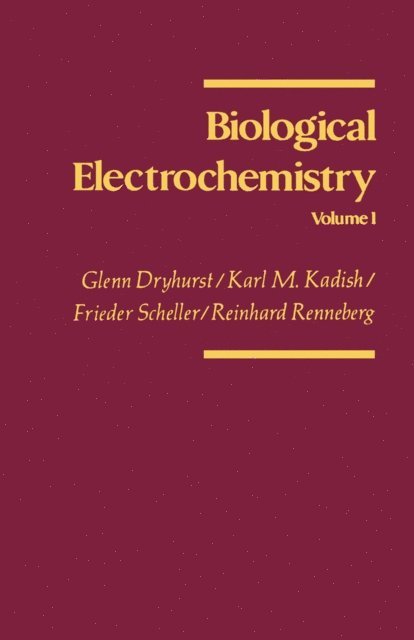
Biological Electrochemistry, Volume I is a result of a series of lectures given regarding the electrochemistry of small and large organic and inorganic molecules and how electrochemical information helps in understanding some of the biological redox reactions of these systems. This volume ultimately focuses on the electrochemistry of small and macromolecular organic compounds. This book is divided into seven chapters where each focuses on a particular organic compound. These compounds are quinones, catecholamines, phenothiazines, ascorbic acid, purines, vitamin B12 and related compounds, and proteins. Each chapter starts with a brief introduction to the compounds and then its structure and electrochemistry aspect. The last chapter gives a detailed discussion on different kinds of proteins and their electrochemistry aspects. This volume will be of help to students as well as electrochemists, biochemists, biologists, and other scientists in the field of biotechnology.
E-bok
PDF, Engelska, 2012687 kr
Läs direkt efter köp
The papers in this book were presented at the Third International Symposium on Redox Mechanisms and Interfacial Properties of Molecules of Biological Importance held in Honolulu, Hawaii between October 19-23, 1987. This Symposium was held as part of the 172nd Meeting of The Electrochemical Society which was cosponsored by The Electrochemical Society of Japan with the cooperation of The Japan Society of Applied Physics. The aim of the Symposium was to bring together a group of electrochemists and bio-medical scientists with interests in electrochemistry from around the world to present their most current research results and/or to present up-to-date reviews of current areas of research activity. It is quite clear from the diversity of topics covered in the various papers that electrochemistry and electrochemical techniques and principles have much to contribute to our under standing of many important biochemical phenomena. For example, electrochemical studies are providing important insights into the redox properties of biomolecules ranging from relatively small organic molecules such as indoleamine neurotransmitters to very large organic/organometallic molecules which include various redox enzymes or model enzyme systems. Many of the most powerful analytical techniques are now being coupled to electrodes to monitor potential-controlled behaviors of bio logical molecules at charged interfaces. Electrochemical techniques are now being developed which permit extraordinarily small electrodes to be inserted into single cells to monitor electroactive biomolecules. Other microelectrodes are being employed to control cell growth and to manipulate single cells.
Häftad, Engelska, 2012
544 kr
Skickas inom 10-15 vardagar
The papers in this book were presented at the Third International Symposium on Redox Mechanisms and Interfacial Properties of Molecules of Biological Importance held in Honolulu, Hawaii between October 19-23, 1987.
E-bok
PDF, Engelska, 2015756 kr
Läs direkt efter köp
Periodate Oxidation of Diol and Other Functional Groups: Analytical and Structural Applications deals with the chemistry of organic periodate oxidations with special reference to the study of carbohydrates, along with their analytical and structural applications. This book explores the mechanistic aspects of the periodate reaction; its historical development; the nature of the so-called anomalous reactions; and some of the synthetic uses of periodate oxidation. This book is comprised of seven chapters and opens with a historical background on periodate oxidation, followed by a discussion on the preparation and properties of periodates. The reader is then introduced to the mechanism of periodate oxidation, with particular reference to 1,2-diols and 1,2-hydroxycarbonyl compounds as well as 1,2-diketones, 1,2-aminoalcohols, and active methylene groups. The remaining chapters consider the structure of carbohydrates and related materials; anomalous periodate oxidations; the analytical aspects and applications of periodate oxidation; and a number of tested and generally well-tried analytical procedures such as the Fleury-Lange method, Malaprade method, ion exchange, and spectrophotometric and polarographic techniques. This monograph will be a useful resource for organic chemists and advanced undergraduate students of chemistry.