Gopal Krishna – författare
Visar alla böcker från författaren Gopal Krishna. Handla med fri frakt och snabb leverans.
3 produkter
3 produkter
1 428 kr
Kommande
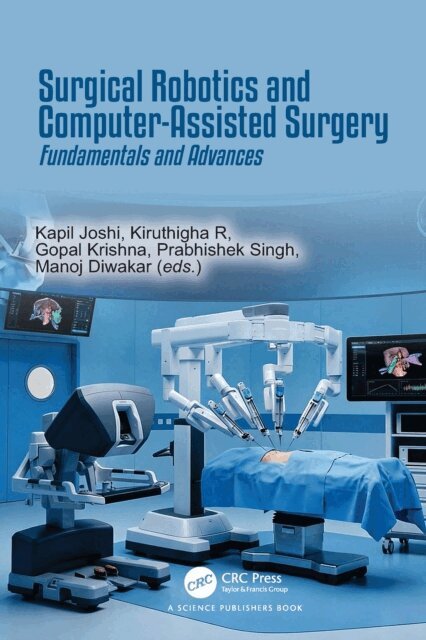
Surgical robotics and computer-assisted surgery represent a rapidly evolving interdisciplinary field that integrates robotics, artificial intelligence, medical imaging, sensing technologies, and human–machine interaction to enhance surgical precision and safety. These technologies enable minimally invasive procedures, improved visualization, real-time decision support, and enhanced dexterity beyond human limitations. As healthcare systems increasingly adopt digital and robotic solutions, computer-assisted surgery is transforming clinical workflows, surgical outcomes, and patient care standards worldwide.This book presents a comprehensive overview of the fundamentals, technologies, and recent advances in surgical robotics and computer-assisted surgery and provides a thorough understanding of the fundamentals and advances in surgical robotics and computer-assisted surgery. It covers core concepts, system architectures, control mechanisms, imaging integration, AI-assisted decision support, and emerging robotic platforms. Through theoretical insights, practical case studies, and clinical applications, the book bridges engineering principles with medical practice, highlighting current challenges, ethical considerations, and future directions in robotic-assisted surgical systems. This edited book provides a comprehensive overview of the latest advancements and applications in surgical robotics. This book covers the fundamental principles, technologies, and clinical applications of robotic surgery.The book is intended for researchers, graduate students, surgeons, biomedical engineers, and industry professionals working in surgical robotics, medical imaging, healthcare technology, and computer-assisted intervention systems.
1 378 kr
Skickas inom 7-10 vardagar
This book titled Livestock Nutrition: Analytical Techniques clearly presents the recommended and standard methods of analysis. The most recent techniques, such as bomb calorimetry, isothermal, adiabatic, and ballistic methods, as well as the analysis of non-protein nitrogen fractions, oxalic acid in feeds and fodders, cyanides in plants, nitrate and nitrite in forages, thioglucoside in rapeseed meal, free gossypol in cottonseed meal, and aflatoxins in feed, are all explained in a straightforward and illustrative manner. The book also includes simple explanations of additional methods, such as the analysis of desoxyribonuleic acid (DNA) and ribonucleic acid (RNA) in animal tissues, non-esterified fatty acid, total lipids in serum or plasma lipolase, blood glucose, cholesterol, and urea, and the biuret method for protein content in wheat, as well as examples of calculations of results. The method of urea estimation in animal feed as an adulterant is discussed in detail. This book serves as an essential resource for undergraduate and postgraduate degree students in Food Science and Technology, Animal Nutrition, Animal Products Technology, Animal Feed Technology, and Foods Nutrition (F&N). It covers the syllabus for B.V. Sc and A.H., M.V.Sc., M.Sc (F & N), M.Sc (Food Science & Technology), Ph.D. (A.N.), Ph.D. (Food Science Technology), Ph.D. (F & N), M.Sc. (APT), and M.Sc., M.V.Sc.(AFT), Ph.D. (AFT), Ph.D. (APT), and other degrees from universities in India and the Asian subcontinent. Animal Feed Compounding Industries and Human Food (Vegetarian and Non-Vegetarian) Products Manufacturing Industries (Quality Control Laboratories) can also use this book to gather information on the quality of their products before marketing. It is a valuable resource for candidates preparing for senior scientist, principal scientist, and head of department posts advertised by the ASRB (ICAR), Delhi, and CSIR institutions throughout the country.
2 749 kr
Skickas inom 7-10 vardagar
The book Livestock Nutrition: Analytical Techniques elucidates the recommended and standard methods of analysis in a comprehensive and lucid manner. The most recent methods, including Bomb calorimetry, Isothermal, Adiabatic and Ballistic, non-protein nitrogen fractions, oxalic acid in feeds and fodders, cyanides in plants, nitrate and nitrite in forages, thioglucoside in rapeseed meal, free gossypol in cottonseed meal, and aflatoxins in feed, have been presented in a simple and illustrative manner. The book also covers additional analytical methods such as desoxyribonucleic acid (DNA) and ribonucleic acid (RNA) analysis in animal tissues, non-esterified fatty acid, and total lipids in serum or plasma lipolase, blood glucose, cholesterol, and urea, biuret method for protein content in wheat, and fractions of total lipids, including cholesterol, HDL, and LDL cholesterol. Furthermore, the book provides a detailed description of the method of urea estimation in animal feed as an adulterant. The book serves as an essential resource for undergraduate and postgraduate degree students in Food Science and Technology, Animal Nutrition, Animal Products Technology, Animal Feed Technology, and Foods Nutrition (F&N). It covers the syllabus for various degrees, including B.V. Sc and A.H., M.V.Sc., M.Sc (F & N), M.Sc (Food Science & Technology), Ph.D. (A.N.), Ph.D. (Food Science Technology), Ph.D. (F & N), M.Sc. (APT), and M.V.Sc.(AFT), Ph.D. (AFT), Ph.D. (APT), degrees of Indian and Asian subcontinent universities. The book is also beneficial for the Animal Feed Compounding Industries and Human Food (Vegetarian and Non Vegetarian) Products manufacturing Industries (Quality Control Laboratories) to gather information on the quality of their products before marketing. Lastly, this book is of great help to the candidates appearing for the interview of senior scientist, principal scientist, and Head of department post advertised by the ASRB (ICAR), Delhi, and CSIR Institutions of Country.