G.R. Newkome – författare
Visar alla böcker från författaren G.R. Newkome. Handla med fri frakt och snabb leverans.
7 produkter
7 produkter
E-bok
PDF, Engelska, 20021 603 kr
Läs direkt efter köp
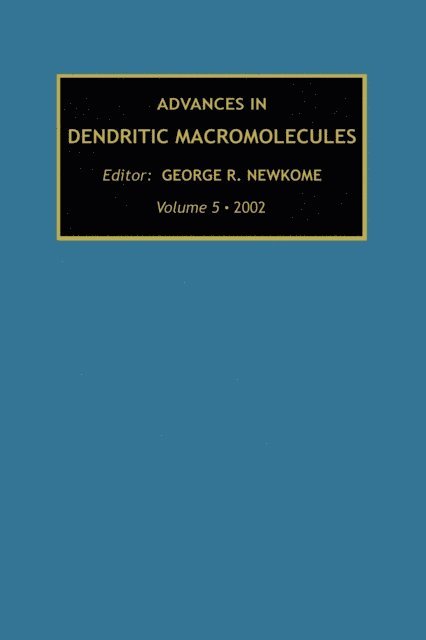
The series Advances in Dendritic Macromolecules aims to cover the synthesis and supramolecular chemistry of dendritic or cascade super-molecules as well as their less perfect hyperbranched cousins.This volume demonstrates the novel and varied growth in this topic and certainly pushes the supramolecular concepts of Lehn into the budding "supramacro-molecular" frontier. In Chapter 1, Villavicenio and McGrath present their pivotal work in the creation of azobenzene-containing dendrimers; their Chapter describes the fundamental underpinnings to this interesting family. As they state in their summation, "A continuing combination of fundamental studies on the photomodulation of dendrimer properties in azobenzene-containing dendrimers and the new developments in the application of these materials to new and existing technologies is anticipated." The field of linear - dendritic block copolymers is summarized inChapter 2 from the eyes of Ivan Gitsov, who along with Professor Fréchet were the initiators of this variety of macromolecules.In Chapter 3, Astruc and colleagues present the recent advances in metallodendrimers, which incorporate ferrocenyl and/or other transition metal sandwich components; their Chapter capitalizes on the importance of supramolecular chemistry in these dendritic constructs.Finally, in Chapter 4, Wiener and Narayanan describe the practical applications of dendrimers to the area of magnetic resonance imaging contrast agents. Each of these unique chapters covers a different perspective of this versatile group of macromolecules.
E-bok
PDF, Engelska, 19991 387 kr
Läs direkt efter köp
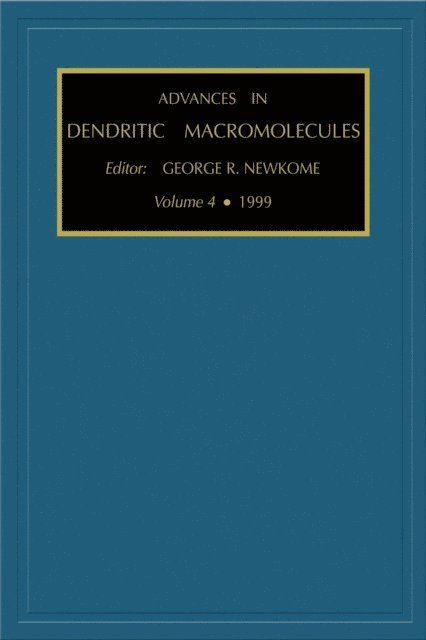
The series Advances in Dendritic Macromolecules aims to cover the synthesis and supramolecular chemistry of dendritic or cascade super-molecules as well as their less perfect hyperbranched cousins.The field of hyperbranched macromolecules, specifically dendrimers, has continued to expand at an amazing rate. The synthetic aspects, which were assumed to be over several years ago, have opened new avenues into the mesomolecular regime. The synthetic ingenuity of chemical artists has afforded new monomers and their diverse combinations to give rise to (poly)functionalized materials that embrace new supramolecular concepts in areas such as molecular recognition, assembly, encapsulation, and inclusion; catalysts; coatings; drug delivery systems; and in essence opens up the field of suprasupermolecular chemistry.In chapter 1 the synthesis of organometallic and related transition metal-cotaining dendrimers is summarized and their novel properties and useful applications are described. Chapter 2 covers work on the commercial poly(propylene imine)s, including the "dendritic box", dendrimer-based superamphiphiles, and unimolecular inverse micelles. The next chapter looks at aspects of chirality in dendritic systems and this is followed by a look inside dendrimers from a molecular topologist''s point-of-view.
E-bok
PDF, Engelska, 1995672 kr
Läs direkt efter köp
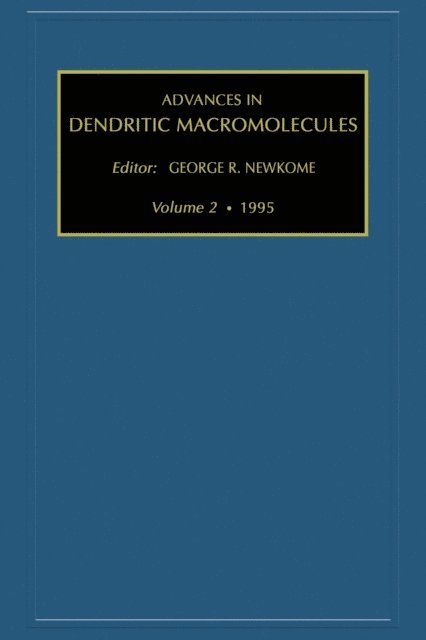
The series Advances in Dendritic Macromolecules aims to cover the synthetic, as well as chemical, aspects of this expanding field: the chemistry to and supramolecular chemistry of dendritic or cascade supermolecular compounds. In Chapter 1 of this volume, Hawker and Wooley delineate the convergent growth approach to dendrimers, then relate their three-dimensional architectures to different block polymers. In Chapter 2, Moors and Vögtle describe Professor Vögtle''s initial cascade molecules via the repetitive strategy, then expand his original concepts of its application by others, and lastly delineate the synthesis of a new series of tosylamide cascades. They also demonstrate the utility of his original Michael addition/reduction procedure by its application to differ cores. Chapter 3, composed by Professor Engel, describes ionic dendrimers which incorporated an internal transition metal center as well as his work based on ammonium and phosphonium centers. In Chapter 4, Mathias and Carothers review recent studies on silicon-based dendrimers and hyperbranched polymers. Chapter 5, by Kim, describes the preparation and utility of hyperbranched aromatic polymers. Lastly in Chapter 6, Escamilla reviews the historical as well as recent examples of ionic and nonionic bolaamphiphiles.
E-bok
PDF, Engelska, 19961 305 kr
Läs direkt efter köp
The series Advances in Dendritic Macromolecules aims to cover the synthesis and supramolecular chemistry of dendritic or cascade super-molecules as well as their less perfect hyperbranched cousins.In Volume 3, Chapter 1 describes the synthesis and characterization of dendrimers and hyperbranched polyesters, both based on 2,2-bis(hydroxymethyl)propionic acid, as the AB2-monomer. Chapter 2, discusses the advantages and drawbacks of dendritic molecular architectures necessary to create polymeric organic magnetic materials. In Chapter 3, Balzani and colleagues delineate their contributions to the field of polynuclear transition metal complexes in the design and construction of dendritic nanostructures; these luminesence and redox-active complexes suggest their role as photochemical molecular devices operating by photoinduced energy and electron transfer processes. Chapter 4, reviews the overall progress on redox-active dendrimers, especially as redox catalysts, organic conductors, modified electrodes, and models for electron transfer proteins. Chapter 5, summarizes the pioneering research in organometallic dendritic macromolecules and then delineates the redox properties of a series of silicon-based ferrocenyl-containing dendrimers.
Del 3 - Advances in Dendritic Macromolecules
Advances in Dendritic Macromolecules
Inbunden, Engelska, 1996
1 383 kr
Skickas inom 5-8 vardagar
The series Advances in Dendritic Macromolecules aims to cover the synthesis and supramolecular chemistry of dendritic or cascade super-molecules as well as their less perfect hyperbranched cousins.In Volume 3, Chapter 1 describes the synthesis and characterization of dendrimers and hyperbranched polyesters, both based on 2,2-bis(hydroxymethyl)propionic acid, as the AB2-monomer. Chapter 2, discusses the advantages and drawbacks of dendritic molecular architectures necessary to create polymeric organic magnetic materials. In Chapter 3, Balzani and colleagues delineate their contributions to the field of polynuclear transition metal complexes in the design and construction of dendritic nanostructures; these luminesence and redox-active complexes suggest their role as photochemical molecular devices operating by photoinduced energy and electron transfer processes. Chapter 4, reviews the overall progress on redox-active dendrimers, especially as redox catalysts, organic conductors, modified electrodes, and models for electron transfer proteins. Chapter 5, summarizes the pioneering research in organometallic dendritic macromolecules and then delineates the redox properties of a series of silicon-based ferrocenyl-containing dendrimers.
Del 5 - Advances in Dendritic Macromolecules
Advances in Dendritic Macromolecules
Inbunden, Engelska, 2002
1 698 kr
Skickas inom 5-8 vardagar
The series Advances in Dendritic Macromolecules aims to cover the synthesis and supramolecular chemistry of dendritic or cascade super-molecules as well as their less perfect hyperbranched cousins.This volume demonstrates the novel and varied growth in this topic and certainly pushes the supramolecular concepts of Lehn into the budding "supramacro-molecular" frontier. In Chapter 1, Villavicenio and McGrath present their pivotal work in the creation of azobenzene-containing dendrimers; their Chapter describes the fundamental underpinnings to this interesting family. As they state in their summation, "A continuing combination of fundamental studies on the photomodulation of dendrimer properties in azobenzene-containing dendrimers and the new developments in the application of these materials to new and existing technologies is anticipated." The field of linear - dendritic block copolymers is summarized inChapter 2 from the eyes of Ivan Gitsov, who along with Professor Fr�chet were the initiators of this variety of macromolecules.In Chapter 3, Astruc and colleagues present the recent advances in metallodendrimers, which incorporate ferrocenyl and/or other transition metal sandwich components; their Chapter capitalizes on the importance of supramolecular chemistry in these dendritic constructs.Finally, in Chapter 4, Wiener and Narayanan describe the practical applications of dendrimers to the area of magnetic resonance imaging contrast agents. Each of these unique chapters covers a different perspective of this versatile group of macromolecules.
Del 2 - Advances in Dendritic Macromolecules
Advances in Dendritic Macromolecules
Inbunden, Engelska, 1995
1 371 kr
Skickas inom 5-8 vardagar
The series Advances in Dendritic Macromolecules aims to cover the synthetic, as well as chemical, aspects of this expanding field: the chemistry to and supramolecular chemistry of dendritic or cascade supermolecular compounds. In Chapter 1 of this volume, Hawker and Wooley delineate the convergent growth approach to dendrimers, then relate their three-dimensional architectures to different block polymers. In Chapter 2, Moors and Vögtle describe Professor Vögtle's initial cascade molecules via the repetitive strategy, then expand his original concepts of its application by others, and lastly delineate the synthesis of a new series of tosylamide cascades. They also demonstrate the utility of his original Michael addition/reduction procedure by its application to differ cores. Chapter 3, composed by Professor Engel, describes ionic dendrimers which incorporated an internal transition metal center as well as his work based on ammonium and phosphonium centers. In Chapter 4, Mathias and Carothers review recent studies on silicon-based dendrimers and hyperbranched polymers. Chapter 5, by Kim, describes the preparation and utility of hyperbranched aromatic polymers. Lastly in Chapter 6, Escamilla reviews the historical as well as recent examples of ionic and nonionic bolaamphiphiles.