Graeme Guthrie - Böcker
Visar alla böcker från författaren Graeme Guthrie. Handla med fri frakt och snabb leverans.
2 produkter
2 produkter
The Firm Divided
Manager-Shareholder Conflict and the Fight for Control of the Modern Corporation
Inbunden, Engelska, 2017
643 kr
Skickas inom 5-8 vardagar
A battle is being fought within corporations. Shareholders want managers to make their shares as valuable as possible, managers want shareholders to leave them alone, and the board of directors is caught in the middle. The Firm Divided shows how strong boards persuade managers to do what's best for shareholders-and why weak boards don't.Graeme Guthrie blends the stories of particular firms and individuals with the insights of scholarly research, enhancing understanding of how seemingly separate events are consequences of the separation of ownership and control, the ultimate cause of manager-shareholder conflict. Boards of directors can affect the outcome of this conflict by monitoring managers, providing incentives for managers to work in shareholders' best interests, delegating monitoring to outside parties, and influencing the effectiveness of the market for corporate control. How directors do this depends on how they weigh their fiduciary duty to shareholders against the close ties that bind them to senior executives.The Firm Divided provides conceptual insight, underpinned by research into corporate governance, into board-manager interactions. It shows how tools that can benefit shareholders when used by strong boards can actually harm shareholders when used by weak boards. Guthrie provides a 360 degree view of firms, exploring the ways in which each player pursues their own goals, with examples from a range of firms in diverse industries.
1 630 kr
Skickas inom 5-8 vardagar
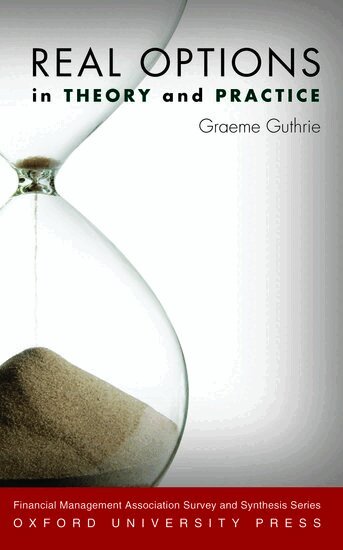
Decision makers in business and economics face a staggering array of problems. Managers of growing firms have to decide which growth options will expand their business. Governments have to decide which infrastructure investments to undertake. Managers of oil firms must decide how rapidly to deplete their reserves. Owners of land must decide when and how to develop. Operators of power plants must decide when to start them up and when to shut them down. While these problems seem quite diverse, they share many important features. In each case, the decision maker must choose when to take a particular action that will be difficult, if not impossible, to reverse. In each case, the consequences of taking (or not taking) that action are uncertain. The timing and nature of these actions directly affect revenue. Real options that often vary radically from one problem to another. The book focuses on building a general approach to solving problems from the ground up to show readers how real options can be assembled in a way appropriate to the individual problem being analyzed. The book will inform both practitioners who want to develop their analytical techniques and also graduate students who will eventually become practitioners. The real-options approach to capital budgeting (and business decision-making more generally) was introduced 30 years ago and is now widely accepted. While there are now many books that introduce the concept of real options to a general business audience, students and practitioners have been given little guidance as to how to actually implement these concepts in practice.