Graham Low – författare
Visar alla böcker från författaren Graham Low. Handla med fri frakt och snabb leverans.
4 produkter
4 produkter
Häftad, Engelska, 1999
625 kr
Skickas inom 7-10 vardagar
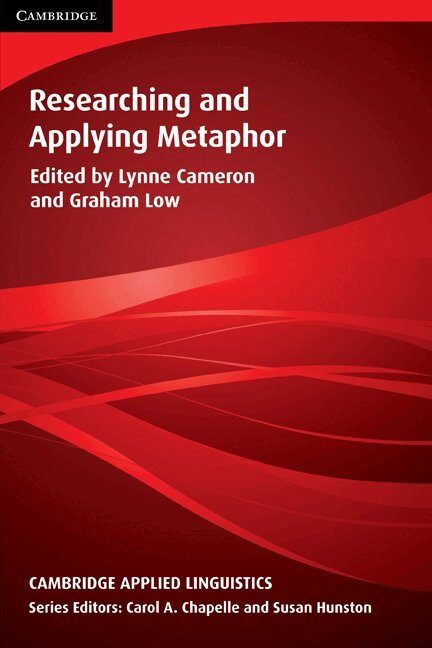
Research into metaphor has become one of the fastest-growing and important areas of language research over the past twenty years, and metaphor is now recognized as central to language and language use. The implications of these findings are only just beginning to be felt in applied linguistics and this is designed to convey the excitement of metaphor study to a wider applied linguistic audience of researchers, trainers, programme developers and postgraduate students. The authors of the 12 papers are all internationally active researchers, contributing from their various backgrounds to this lively collection. Researching and Applying Metaphor presents a series of case studies plus an innovative initial section which discusses key aspects of researching metaphor in use. It demonstrates how metaphor can be, and needs to be, researched using multiple methods of investigation.
E-bok
PDF, Engelska, 1999405 kr
Läs direkt efter köp
Research into metaphor has become one of the fastest-growing and important areas of language research over the past twenty years, and metaphor is now recognized as central to language and language use. The implications of these findings are only just beginning to be felt in applied linguistics and this is designed to convey the excitement of metaphor study to a wider applied linguistic audience of researchers, trainers, programme developers and postgraduate students. The authors of the 12 papers are all internationally active researchers, contributing from their various backgrounds to this lively collection. Researching and Applying Metaphor presents a series of case studies plus an innovative initial section which discusses key aspects of researching metaphor in use. It demonstrates how metaphor can be, and needs to be, researched using multiple methods of investigation.
Häftad, Engelska, 2005
561 kr
Skickas inom 10-15 vardagar
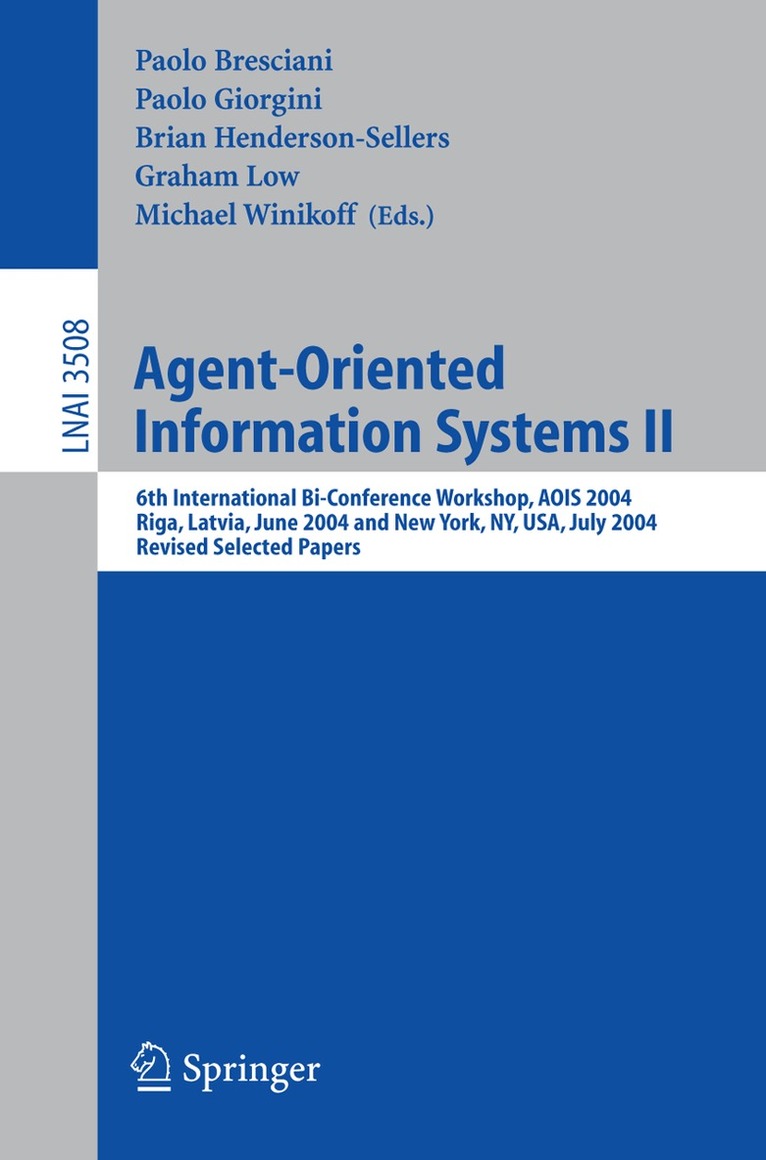
Information systems have become the backbone of all kinds of organizations - day. In almost every sector – manufacturing, education, health care, government and businesses large and small – information systems are relied upon for - eryday work, communication, information gathering and decision-making. Yet, the in?exibilities in current technologies and methods have also resulted in poor performance, incompatibilities and obstacles to change. As many organizations are reinventing themselves to meet the challenges of global competition and e-commerce, there is increasing pressure to develop and deploy new technologies that are ?exible, robust and responsive to rapid and unexpected change. Agent concepts hold great promise for responding to the new realities of - formation systems. They o?er higher-level abstractions and mechanisms which address issues such as knowledge representation and reasoning, communication, coordination, cooperation among heterogeneous and autonomous parties, p- ception, commitments, goals, beliefs, intentions, etc., all of which need conc- tual modelling. On the one hand, the concrete implementation of these concepts can lead to advanced functionalities, e.g., in inference-based query answering, transaction control, adaptive work ?ows, brokering and integration of disparate information sources, and automated communication processes. On the other hand, their rich representational capabilities allow for more faithful and ?- ible treatments of complex organizational processes, leading to more e?ective requirements analysis and architectural/detailed design.
E-bok
PDF, Engelska, 2005708 kr
Läs direkt efter köp
Information systems have become the backbone of all kinds of organizations - day. In almost every sector – manufacturing, education, health care, government and businesses large and small – information systems are relied upon for - eryday work, communication, information gathering and decision-making. Yet, the in?exibilities in current technologies and methods have also resulted in poor performance, incompatibilities and obstacles to change. As many organizations are reinventing themselves to meet the challenges of global competition and e-commerce, there is increasing pressure to develop and deploy new technologies that are ?exible, robust and responsive to rapid and unexpected change. Agent concepts hold great promise for responding to the new realities of - formation systems. They o?er higher-level abstractions and mechanisms which address issues such as knowledge representation and reasoning, communication, coordination, cooperation among heterogeneous and autonomous parties, p- ception, commitments, goals, beliefs, intentions, etc., all of which need conc- tual modelling. On the one hand, the concrete implementation of these concepts can lead to advanced functionalities, e.g., in inference-based query answering, transaction control, adaptive work ?ows, brokering and integration of disparate information sources, and automated communication processes. On the other hand, their rich representational capabilities allow for more faithful and ?- ible treatments of complex organizational processes, leading to more e?ective requirements analysis and architectural/detailed design.