Grahame F. Thompson - Böcker
Visar alla böcker från författaren Grahame F. Thompson. Handla med fri frakt och snabb leverans.
4 produkter
4 produkter
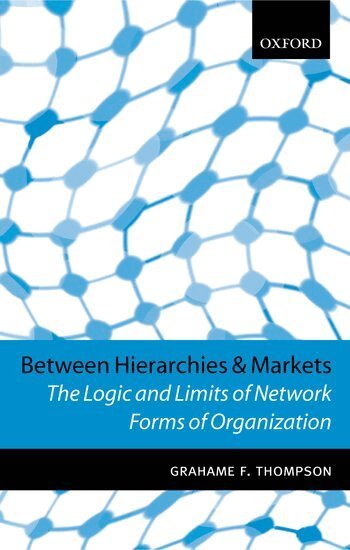
Between Hierarchies and Markets
The Logic and Limits of Network Forms of Organization
Inbunden, Engelska, 2003
2 483 kr
Skickas inom 5-8 vardagar
This text conducts a survey into the ways in which the word "network" has been deployed in a wide range of literature. In particular, it offers a commentary on how the idea of networks has been used to illustrate contemporary forms of socio-economic organization (as with the idea of a "network society" or a "network state", for instance), broadly conceived to also include the political aspects of networks. The term "network" has become a ubiquitous metaphor to describe too many aspects of contemporary life. In doing so, Grahame Thompson argues, the term has lost much of its analytical precision and has no clear conceptual underpinnings. The problem is that something claiming to explain everything ends up by explaining very little. The book brings some intellectual clarity to the discussion of networks by asking whether it is possible to construct a clearly demarcated idea of a network as a separable form of socio-economic co-ordination and governance mechanism with its own consistent logic. In doing this, the primary contrast is with hierarchies and markets as alternative and already well understood forms of socio-economic co-ordination each with their own distinctive logic.
Between Hierarchies and Markets
The Logic and Limits of Network Forms of Organization
Häftad, Engelska, 2003
688 kr
Skickas inom 5-8 vardagar
This book conducts a survey into the ways in which the word 'network' has been deployed in a wide range of literature. In particular, it offers a commentary on how the idea of networks has been used to illustrate contemporary forms of socio-economic organization (as with the idea of a 'network society' or a 'network state', for instance), broadly conceived to also include the political aspects of networks. The term 'network' has become a ubiquitous metaphor to describe too many aspects of contemporary life. In doing so, Thompson argues, the term has lost much of its analytical precision and has no clear conceptual underpinnings. The problem is that something claiming to explain everything ends up by explaining very little. The book brings some intellectual clarity to the discussion of networks by asking whether it is possible to construct a clearly demarcated idea of a network as a separable form of socio-economic coordination and governance mechanism with its own consistent logic. In doing this, the primary contrast is with hierarchies and markets as alternative and already well understood forms of socio-economic coordination each with their own distinctive logic.The author identifies two underlying programmatic issues: the question of whether there can be a particular logic to the network form of organization, and whether there are any limits to networks. He makes the argument that if networks are to mean anything then they must not apply to everything, so this raises an obvious limit to their embrace. The questions thus become where and how to draw these limits. These are reviewed in the light of the concrete organizational forms that networks have taken in the contemporary period.
1 152 kr
Skickas inom 5-8 vardagar
With the advent of globalization - where corporate organizations and the commercial relations that accompany them are argued to be becoming increasingly transnational - the locus of powers, authorities, and responsibilities has shifted to the global level. The nation-state arena is losing its capacity to regulate and control commercial processes and practices as a transformational logic kicks-in, associated with new forms of global rule-making and governance. It is this new arena of global rule-making that can be considered as a surrogate form of global constitutionalization, or 'quasi-constitutionalization'. But as might be expected, this surrogate process of constitutionalization is not a coherent system or set of rounded outcomes but full of contradictory half-finished currents and projects: an 'assemblage' of many disparate advances and often directionless moves - almost an accidental coming together of elements. It is this assemblage that is to be investigated and unbundled by the analysis of the book.The book discusses governance, law, and constitutional matters in the context of international corporate constitutional governance. It examines how and why the business world, commercial relations, and company activities have increasingly become subject to legal and constitutional forms of regulation and governance at the international level. It analyses how we should characterize the process that has seen the international corporate arena increasingly subject to juridical and constitutional-like regulatory initiatives and interventions and whether this amounts to a new attempt to subject international commercial relations to the 'rule of law' and, indeed, to rule the world through these very means.

ECONOMIC EMERGENCE OF A NEW EUROPE?
The Political Economy of Cooperation and Competition in the 1990s
Inbunden, Engelska, 1993
1 986 kr
Skickas inom 7-10 vardagar
Questions of European economic and political integration have been placed firmly on the policy agenda as we enter the late 1990s. The Economic Emergence of a New Europe? explores the arguments and forms of analysis deployed by those who have been pressing for closer integration since the early 1980s.Although events in Denmark and the United Kingdom have thrown the future of the post-Maastricht European Community into some confusion, the agreements already reached will propel the Community along a path of ever closer economic co-operation. Casting a sceptical eye over much of the economic analysis used to explore the effects and implications of the integration process, this book critically examines the reasons behind the contemporary imperative for greater integration among the European states, and assesses the likely limits of this programme.