Gregory B. Baecher - Böcker
Visar alla böcker från författaren Gregory B. Baecher. Handla med fri frakt och snabb leverans.
4 produkter
4 produkter
1 720 kr
Skickas inom 7-10 vardagar
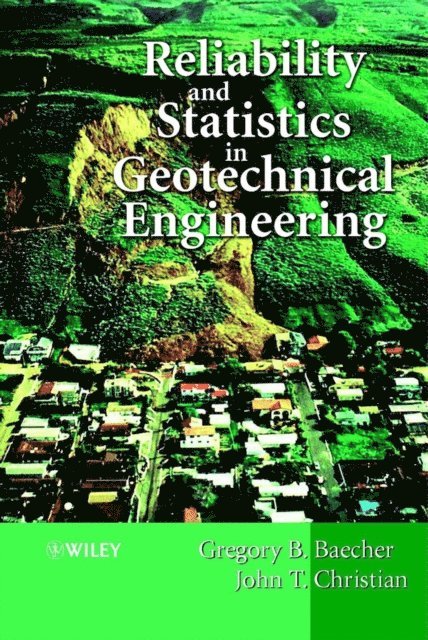
Risk and reliability analysis is an area of growing importance in geotechnical engineering, where many variables have to be considered. Statistics, reliability modeling and engineering judgement are employed together to develop risk and decision analyses for civil engineering systems. The resulting engineering models are used to make probabilistic predictions, which are applied to geotechnical problems. Reliability & Statistics in Geotechnical Engineering comprehensively covers the subject of risk and reliability in both practical and research terms* Includes extensive use of case studies* Presents topics not covered elsewhere--spatial variability and stochastic properties of geological materials* No comparable texts available Practicing engineers will find this an essential resource as will graduates in geotechnical engineering programmes.
1 793 kr
Skickas inom 7-10 vardagar
The use of risk assessment in dam safety management as advocated by the International Commission On Large Dams (ICOLD) will be greatly enhanced by Risk and Uncertainty in Dam Safety, an authoritative, comprehensive and valuable contribution to dam safety practices.Through the presentation of a systematic and integrated process, Risk and Uncertainty in Dam Safety assists the dam owner in evaluating the needs for dam safety improvement, selecting and prioritizing remedial and corrective actions, and improving the operation, maintenance and surveillance procedures. As a result of the unique cooperation among experienced and knowledgeable dam owners, dam safety mangers and engineers, and experts in the theoretical basis for risk assessment, Risk and Uncertainty in dam safety contains a thorough review of how state-of-the-art 'the industry' has become, provides lessons from first hand practical experience, and gives significant new contributions that will enhance understanding of the risk assessment and management process and how to apply it effectively, increasing awareness and reduce complacency regarding dam safety issues.Risk and Uncertainty in Dam Safety will appeal not only to industry specialists but also to readers outside the dam engineering community due to its general and excellent treatment of the various topics in the integrated process of risk assessment
2 117 kr
Skickas inom 10-15 vardagar
1 2 Konstantine V. Frolov and Gregory B. Baecher 1 2 Director of the Institute for Machine Sciences, RAS; and University of Maryland The objective of the Workshop on Protection of Civilian Infrastructure From Acts of Terrorism was to lay the foundation for a risk-informed - proach to modeling, analyzing, predicting, managing, and controlling mul- sector Infrastructure networks in the face of human threats and errors. The goal was to combine the insights of a spectrum of disciplines across en- neering, public policy, planning, and economics. The workshop addressed the need to develop an understanding for s- tems behaviors and vulnerabilities of interacting networks; create a ri- informed analysis capability for modeling and predicting the behavior of complex networks; apply emerging technology to the problems of desi- ing, constructing, monitoring, and operating critical infrastructure; and build an understanding of the social, economic, and environmental factors that affect, and are affected by, critical infrastructure. The objective was to develop an understanding of the vulnerability of critical systems to various modes of terrorist attack. The benefit of developing such understanding is that approaches can be crafted to reducing vulnerability and to containing or limiting the propagation of failure within an infrastructure system, thus limiting the impact of terrorism. This also leads to improved understanding of infrastructure systems in general, not only in the face of threats but also natural hazards. Areas of research need and capability were identified, along with opportunities for future exchange and collaboration.
2 117 kr
Skickas inom 10-15 vardagar
1 2 Konstantine V. Frolov and Gregory B. Baecher 1 2 Director of the Institute for Machine Sciences, RAS; and University of Maryland The objective of the Workshop on Protection of Civilian Infrastructure From Acts of Terrorism was to lay the foundation for a risk-informed - proach to modeling, analyzing, predicting, managing, and controlling mul- sector Infrastructure networks in the face of human threats and errors. The goal was to combine the insights of a spectrum of disciplines across en- neering, public policy, planning, and economics. The workshop addressed the need to develop an understanding for s- tems behaviors and vulnerabilities of interacting networks; create a ri- informed analysis capability for modeling and predicting the behavior of complex networks; apply emerging technology to the problems of desi- ing, constructing, monitoring, and operating critical infrastructure; and build an understanding of the social, economic, and environmental factors that affect, and are affected by, critical infrastructure. The objective was to develop an understanding of the vulnerability of critical systems to various modes of terrorist attack. The benefit of developing such understanding is that approaches can be crafted to reducing vulnerability and to containing or limiting the propagation of failure within an infrastructure system, thus limiting the impact of terrorism. This also leads to improved understanding of infrastructure systems in general, not only in the face of threats but also natural hazards. Areas of research need and capability were identified, along with opportunities for future exchange and collaboration.