Gregory J. Madden - Böcker
Visar alla böcker från författaren Gregory J. Madden. Handla med fri frakt och snabb leverans.
4 produkter
4 produkter
1 093 kr
Skickas inom 7-10 vardagar
AN INTRODUCTION TO BEHAVIOR ANALYSIS Explore a fascinating introductory treatment of the principles of behavior analysis written by three leading voices in the fieldAn Introduction to Behavior Analysis delivers an engaging and comprehensive introduction to the concepts and applications for graduate students of behavior analysis. Written from the ground up to capture and hold student interest, the book keeps its focus on practical issues.The book offers readers sound analyses of Pavlovian and operant learning, reinforcement and punishment, motivation and stimulus control, language and rule-following, decision-making and clinical behavior analysis. With fully up to date empirical research references and theoretical content, An Introduction to Behavior Analysis thoroughly justifies every principle it describes with empirical support and explicitly points out where more data are required.The text encourages students to analyze their own experiences and some foundational findings in the field in a way that minimizes jargon and maximizes engagement. Readers will also benefit from the inclusion of:A clear articulation and defense of the philosophical assumptions and overarching goals of behavior analysis.A thorough description of objective data collection, experimental methods, and data analysis in the context of psychologyAn exploration of the core principles of behavior analysis, presented at a level comprehensible to an introductory audienceA broad array of principles that cover issues as varied as language, substance-use disorders, and common psychological disordersPerfect for students taking their first course in behavior analysis or behavior modification, An Introduction to Behavior Analysis will also earn a place in the libraries of students pursuing certification through the Behavior Analysis Certification Board or taking courses in the applied psychological sciences.
1 060 kr
Kommande
The latest edition of the gold standard in introductory behavior analysis texts In the newly revised second edition of An Introduction to Behavior Analysis, a team of experienced researchers delivers an engaging and comprehensive introduction to the theoretical fundamentals and applications of behavior analysis. The authors focus on practical issues encountered by practicing behavior analysts, including Pavlovian and operant learning, reinforcement and punishment, motivation and stimulus control, and other key concepts in the field. The book clearly articulates and defends the philosophical assumptions and overarching goals of behavior analysis. It describes objective data collection, experimental methods, and data analysis in the context of modern psychology. You'll also find: Core behavioral analysis principles explained in an accessible way that are appropriate for introductory audiencesExpert discussions of a variety of common behavior issues, including language, substance-use disorders, and psychological disordersUp-to-date examinations of the latest empirical research and theory, along with identifications of areas that require further data and studyComplimentary access to a companion website containing PowerPoint slides and a test bank for each chapterPerfect for students undertaking their first course in behavior analysis or behavior modification, An Introduction to Behavior Analysis is also a must-read for trainees pursuing certification through the Behavior Analysis Certification Board and for students of the applied psychological sciences.
712 kr
Skickas inom 7-10 vardagar
Impulsivity explores the basis for the seemingly universal tendency to devalue rewards or punishments that are not immediately available. When confronted with any number of modern impulsive behaviors-such as drug use, pathological gambling, marital infidelity, and gluttony-individuals have a choice with two outcomes: an immediate benefit, such as getting high, or a delayed or probabilistic benefit, such as health, money saved, or the satisfaction of a good life. This volume is an approachable, comprehensive overview of the behavioral science and neuroscience of these impulsive choices and their relation to delay discounting-the tendency to devalue temporally distant rewards or punishments, even though they may greatly outbalance the immediate benefit of our choices. The cutting-edge researchers who contributed to this volume have documented cross-species similarities in impulsive decision making and pioneered the neuroscience of impulsive choice. In this text they provide insights into harmless impulsive acts as well as those that dominate and destroy lives. The contributors tackle key issues such as whether impulsivity and risk taking are a trait or state the neuroscience, neuroeconomics, and computational modeling of neural systems underlying impulsivity and the relation between impulsivity and addictions, health decision making, altruism, and attention-deficit disorder. Theoretical debates regarding the origins of impulsivity round out this text, which will be of interest to researchers and graduate students in psychology, behavioral economics, psychopharmacology, behavioral analysis and therapy, and the science of decision making.
4 991 kr
Skickas inom 7-10 vardagar
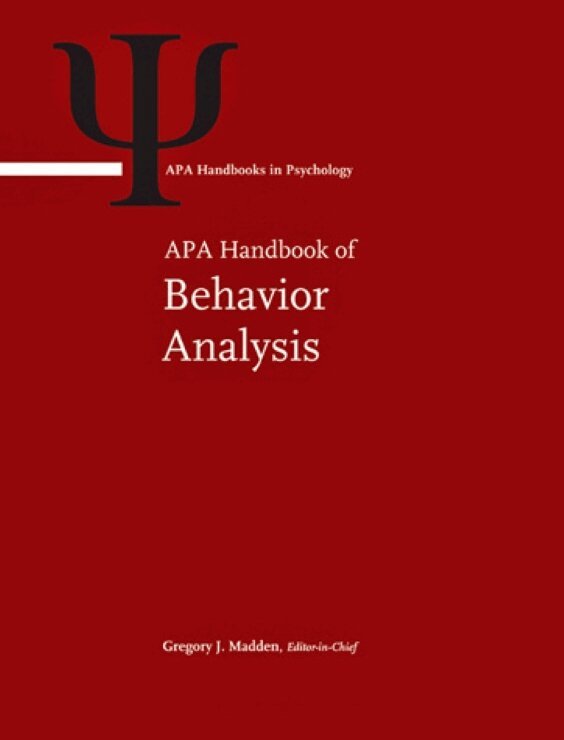
This two-volume handbook continues the inductive translational approach to the science of behavior analysis by providing overview and in-depth chapters spanning the breadth of behavior analysis.Behavior analysis emerged from the nonhuman laboratories of B. F. Skinner, Fred Keller, Nate Schoenfeld, Murray Sidman, James Dinsmoor, Richard Herrnstein, Nate Azrin, and others who pioneered experimental preparations designed to do one thing - find orderly relations between environment and behavior. This bottom-up approach to a natural science of behavior yielded a set of behavioral principles that proved orderly and replicable across subjects, laboratories, and species. By the 9 s, behavior analysts began translating these principles into interventions for institutionalized humans characterized by impoverished repertoires of adaptive behavior. When these interventions proved successful in replacing problem- with adaptive-behavior, the field of Applied Behavior Analysis was born. Over the last 5 years the field of behavior analysis has grown substantially both in the number of practicing behavior analysts and the range of behavior to which behavioral principles have been applied. Today the laboratory study of basic principles of behavior continues to expand our understanding of behavior and to inform the treatment of disorders ranging from autism to substance abuse. The present volumes continue this inductive translational approach to the science of behavior analysis by providing overview and in-depth chapters spanning the breadth of behavior analysis. Volume I provides comprehensive coverage of the logic, clinical utility, and methods of single-case research designs. Chapters walk the reader through the design, data collection, and data analysis phases and are appropriate for students, researchers, and clinicians concerned with best practice. Volume I also provides an overview of the experimental analysis of behavior, and chapters reviewing some of the most important areas of contemporary laboratory research in behavior analysis. Topics covered include memory, attention, choice, behavioral neuroscience, and behavioral pharmacology. Volume II includes chapters illustrating how principles of behavior discovered in basic-science laboratories have provided insights on socially important human behavior ranging from the complex discriminations that underlie human language to disorders treated by clinical psychologists. The second section of Volume II includes 2 chapters, each devoted to a particular behavioral/developmental disorder (e.g., behavioral treatments of ADHD, autism) or to behavior of societal importance (e.g., effective college teaching, effective treatment of substance abuse). Each of these chapters provides a review of what works and where additional research is needed.