Gregory V. Bard - Böcker
Visar alla böcker från författaren Gregory V. Bard. Handla med fri frakt och snabb leverans.
2 produkter
2 produkter
349 kr
Skickas inom 7-10 vardagar
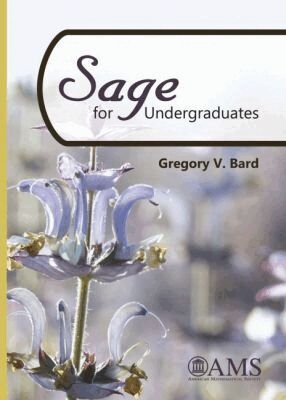
As the open-source and free competitor to expensive software like Maple™, Mathematica®, Magma, and MATLAB®, Sage offers anyone with access to a web browser the ability to use cutting-edge mathematical software and display his or her results for others, often with stunning graphics. This book is a gentle introduction to Sage for undergraduate students toward the end of Calculus II (single-variable integral calculus) or higher-level course work such as Multivariate Calculus, Differential Equations, Linear Algebra, or Math Modeling.The book assumes no background in computer science, but the reader who finishes the book will have learned about half of a first semester Computer Science I course, including large parts of the Python programming language. The audience of the book is not only math majors, but also physics, engineering, finance, statistics, chemistry, and computer science majors.
678 kr
Skickas inom 7-10 vardagar
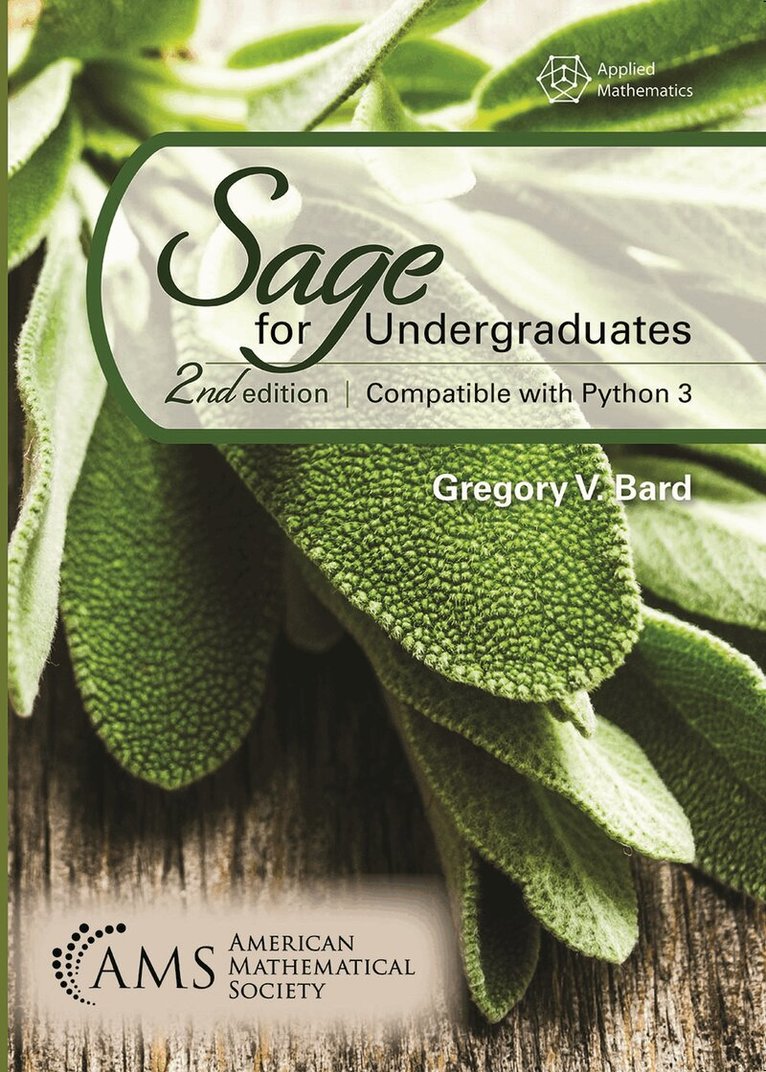
As the open-source and free alternative to expensive software like MapleTM, MathematicaR, and MATLABR, Sage offers anyone with a web browser the ability to use cutting-edge mathematical software and share the results with others, often with stunning graphics. This book is a gentle introduction to Sage for undergraduate students during Calculus II, Multivariate Calculus, Differential Equations, Linear Algebra, Math Modeling, or Operations Research.This book assumes no background in programming, but the reader who finishes the book will have learned about 60 percent of a first semester computer science course, including much of the Python programming language. The audience is not only math majors, but also physics, engineering, environmental science, finance, chemistry, economics, data science, and computer science majors. Many of the book's examples are drawn from those fields. Filled with ""challenges"" for the students to test their progress, the book is also ideal for self-study.What's New in the Second Edition:In 2019, Sage transitioned from Python 2 to Python 3, which changed the syntax in several significant ways, including for the print command. All the examples in this book have been rewritten to be compatible with Python 3. Moreover, every code block longer than four lines has been placed in an archive on the book's website http://www.sage-for-undergraduates.org that is maintained by the author, so that the students won't have to retype the code! Other additions include:The number of ""challenges"" for the students to test their own progress in learning Sage has roughly doubled, which will be a great boon for self-study.There's approximately 150 pages of new content, including: New projects on Leontief Input-Output Analysis and on Environmental ScienceNew sections about Complex Numbers and Complex Analysis, on SageTex, and on solving problems via Monte-Carlo Simulations. The first three sections of Chapter 1 have been completely rewritten to give absolute beginners a smoother transition into Sage.