Greta Jones - Böcker
Visar alla böcker från författaren Greta Jones. Handla med fri frakt och snabb leverans.
5 produkter
5 produkter
1 261 kr
Skickas inom 10-15 vardagar
First published in 1988, Science, Politics and the Cold War is a history of the cold-war era that demonstrates the extent to which science and scientists have been implicated in every aspect of the political process.The book discusses how politically aware scientists involved themselves in controversies relating to atomic technology and genetics, and how the science world became a battleground between competing ideologies. The politicisation of science is shown to go deeper than any individual issue—right-wing critics of the Soviet Union argued that true science and socialism were incompatible, whilst their opponents forwarded similar arguments about science and capitalism. At the same time, the science world always contained a powerful lobby for political non-alignment, a faction which saw and continues to see science as a force for internationalism. This volume analyses all these positions and draws out the main contours of the politics/science debate in this period.
456 kr
Kommande
First published in 1988, Science, Politics and the Cold War is a history of the cold-war era that demonstrates the extent to which science and scientists have been implicated in every aspect of the political process.The book discusses how politically aware scientists involved themselves in controversies relating to atomic technology and genetics, and how the science world became a battleground between competing ideologies. The politicisation of science is shown to go deeper than any individual issue—right-wing critics of the Soviet Union argued that true science and socialism were incompatible, whilst their opponents forwarded similar arguments about science and capitalism. At the same time, the science world always contained a powerful lobby for political non-alignment, a faction which saw and continues to see science as a force for internationalism. This volume analyses all these positions and draws out the main contours of the politics/science debate in this period.
1 261 kr
Skickas inom 10-15 vardagar
In the early twentieth century, a group of writers and publicists began to talk and write about social hygiene or more commonly known as the theory of eugenics. By this they meant the improvement of the quality of the population by a conscious intervention in the biological laws which governed its growth, development, and reproduction. This discussion led to the foundation of several social hygiene/eugenics organisations: the Eugenics Society, the National Council for Mental Hygiene, the Central Association for Mental Welfare, the People’s League of Health, the New Health Society, the National Institute for Industrial Psychology, and several others. First published in 1986, Social Hygiene in Twentieth Century Britain (now with a new preface by the author) suggests that they were linked by a set of interrelated ideas about health and social progress which was influential in the period from the First World War to the aftermath of the Second. Its basic contention is that these groups were influenced by Social Darwinism and that they based their policies on two foundations: the elimination of the unfit and the improvement of the general level of industrial and personal efficiency among the working class.The book offers a critique of Foucault’s theory of the development of the sciences of human life, as well as relating the ideas of these groups to the social climate of British life. The social management they envisaged was based on an expectation of deflation and a high level of unemployment. They can thus be seen as throwing light on developments in Conservative policy on ‘family life’ and the like.
456 kr
Kommande
In the early twentieth century, a group of writers and publicists began to talk and write about social hygiene or more commonly known as the theory of eugenics. By this they meant the improvement of the quality of the population by a conscious intervention in the biological laws which governed its growth, development, and reproduction. This discussion led to the foundation of several social hygiene/eugenics organisations: the Eugenics Society, the National Council for Mental Hygiene, the Central Association for Mental Welfare, the People’s League of Health, the New Health Society, the National Institute for Industrial Psychology, and several others. First published in 1986, Social Hygiene in Twentieth Century Britain (now with a new preface by the author) suggests that they were linked by a set of interrelated ideas about health and social progress which was influential in the period from the First World War to the aftermath of the Second. Its basic contention is that these groups were influenced by Social Darwinism and that they based their policies on two foundations: the elimination of the unfit and the improvement of the general level of industrial and personal efficiency among the working class.The book offers a critique of Foucault’s theory of the development of the sciences of human life, as well as relating the ideas of these groups to the social climate of British life. The social management they envisaged was based on an expectation of deflation and a high level of unemployment. They can thus be seen as throwing light on developments in Conservative policy on ‘family life’ and the like.
Del 99 - Clio Medica
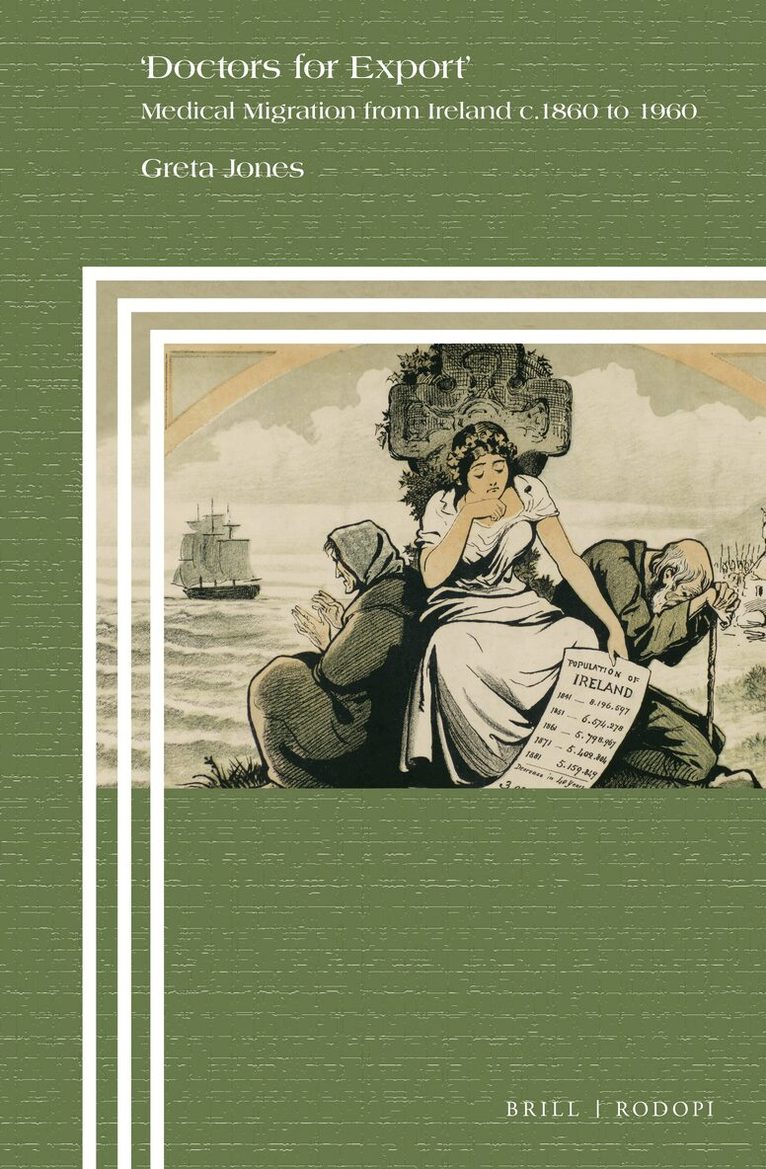
‘Doctors for Export’
Medical Migration from Ireland c.1860 to 1960
Inbunden, Engelska, 2021
2 172 kr
Skickas inom 5-8 vardagar
This is the first full-length study of doctor migration from Ireland covering roughly a century of the export of Irish medical graduates to other parts of the world. From 1860 around forty percent of Ireland’s medical graduates left to pursue careers elsewhere. The book examines the factors which drove emigration, the shifting destinations of the emigrants and the effect of migration both upon them and the Ireland they left behind. This was the migration of a part of the Irish middle class, small in terms of Irish emigration as a whole, but important in the global history of medical migration. At the end of the twentieth century doctor migration as a whole has increased and become a significant part of the medical experience. The book is a contribution to the growing literature on the global history of doctor movements across the world.