Günay Yıldız Töre - Böcker
Visar alla böcker från författaren Günay Yıldız Töre. Handla med fri frakt och snabb leverans.
3 produkter
3 produkter
1 325 kr
Skickas inom 10-15 vardagar
Phycoremediation is an alternative method of water and wastewater remediation, which includes the use of algae for treatment, and is an environmentally friendly and sustainable technology. More conventional methods of wastewater treatment have been successful in the removal of conventional contaminants from the water; however, these techniques typically require more time and energy than phycoremediation. Phycoremediation of Wastewater: Practical Applications for Sustainability focuses on the latest developments in water remediation as well as the major challenges faced by municipalities implementing large-scale phycoremediation operations. It addresses the latest advancements in the field as well as the future applications and techniques to make water remediation processes more environmentally sustainable.It focuses on the latest developments in phycoremediation and outlines the major challenges in large-scale operation and implementation.It explores the future scope of the remediation techniques to make processes more sustainable going forward.
1 909 kr
Skickas inom 10-15 vardagar
In recent years, problems such as environmental pollution, global warming, and high energy consumption have brought waste treatment technologies to the forefront. As the scientific world turns to sustainable, environmentally friendly, and ecologically sound energy sources, microalgae-based technologies have become one of the most intensely studied subjects in academia. This book delves deeper into the emergence of microalgae as the green alternative that could lead the world toward adopting a circular economy and zero-discharge approach.With insights from professors and industry experts in the field, this book provides new perspectives on the day-to-day environmental applications of microalgal technologies in waste treatment and management as well as recycling. It also explores the environmental impact of traditional waste treatment and recovery technologies and highlights how algae-based technologies can serve as an eco-friendly alternative in microplastic removal and biofuel production. This book equips readers with the essential knowledge on algae-based phycoremediation technologies, with special emphasis on their use in conventional treatment facilities to remove harmful contaminants and stabilize pH for effective bacterial treatment.This is a valuable resource for environmentalists, scientists, and technologists around the world. It will also be of interest to academics and students within the disciplines of Phycology, Water Systems Engineering, Environmental Science and Remediation, and Sustainable Development.
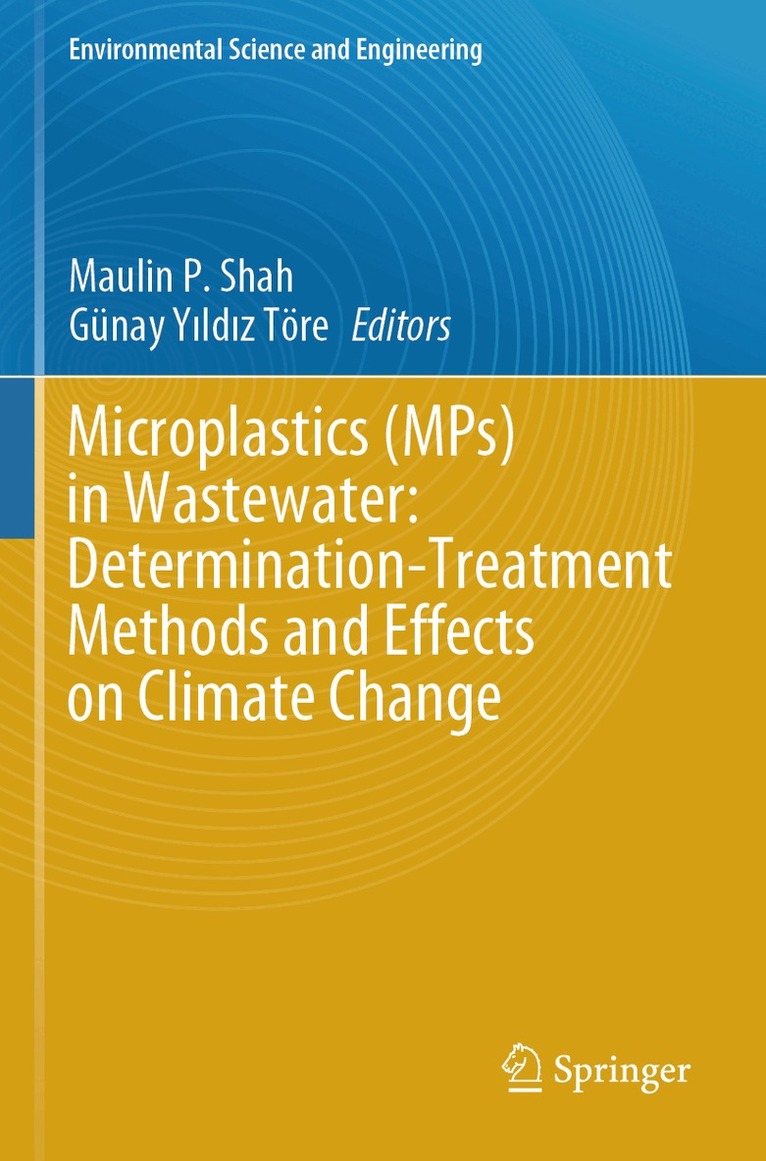
Microplastics (MPs) in Wastewater: Determination-Treatment Methods and Effects on Climate Change
Inbunden, Engelska, 2025
1 695 kr
Skickas inom 10-15 vardagar
This book systematically summarizes the occurrence and source of MPs through various municipal and industrial wastewaters. It covers the type of MPs, its effects on human health and climate, and emerging detection and treatment methods.Plastics are one of the refractory pollutants produced in many and varied forms using chemistry and materials science. Microplastics (MPs), which are formed as a result of plastics breaking down into small pieces, are a new indicator that indicates that the plastic footprint of humans is growing today and this has become a risk for the general living health and sustainable environment. Depending on the point of use, they are either directly released to the air, water, and soil, or they break down into secondary MPs in the environment where they are discharged. Especially by means of domestic wastewater, plenty of MPs enter the sewage system on a daily basis. Therefore, wastewater treatment plants (WWTPs) draw attention as an important source of MP pollution in coastal or surface waters such as sea, lake, and river. There is still a limited number of studies on MPs in the literature and it has become the focus of many researchers around the world.This book mainly focuses on the behavior of microplastics in the wastewaters. The book has 12 chapters and throughout each chapter, it presents the fate and effect of MPs, quantitative and qualitative analyses of MPs in wastewaters and treatment of MPs through conventional and advanced wastewater treatment technologies, effects of MPs on human health and climate change and also evaluates the legal restrictions for MPs pollution in the environment and will also be examined in all details. It also boosts the knowledge of students, researchers, scientists, professors, engineer, and professionals who aspire to work in the field of environmental science, environmental biotechnology, environmental microbiology, civil/environmental engineering, eco-toxicology and other relevant areas of wastewater treatment and management for the safety of environment. In addition to this, the readers of the book can also get the valuable information about the various environmental problems-related climate change and their solutions.