Gunter Berghaus – författare
6 679 kr
Skickas inom 7-10 vardagar
1 052 kr
Läs direkt efter köp
602 kr
Läs direkt efter köp
1 830 kr
Skickas inom 10-15 vardagar
568 kr
Skickas inom 10-15 vardagar
1 960 kr
Skickas inom 3-6 vardagar
1 960 kr
Skickas inom 3-6 vardagar
565 kr
Skickas inom 3-6 vardagar
314 kr
Läs direkt efter köp
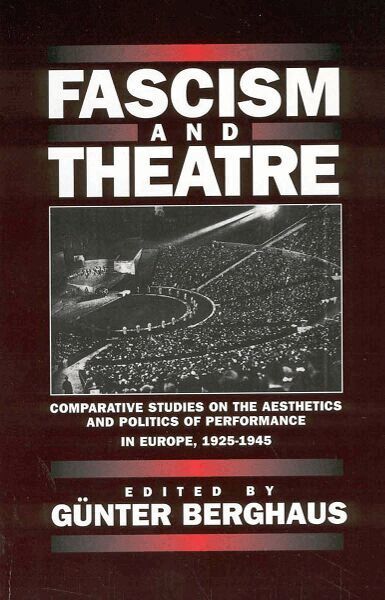
Since the 1920s, an endless flow of studies has analyzed the political systems of fascism, theseizure of power, the nature of the regimes, the atrocities committed, and, finally, the wars waged against other countries. However, much less attention has been paid to the strategies of persuasion employed by the regimes to win over the masses for their cause. Among these, fascist propaganda has traditionally been seen as the key means of influencing public opinion. Only recently has the "fascination with Fascism" become a topic of enquiry that has also formed the guiding interest of this volume: it offers, for the first time, a comparative analysis of the forms and functions of theater in countries governed by fascist or para-fascist regimes. By examining a wide spectrum of theatrical manifestations in a number of States with a varying degree of fascistization, these studies establish some of the similarities and differences between the theatrical cultures of several cultures in the interwar period.
3 343 kr
Skickas inom 5-8 vardagar
2 984 kr
Kommande
2 260 kr
Skickas inom 5-8 vardagar
2 916 kr
Skickas inom 5-8 vardagar
2 951 kr
Läs direkt efter köp
The Handbook of International Futurism is the first reference work ever to presents in a comparative fashion all media and countries in which the movement, initiated by F.T. Marinetti in 1909, exercised a particularly noteworthy influence. The handbook offers a synthesis of the state of scholarship regarding the international radiation of Futurism and its influence in some fifteen artistic disciplines and thirty-eight countries. While acknowledging the great achievements of the movement in the visual and literary arts of Italy and Russia, it treats Futurism as an international, multidisciplinary phenomenon that left a lasting mark on the manifold artistic manifestations of the early twentieth-century avant-garde. Hundreds of artists, who in some phase in their career absorbed Futurist ideas and stylistic devices, are presented in the context of their national traditions, their international connections and the media in which they were predominantly active. The handbook acts as a kind of multi-disciplinary, geographical encyclopaedia of Futurism and gives scholars with varying levels of experience a detailed overview of all countries and disciplines in which the movement had a major impact.
2 382 kr
Skickas inom 5-8 vardagar
2 407 kr
Läs direkt efter köp
The International Yearbook of Futurism Studies was founded in 2009, the centenary year of Italian Futurism, in order to foster intellectual cooperation between Futurism scholars across countries and academic disciplines. The Yearbook does not focus exclusively on Italian Futurism, but on the relations between Italian Futurism and other Futurisms worldwide, on artistic movements inspired by Futurism, and on artists operating in the international sphere with close contacts to Italian or Russian Futurism.
Volume 4 (2014) is an open issue that addresses reactions to Italian Futurism in 16 countries (Argentina, Armenia, Brazil, Egypt, France, Germany, Great Britain, Greece, Holland, Hungary, Japan, Portugal, Russia, Slovenia, Spain, USA), and in the artistic media of photography, theatre and visual poetry.
2 407 kr
Läs direkt efter köp
The International Yearbook of Futurism Studies was founded in 2009, the centenary year of Italian Futurism, in order to foster intellectual cooperation between Futurism scholars across countries and academic disciplines. The Yearbook does not focus exclusively on Italian Futurism, but on the relations between Italian Futurism and other Futurisms worldwide, on artistic movements inspired by Futurism, and on artists operating in the international sphere with close contacts to Italian or Russian Futurism.
Volume 4 (2014) is an open issue that addresses reactions to Italian Futurism in 16 countries (Argentina, Armenia, Brazil, Egypt, France, Germany, Great Britain, Greece, Holland, Hungary, Japan, Portugal, Russia, Slovenia, Spain, USA), and in the artistic media of photography, theatre and visual poetry.
2 951 kr
Läs direkt efter köp
The Handbook of International Futurism is the first reference work ever to presents in a comparative fashion all media and countries in which the movement, initiated by F.T. Marinetti in 1909, exercised a particularly noteworthy influence. The handbook offers a synthesis of the state of scholarship regarding the international radiation of Futurism and its influence in some fifteen artistic disciplines and thirty-eight countries. While acknowledging the great achievements of the movement in the visual and literary arts of Italy and Russia, it treats Futurism as an international, multidisciplinary phenomenon that left a lasting mark on the manifold artistic manifestations of the early twentieth-century avant-garde. Hundreds of artists, who in some phase in their career absorbed Futurist ideas and stylistic devices, are presented in the context of their national traditions, their international connections and the media in which they were predominantly active. The handbook acts as a kind of multi-disciplinary, geographical encyclopaedia of Futurism and gives scholars with varying levels of experience a detailed overview of all countries and disciplines in which the movement had a major impact.
2 382 kr
Skickas inom 5-8 vardagar
2 407 kr
Läs direkt efter köp
The special issue of International Yearbook of Futurism Studies for 2015 will investigate the role of Futurism in the œuvre of a number of Women artists and writers. These include a number of women actively supporting Futurism (e.g. Růžena Zátková, Edyth von Haynau, Olga Rozanova, Eva Kühn), others periodically involved with the movement (e.g. Valentine de Saint Point, Aleksandra Ekster, Mary Swanzy), others again inspired only by certain aspects of the movement (e.g. Natalia Goncharova, Alice Bailly, Giovanna Klien).
Several artists operated on the margins of a Futurist inspired aesthetics, but they felt attracted to Futurism because of its support for women artists or because of its innovatory roles in the social and intellectual spheres. Most of the artists covered in Volume 5 (2015) are far from straightforward cases, but exactly because of this they can offer genuinely new insights into a still largely under-researched domain of twentieth-century art and literature. Guiding questions for these investigations are: How did these women come into contact with Futurist ideas? Was it first-hand knowledge (poems, paintings, manifestos etc) or second-hand knowledge (usually newspaper reports or personal conversions with artists who had been in contact with Futurism)? How did the women respond to the (positive or negative) reports? How did this show up in their œuvre? How did it influence their subsequent, often non-Futurist, career?
2 407 kr
Läs direkt efter köp
The special issue of International Yearbook of Futurism Studies for 2015 will investigate the role of Futurism in the œuvre of a number of Women artists and writers. These include a number of women actively supporting Futurism (e.g. Růžena Zátková, Edyth von Haynau, Olga Rozanova, Eva Kühn), others periodically involved with the movement (e.g. Valentine de Saint Point, Aleksandra Ekster, Mary Swanzy), others again inspired only by certain aspects of the movement (e.g. Natalia Goncharova, Alice Bailly, Giovanna Klien).
Several artists operated on the margins of a Futurist inspired aesthetics, but they felt attracted to Futurism because of its support for women artists or because of its innovatory roles in the social and intellectual spheres. Most of the artists covered in Volume 5 (2015) are far from straightforward cases, but exactly because of this they can offer genuinely new insights into a still largely under-researched domain of twentieth-century art and literature. Guiding questions for these investigations are: How did these women come into contact with Futurist ideas? Was it first-hand knowledge (poems, paintings, manifestos etc) or second-hand knowledge (usually newspaper reports or personal conversions with artists who had been in contact with Futurism)? How did the women respond to the (positive or negative) reports? How did this show up in their œuvre? How did it influence their subsequent, often non-Futurist, career?
2 014 kr
Skickas inom 5-8 vardagar
2 218 kr
Skickas inom 5-8 vardagar
2 382 kr
Skickas inom 5-8 vardagar
2 263 kr
Läs direkt efter köp
Volume 6 (2016) is an open issue with an emphasis on Nordic countries (Denmark, Finland, Lithuania, Estonia, Iceland). Four essays focus on Russia, two on music; other contributions are concerned with Egypt, USA and Korea. Furthermore there are sections on Futurist archives, Futurism in caricatures and Futurism in fiction.
2 263 kr
Läs direkt efter köp
Volume 6 (2016) is an open issue with an emphasis on Nordic countries (Denmark, Finland, Lithuania, Estonia, Iceland). Four essays focus on Russia, two on music; other contributions are concerned with Egypt, USA and Korea. Furthermore there are sections on Futurist archives, Futurism in caricatures and Futurism in fiction.
2 403 kr
Skickas inom 5-8 vardagar
2 263 kr
Läs direkt efter köp
The eighth volume of the International Yearbook of Futurism Studies is again an open issue and presents in its first section new research into the international impact of Futurism on artists and artistic movements in France, GreatBritain, Hungary and Sweden. This is followed by a study that investigates a variety of Futurist inspired developments in architecture, and an essay that demonstrates that the Futurist heritage was far from forgotten after the Second World War. These papers show how a wealth of connections linked Futurism with Archigram, Metabolism, Archizoom and Deconstructivism, as well as the Nuclear Art movement, Spatialism, Environmental Art, Neon Art, Kinetic Art and many other trends of the 1960s and 70s.
The second section focuses on Futurism and Science and contains a number of papers that were first presented atthe fifth bi-annual conference of the European Network for Avant-Garde and Modernism Studies (EAM), held on 1–3 June 2016 in Rennes. They investigate the impact of science on Futurist aesthetics and the Futurist quest for a new perception and rational understanding of the world, as well as the movement’s connection with the esoteric domain, especially in the field of theosophy, the Hermetic tradition, Gnostic mysticism and a whole phalanx of Spiritualist beliefs.
The Archive section offers a survey of collections and archives in Northern Italy that are concerned with Futurist ceramics, and a report on the Fondazione Primo Conti in Fiesole, established in April 1980 as a museum, library and archive devoted to the documentation of the international avant-garde, and to Italian Futurism in particular.
A review section dedicated to exhibitions, conferences and publications is followed by an annual bibliography of international Futurism studies, exhibition catalogues, special issues of periodicals and new editions.
2 263 kr
Läs direkt efter köp
The eighth volume of the International Yearbook of Futurism Studies is again an open issue and presents in its first section new research into the international impact of Futurism on artists and artistic movements in France, GreatBritain, Hungary and Sweden. This is followed by a study that investigates a variety of Futurist inspired developments in architecture, and an essay that demonstrates that the Futurist heritage was far from forgotten after the Second World War. These papers show how a wealth of connections linked Futurism with Archigram, Metabolism, Archizoom and Deconstructivism, as well as the Nuclear Art movement, Spatialism, Environmental Art, Neon Art, Kinetic Art and many other trends of the 1960s and 70s.
The second section focuses on Futurism and Science and contains a number of papers that were first presented atthe fifth bi-annual conference of the European Network for Avant-Garde and Modernism Studies (EAM), held on 1–3 June 2016 in Rennes. They investigate the impact of science on Futurist aesthetics and the Futurist quest for a new perception and rational understanding of the world, as well as the movement’s connection with the esoteric domain, especially in the field of theosophy, the Hermetic tradition, Gnostic mysticism and a whole phalanx of Spiritualist beliefs.
The Archive section offers a survey of collections and archives in Northern Italy that are concerned with Futurist ceramics, and a report on the Fondazione Primo Conti in Fiesole, established in April 1980 as a museum, library and archive devoted to the documentation of the international avant-garde, and to Italian Futurism in particular.
A review section dedicated to exhibitions, conferences and publications is followed by an annual bibliography of international Futurism studies, exhibition catalogues, special issues of periodicals and new editions.
2 382 kr
Skickas inom 5-8 vardagar