Gunter Bolch - Böcker
Visar alla böcker från författaren Gunter Bolch. Handla med fri frakt och snabb leverans.
5 produkter
5 produkter
Queueing Networks and Markov Chains
Modeling and Performance Evaluation with Computer Science Applications
Inbunden, Engelska, 2006
2 332 kr
Skickas inom 5-8 vardagar
Critically acclaimed text for computer performance analysis--now in its second edition The Second Edition of this now-classic text provides a current and thorough treatment of queueing systems, queueing networks, continuous and discrete-time Markov chains, and simulation. Thoroughly updated with new content, as well as new problems and worked examples, the text offers readers both the theory and practical guidance needed to conduct performance and reliability evaluations of computer, communication, and manufacturing systems. Starting with basic probability theory, the text sets the foundation for the more complicated topics of queueing networks and Markov chains, using applications and examples to illustrate key points. Designed to engage the reader and build practical performance analysis skills, the text features a wealth of problems that mirror actual industry challenges. New features of the Second Edition include:* Chapter examining simulation methods and applications* Performance analysis applications for wireless, Internet, J2EE, and Kanban systems* Latest material on non-Markovian and fluid stochastic Petri nets, as well as solution techniques for Markov regenerative processes* Updated discussions of new and popular performance analysis tools, including ns-2 and OPNET* New and current real-world examples, including DiffServ routers in the Internet and cellular mobile networks With the rapidly growing complexity of computer and communication systems, the need for this text, which expertly mixes theory and practice, is tremendous. Graduate and advanced undergraduate students in computer science will find the extensive use of examples and problems to be vital in mastering both the basics and the fine points of the field, while industry professionals will find the text essential for developing systems that comply with industry standards and regulations.
1 638 kr
Skickas inom 10-15 vardagar
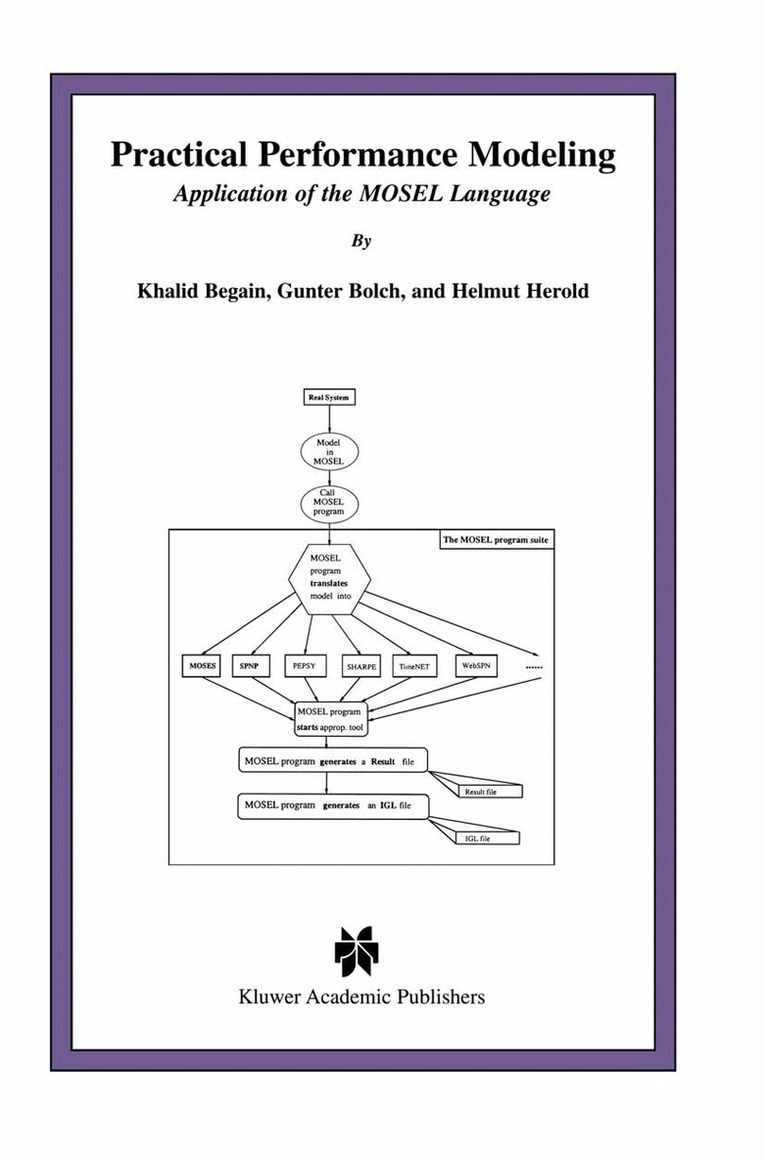
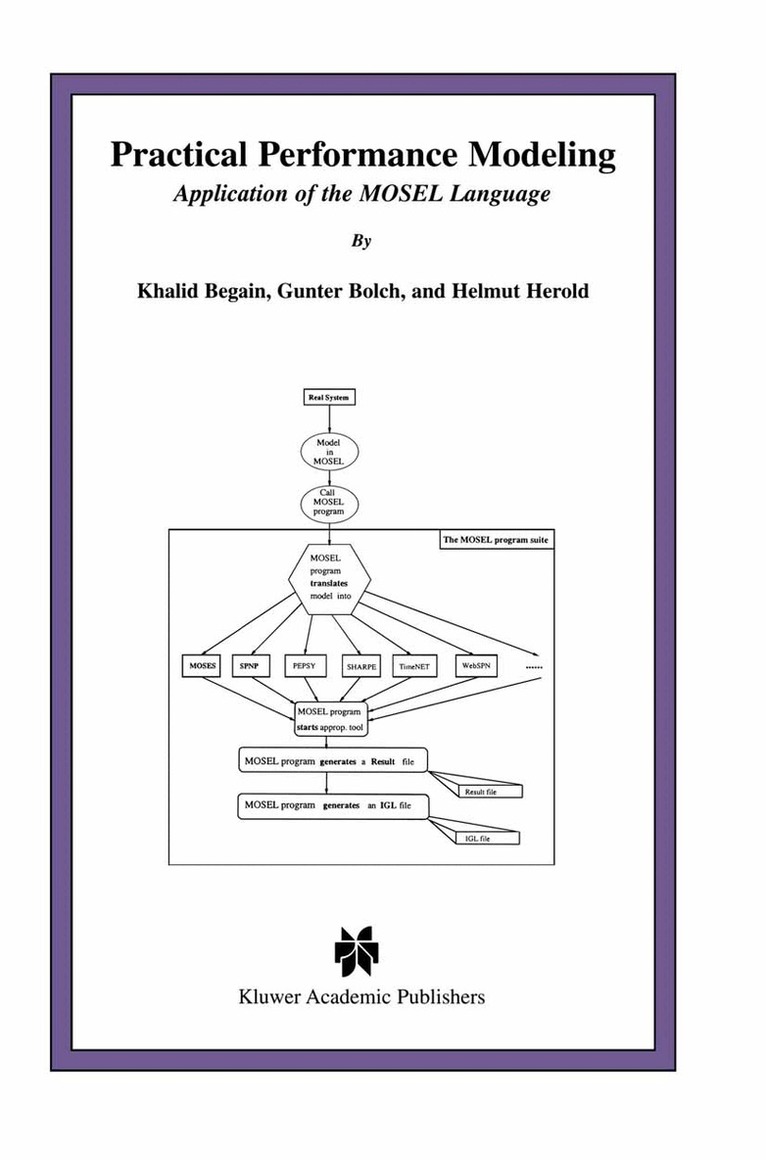
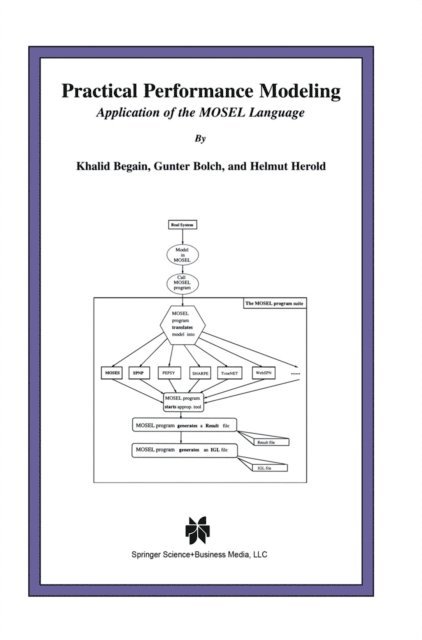
This text introduces the new and powerful performance and reliability modelling language MOSEL (MOdelling, Specification and Evaluation Language), developed at the University of Erlangen, Germany. MOSEL facilitates the performance and reliability modeling of a computer, communication, manufacturing or workflow management system in a very intuitive and simple way. The core of MOSEL consists of constructs to specify the possible states and state transitions of the system under consideration. This specification is very compact and easy to understand. With additional constructs, the interesting performance or reliability measures and graphical representations can be specified. With some experience, it is possible to write down the MOSEL description of a system immediately only by knowing the behavior of the system under study. There are no restrictions, unlike models using, for example, queueing networks, Petri nets or fault trees. MOSEL fulfills all the requirements for a universal modelling language. It is high level, system-oriented, and usable. It is open and can be integrated with many tools.By providing compilers, which translate descriptions specified in MOSEL into the tool-specific languages, all previously implemented tools with their different methods and algorithms (including simulation) can be used. This book provides an easy to understand but nevertheless complete introduction to system modelling using MOSEL and illustrates how easily MOSEL can be used for modeling real-life examples from the fields of computer, communication, and manufacturing systems.
1 624 kr
Skickas inom 10-15 vardagar
Practical Performance Modeling: Application of the MOSEL Language introduces the new and powerful performance and reliability modeling language MOSEL (MOdeling, Specification and Evaluation Language), developed at the University of Erlangen, Germany. MOSEL facilitates the performance and reliability modeling of a computer, communication, manufacturing or workflow management system in a very intuitive and simple way. The core of MOSEL consists of constructs to specify the possible states and state transitions of the system under consideration. This specification is very compact and easy to understand. With additional constructs, the interesting performance or reliability measures and graphical representations can be specified. With some experience, it is possible to write down the MOSEL description of a system immediately only by knowing the behavior of the system under study. There are no restrictions, unlike models using, for example, queueing networks, Petri nets or fault trees. MOSEL fulfills all the requirements for a universal modeling language. It is high level, system-oriented, and usable. It is open and can be integrated with many tools. By providing compilers, which translate descriptions specified in MOSEL into the tool-specific languages, all previously implemented tools with their different methods and algorithms (including simulation) can be used. Practical Performance Modeling: Application of the MOSEL Language provides an easy to understand but nevertheless complete introduction to system modeling using MOSEL and illustrates how easily MOSEL can be used for modeling real-life examples from the fields of computer, communication, and manufacturing systems. Practical Performance Modeling: Application of the MOSEL Language will be of interest to professionals and students in the fields of performance and reliability modeling in computer science, communication, and manufacturing. It is also well suited as a textbook for university courses covering performance and reliability modeling with practical applications.
Analyse von Rechensystemen
Analytische Methoden zur Leistungsbewertung und Leistungsvorhersage
Häftad, Tyska, 1982
505 kr
Skickas inom 10-15 vardagar
Die zunehmende Bedeutung der Leistungsbewertung von Rechensystemen auf der Basis von Warteschlangenmodellen und die Vielzahl der hier zu existierenden, zum Teil komplexen analytischen Methoden haben uns veranlaßt, dieses Buch zu schreiben. Es ist aus einer Vorlesung entstanden, die der eine der bei den Autoren seit 1976 an der Uni versität Erlangen-Nürnberg bzw. an der katholischen Universität von Rio de Janeiro gehalten hat und aus einem internen Arbeitsbe richt der bei den Autoren aus dem Jahre 1981. Das Ziel des Buches besteht darin, eine systematische Einführung in diese analytischen Methoden zu geben und dem Leser dazu einen leichten Einstieg zu ermöglichen. Um dies zu erreichen, wurden alle Methoden an bewußt einfach gehaltenen Beispielen ausführlich erläutert. Wo Beweise und Herleitungen notwendig schienen, sind diese deutlich gekennzeichnet. Dadurch ist es möglich, sich zu nächst nur mit der reinen Anwendung der Methoden zu befassen und davon ausgehend später die Kenntnisse zu vertiefen, wofür auch das umfangreiche aktuelle Literaturverzeichnis dienen kann. Ebenso haben wir bei der exakten Analyse in Abschnitt 4.1 vorbereitend auf Abschnitt 4.2 einige einfache Verfahren eingeführt, obwohl diese als Spezialfall in der in Abschnitt 4.2 beschriebenen Metho de enthalten sind. Das Buch wendet sich besonders an Informatikstudenten höherer Se mester, aber auch an Fachleute aus der Industrie, die sich mit dem Entwurf und der Bewertung von Rechensystemen befassen. Es werden Grundkenntnisse in der Wahrscheinlichkeitstheorie und Informatik vorausgesetzt.
505 kr
Skickas inom 10-15 vardagar