Günter Radden - Böcker
Visar alla böcker från författaren Günter Radden. Handla med fri frakt och snabb leverans.
3 produkter
3 produkter
2 747 kr
Skickas inom 7-10 vardagar
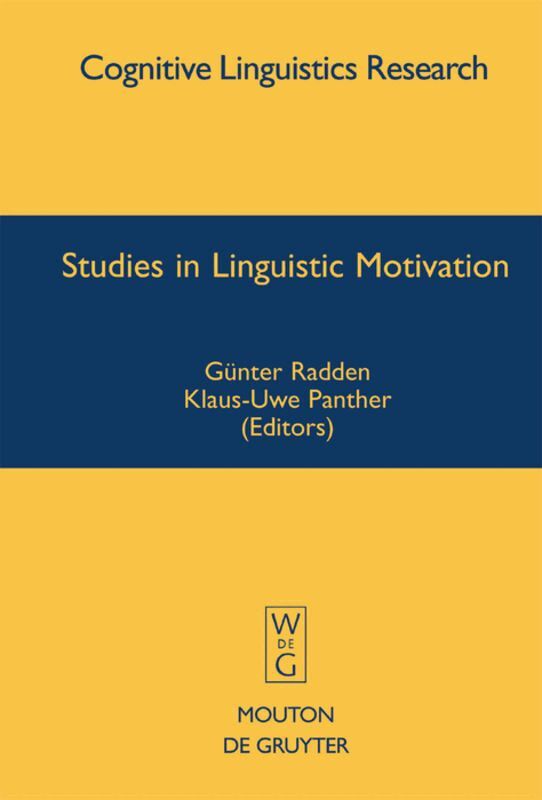
How much of language is motivated? Recently, cognitive and functional linguists have proposed new solutions to this intriguing question. The thirteen articles collected in this volume cover various aspects of motivation in grammar and in the lexicon.The phenomena discussed in the contributions can be grouped into four types of motivation, which, along with other types, are explicated in the introductory chapter: ecological motivation, i.e. motivation of a linguistic unit due to its place, or "ecological niche," within a system; genetic motivation, i.e. motivation of present-day linguistic behavior or structure due to historical factors; experiential motivation, i.e. motivation that is based on embodied experience; and cognitive motivation, i.e. motivation that is based on human knowledge and cognitive operations such as metonymy and metaphor. The languages studied in some detail include Afrikaans, Croatian, Dutch, English, French, German, Hausa, and Hungarian. This volume makes a strong case for the pervasiveness of motivation in natural language. It will be of interest to teachers, researchers and students of linguistics, especially of functional and cognitive linguistics.
1 555 kr
Skickas inom 7-10 vardagar
In the past two decades, the study of prepositions has grown steadily. The papers collected in this volume bring together the multifaceted perspectives on prepositions that have been developed in contemporary linguistics. Some papers mainly discuss syntactic (and morphological) aspects of prepositions; other papers predominantly focus on cognitive aspects. All the papers are, however, concerned with the semantics of prepositions. This volume evolved from a workshop on prepositions held at Hamburg University on June 26 and 27, 1998.
426 kr
Skickas
Cognitive English Grammar is designed to be used as a textbook in courses of English and general linguistics. It introduces the reader to cognitive linguistic theory and shows that Cognitive Grammar helps us to gain a better understanding of the grammar of English. The notions of motivation and meaningfulness are central to the approach adopted in the book. In four major parts comprising 12 chapters, Cognitive English Grammar integrates recent cognitive approaches into one coherent model, allowing the analysis of the most central constructions of English. Part I presents the cognitive framework: conceptual and linguistic categories, their combination in situations, the cognitive operations applied to them, and the organisation of conceptual structures into linguistic constructions. Part II deals with the category of ‘things’ and their linguistic structuring as nouns and noun phrases. It shows how things are grounded in reality by means of reference, quantified by set and scalar quantifiers, and qualified by modifiers. Part III describes situations as temporal units of various layers: internally, as types of situations; and externally, as located relative to the time of speech and grounded in reality or potentiality. Part IV looks at situations as relational units and their structuring as sentences. Its two chapters are devoted to event schemas and space and metaphorical extensions of space.Cognitive English Grammaroffers a wealth of linguistic data and explanations. The didactic quality is guaranteed by the frequent use of definitions and examples, a glossary of the terms used, overviews and chapter summaries, suggestions for further reading, and study questions. For the Key to Study Questions click here.