Guy Bradley - Böcker
Visar alla böcker från författaren Guy Bradley. Handla med fri frakt och snabb leverans.
5 produkter
5 produkter
Ancient Umbria
State, Culture, and Identity in Central Italy from the Iron Age to the Augustan Era
Inbunden, Engelska, 2000
2 797 kr
Skickas inom 5-8 vardagar
How should we understand the ways in which the regions of Italy were affected by Roman imperialism? This book, which is the first full-scale treatment of ancient Umbria in any language, takes a balanced view of the region's history in the first millennium BC, focusing on local actions and motivations as much as the effect of outside influences and Roman policies. Through a careful reading of all the types of evidence it provides an important challenge to traditional treatments emphasising the 'Romanization' of the region, arguing that this is a poor explanation for the complexity of local societies in the late Republican period. Instead it proposes that other trends, particularly the organization of states, help to explain the fascinating plurality of identities that are evident in the imperial period and allow us to appreciate the diversity of local societies that emerged in both mountain and lowland areas of Umbria.
1 822 kr
Skickas inom 7-10 vardagar
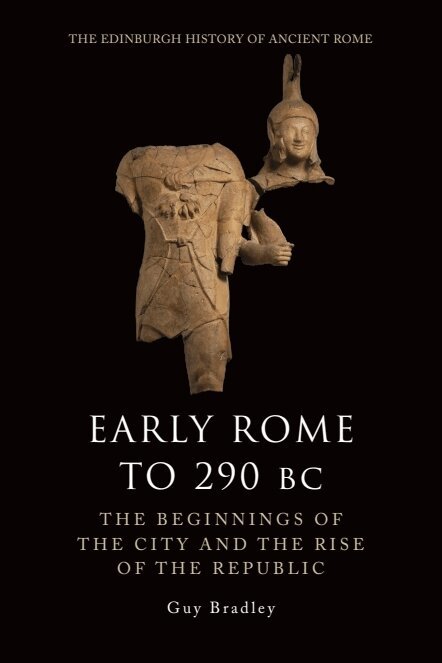
A new view of early Rome as a highly mobile society within a wider interconnected Mediterranean networkCovers the rise of Rome from small scale community to supremacy in central ItalyUses the latest archaeological evidence to demonstrate the sophisticated and cosmopolitan nature of early RomeAnalyses the origins of Rome's Republican form of government and of its aggressive drive to conquerIn the first few centuries of its existence, Rome developed from a minor settlement on the Tiber into the most powerful city-state in Italy. Guy Bradley examines the reasons for Rome's emergence and success within a highly competitive Italian environment, and how much it owed to its neighbours. He explains how many of Rome's key characteristics, such as its powerful ruling elite, its stable political institutions, its openness to outsiders, and its intensely militaristic society, were shaped by their origins in the monarchy and early Republic.
414 kr
Skickas
A new view of early Rome as a highly mobile society within a wider interconnected Mediterranean networkCovers the rise of Rome from small scale community to supremacy in central ItalyUses the latest archaeological evidence to demonstrate the sophisticated and cosmopolitan nature of early RomeAnalyses the origins of Rome's Republican form of government and of its aggressive drive to conquerIn the first few centuries of its existence, Rome developed from a minor settlement on the Tiber into the most powerful city-state in Italy. Guy Bradley examines the reasons for Rome's emergence and success within a highly competitive Italian environment, and how much it owed to its neighbours. He explains how many of Rome's key characteristics, such as its powerful ruling elite, its stable political institutions, its openness to outsiders, and its intensely militaristic society, were shaped by their origins in the monarchy and early Republic.
2 492 kr
Skickas inom 3-6 vardagar
This collection of essays focuses on the peoples and communities of ancient, and mainly pre-Roman Italy. Alongside the Etruscans, a range of less well-known ancient peoples of the Italian peninsula are increasingly coming into focus, and it is now possible to write the history of these communities; a history that led eventually to the formation of Roman Italy and ultimately of the Roman empire. 'Ancient Italy' consists of a series of studies, covering the Ligurians and Celts in north-west Italy, the Veneti, Picenes, the Etruscans, the Faliscans, the Latins, the Samnites, the peoples of Campania and the peoples of south-east Italy. Each essay provides a brief introduction to the region and its communities, a summary of recent scholarship and a map showing the location of significant sites, and then goes on to bring out the key issues raised by the most recent research within that region. The book addresses themes in the study of the ancient world: settlement and landscape; identity; religious and funerary ritual; elite stratification and display; social and cultural interaction drawing on evidence from archaeological excavation and survey, numismatics, epigraphy and literature. Designed to be an important tool for researchers working on the ancient Mediterranean, it is also accessible to undergraduates, providing a starting point for anyone interested in the peoples of Ancient Italy.
3 995 kr
Skickas inom 5-8 vardagar
Although there are many studies of certain individual ancient Italic groups (e.g. the Etruscans, Gauls and Latins), there is no work that takes a comprehensive view of each of them—the famous and the less well-known—that existed in Iron Age and Roman Italy. Moreover, many previous studies have focused only on the material evidence for these groups or on what the literary sources have to say about them.This handbook is conceived of as a resource for archaeologists, historians, philologists and other scholars interested in finding out more about Italic groups from the earliest period they are detectable (early Iron Age, in most instances), down to the time when they begin to assimilate into the Roman state (in the late Republican or early Imperial period). As such, it will endeavor to include both archaeological and historical perspectives on each group, with contributions from the best-known or up-and-coming archaeologists and historians for these peoples and topics. The language of the volume is English, but scholars from around the world have contributed to it. This volume covers the ancient peoples of Italy more comprehensively in individual chapters, and it is also distinct because it has a thematic section.