G.W. Stewart – författare
Visar alla böcker från författaren G.W. Stewart. Handla med fri frakt och snabb leverans.
6 produkter
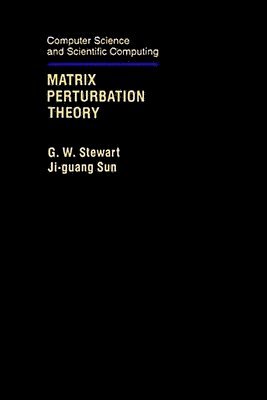
Matrix Perturbation Theory
Av G. W. Stewart, Ji-guang Sun m. fl.
Inbunden, 1990
1547 kr
Lägg i varukorg
This book is a comprehensive survey of matrix perturbation theory, a topic of interest to numerical analysts, statisticians, physical scientists, and engineers. In particular, the authors cover perturbation theory of linear systems and least square problems, the eignevalue problem, and the …
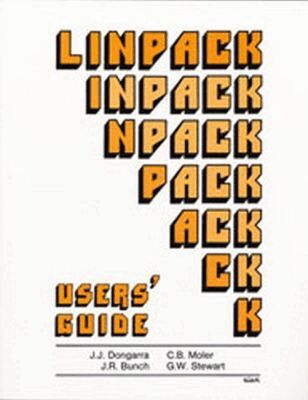
LINPACK Users' Guide
Av J.J. Dongarra, J.R. Bunch m. fl.
Häftad, 1987
1030 kr
Lägg i varukorg
The authors of this carefully-structured guide are the principal developers of LINPACK, a unique package of Fortran subroutines for analyzing and solving various systems of simultaneous linear algebraic equations and linear least squares problems.This guide supports both the casual user of LINPACK …
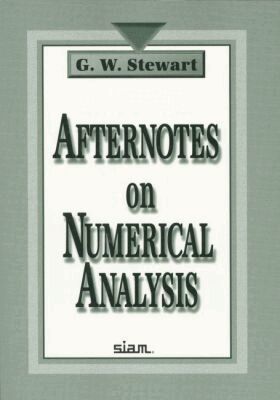
Afternotes on Numerical Analysis
Av G.W. Stewart
Häftad, 1996
818 kr
Lägg i varukorg
This book presents the central ideas of modern numerical analysis in a vivid and straightforward fashion with a minimum of fuss and formality. Stewart designed this volume while teaching an upper-division course in introductory numerical analysis. To clarify what he was teaching, he wrote down each …
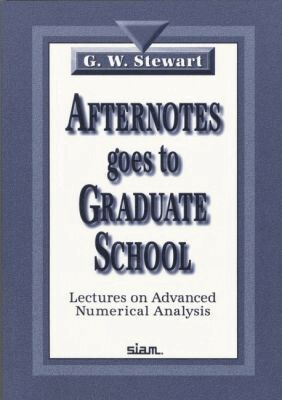
Afternotes Goes to Graduate School
Lectures on Advanced Numerical Analysis
Av G.W. Stewart
Häftad, 1998
888 kr
Lägg i varukorg
In this follow-up to Afternotes on Numerical Analysis (SIAM, 1996) the author continues to bring the immediacy of the classroom to the printed page. Like the original undergraduate volume, Afternotes goes to Graduate School is the result of the author writing down his notes immediately after giving …
Matrix Algorithms, Volume I
Basic Decompositions
Av G.W. Stewart
Häftad, 1998
958 kr
Lägg i varukorg
This thorough, concise, and superbly written volume is the first in a self-contained five-volume series devoted to matrix algorithms. It focuses on the computation of matrix decompositions—that is, the factorization of matrices into products of similar ones.The first two chapters provide the …
Matrix Algorithms, Volume II
Eigensystems
Av G.W. Stewart
Häftad, 2001
1028 kr
Lägg i varukorg
This book is the second volume in a projected five-volume survey of numerical linear algebra and matrix algorithms. This volume treats the numerical solution of dense and large-scale eigenvalue problems with an emphasis on algorithms and the theoretical background required to understand them. …