Gyorgy Markus – författare
Visar alla böcker från författaren Gyorgy Markus. Handla med fri frakt och snabb leverans.
3 produkter
3 produkter
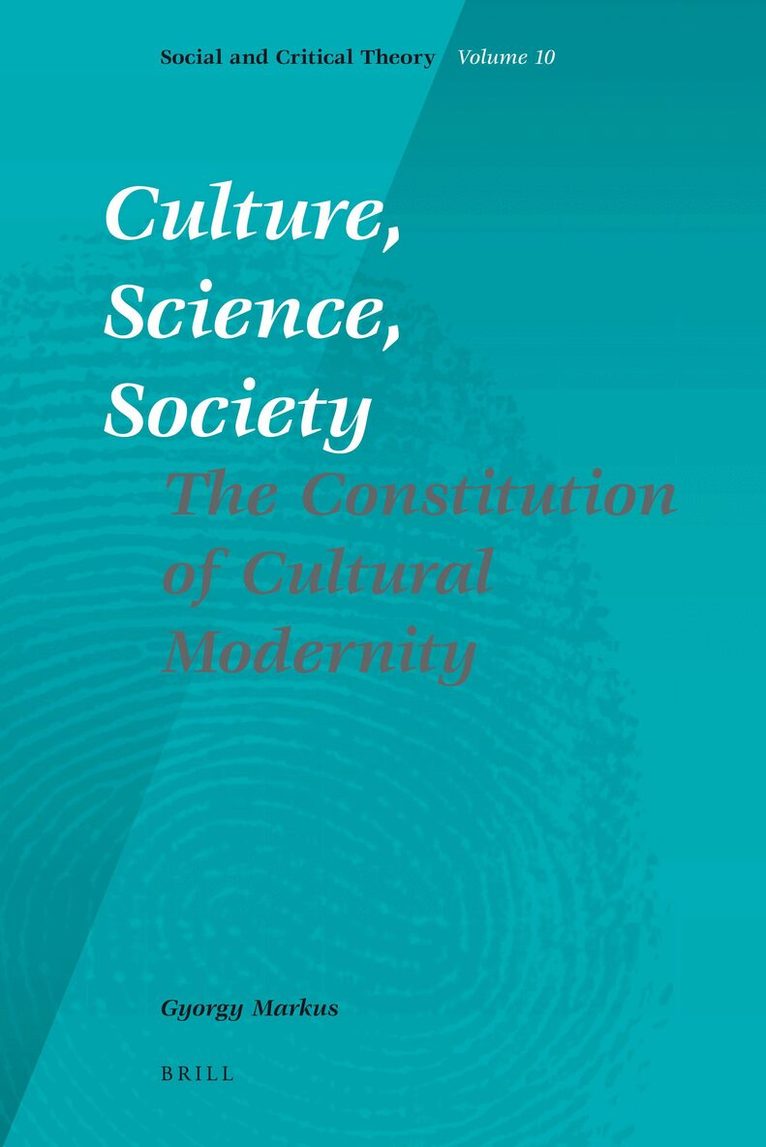
Del 10 - Social and Critical Theory
Culture, Science, Society
The Constitution of Cultural Modernity
Inbunden, Engelska, 2011
4 738 kr
Skickas inom 3-6 vardagar
The closely interrelated essays in this volume address the question of the internal dynamism of the high culture of modernity in its paradoxical constitution as the complementary unity of strict opposites: the sciences (philosophy included) and the arts. Special attention is paid to the internal strains of these two great fields in our contemporaneity. It discusses on the one hand the role of experts and, on the other, that of the market in both of these areas . It also deals with the hermeneutical relationship between author - work - recipient and its historical transformations.Although essays deal with the complex philosophical issues, these are discussed in a clear way, approcheable for a person with a broad philosophical interest. They are, however, addressed primarily to philosophers, social scientists, culturologists and aestheticians.
1 066 kr
Skickas inom 10-15 vardagar
In Language and Production, Gyorgy Markus presents us with a pro found critique of contemporary social theory: of the philosophy and methodology of the social sciences; of the philosophy of language; of hermeneutics and critical theory; and finally, of Marx and of Marxisms. The sweep of Markus' project is complemented by the extraordinary detail of his analysis and the elaborately developed argument which gives the work its clear logical structure: it is a dialectical work. Markus begins with a critique of the paradigm of language and of that scientific ra tionality modeled on language, as frameworks for the understanding of social reality, and for a rational 'science of society' . After revealing what he takes to be the essential failure of that paradigm in its positivist ver sion (in the work of Sir Karl Popper, who, he argues, remains within the positivist framework despite his differences with other positivists) - Markus examines the alternative interpretations of that paradigm in the hermeneutic tradition from Dilthey through Heidegger and Gadamer, and then in the structural anthropology of Claude Levi-Strauss and in the philosophy of language of Ludwig Wittgenstein. In all of these approaches, Markus sees a systematic flaw in the at tempt to frame human action as one or another form of linguistic prac tice, or even to read human self-constitution as essentially linguistic.
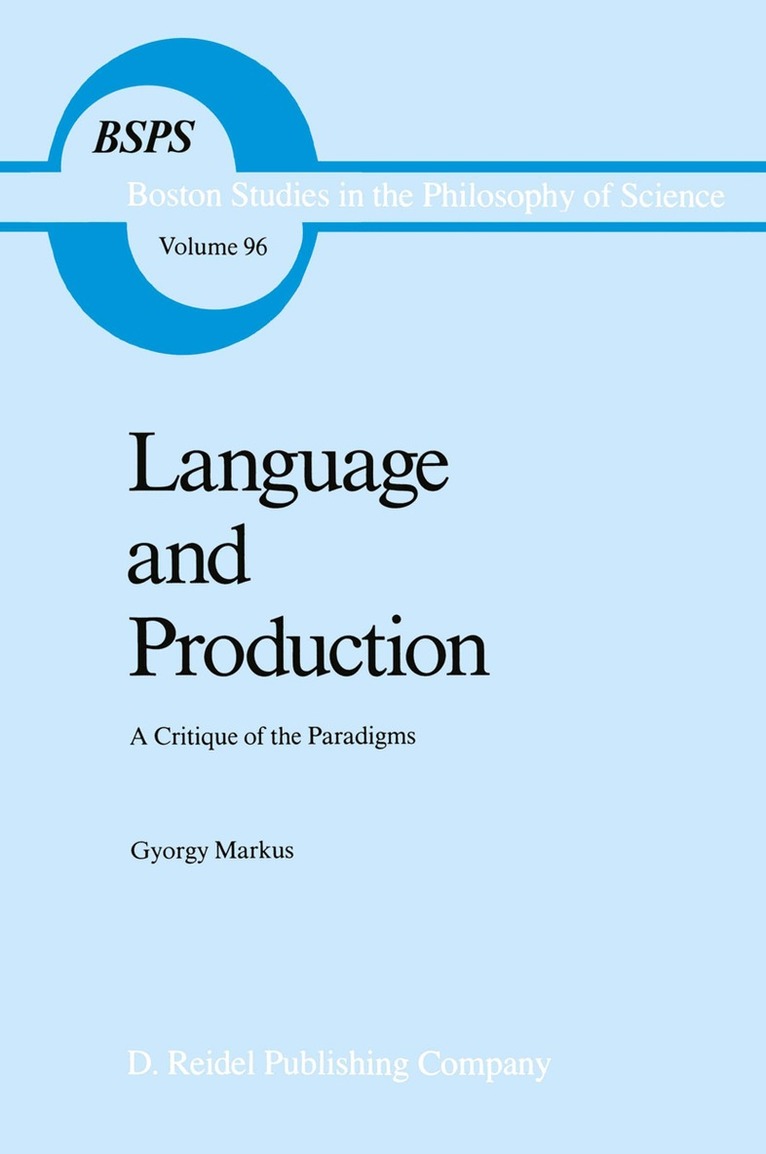
Del 96 - Boston Studies in the Philosophy and History of Science
Language and Production
A Critique of the Paradigms
Häftad, Engelska, 2011
1 066 kr
Skickas inom 10-15 vardagar
In Language and Production, Gyorgy Markus presents us with a pro found critique of contemporary social theory: of the philosophy and methodology of the social sciences; of the philosophy of language; of hermeneutics and critical theory; and finally, of Marx and of Marxisms. The sweep of Markus' project is complemented by the extraordinary detail of his analysis and the elaborately developed argument which gives the work its clear logical structure: it is a dialectical work. Markus begins with a critique of the paradigm of language and of that scientific ra tionality modeled on language, as frameworks for the understanding of social reality, and for a rational 'science of society' . After revealing what he takes to be the essential failure of that paradigm in its positivist ver sion (in the work of Sir Karl Popper, who, he argues, remains within the positivist framework despite his differences with other positivists) - Markus examines the alternative interpretations of that paradigm in the hermeneutic tradition from Dilthey through Heidegger and Gadamer, and then in the structural anthropology of Claude Levi-Strauss and in the philosophy of language of Ludwig Wittgenstein. In all of these approaches, Markus sees a systematic flaw in the at tempt to frame human action as one or another form of linguistic prac tice, or even to read human self-constitution as essentially linguistic.