H. Fritzsch – författare
Visar alla böcker från författaren . Handla med fri frakt och snabb leverans.
5 produkter
5 produkter
Inbunden, Engelska, 1985
2 479 kr
Skickas inom 10-15 vardagar
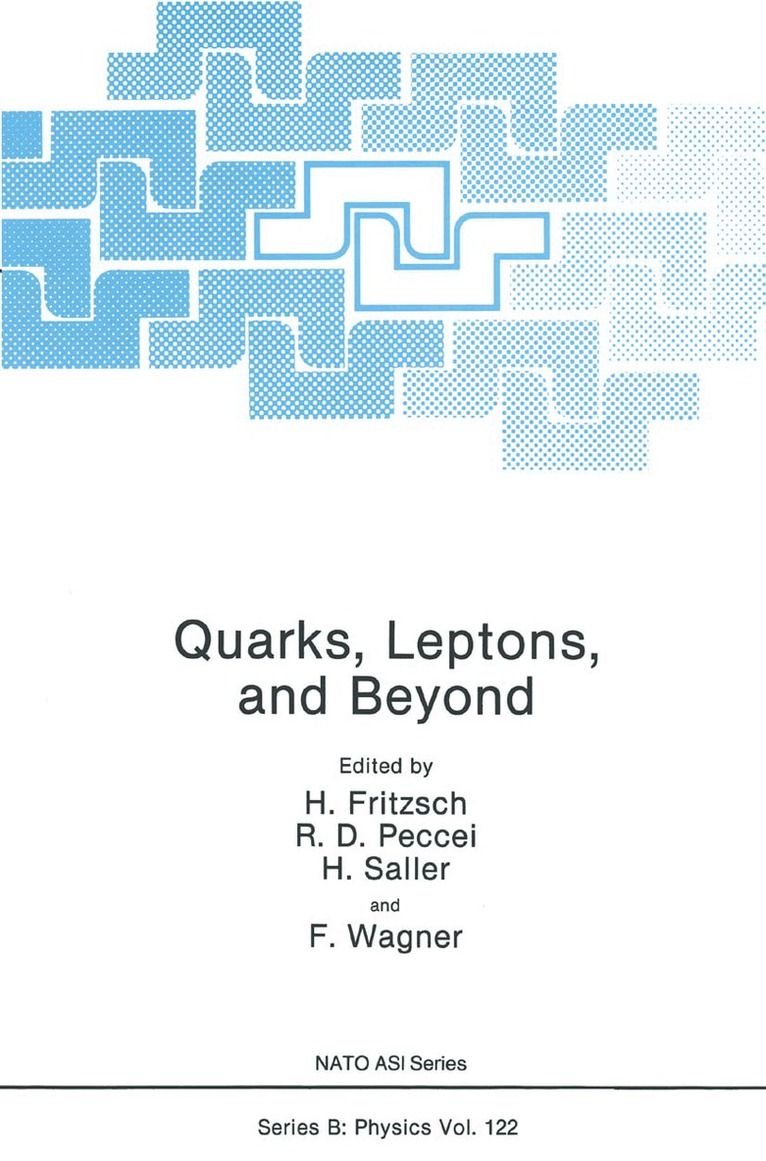
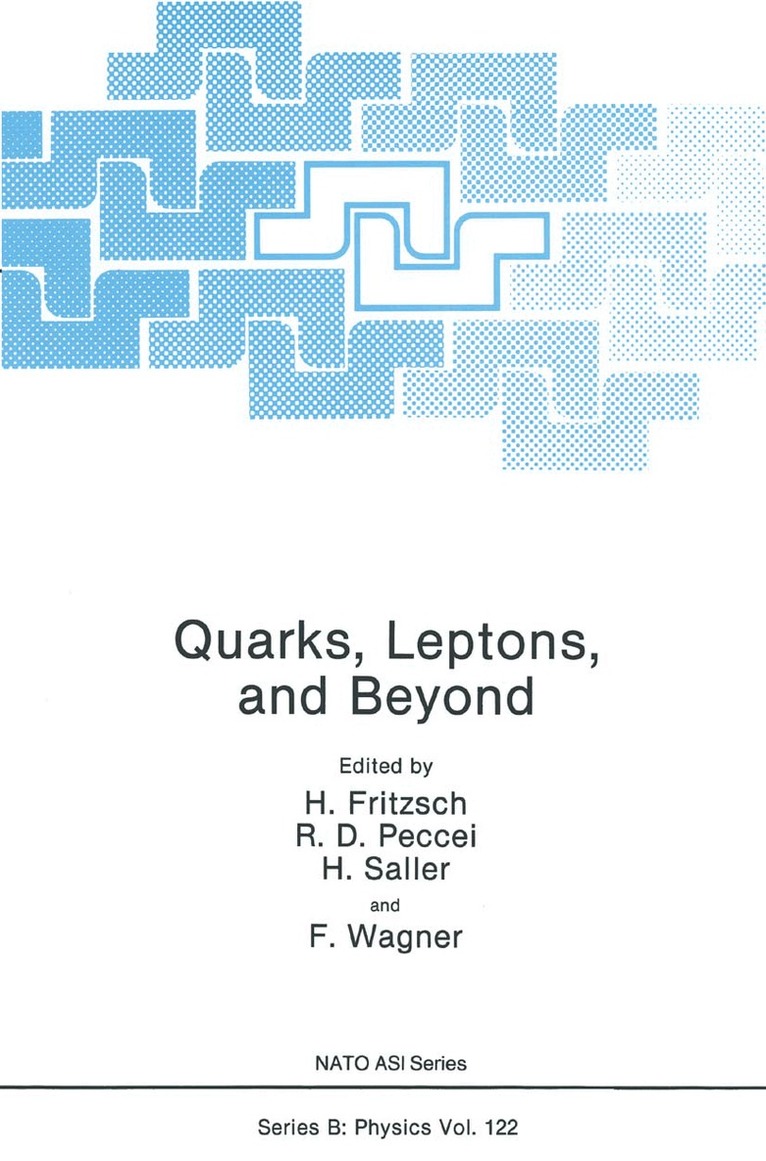
The ASI Quarks, Leptons and Beyond, held in Munich from the 5th to the 16th of September 1983 was dedicated to the study of what we now believe are the fundamental building blocks of nature: quarks and leptons. The subject was approached on two levels. On the one hand, a thorough discussion was given of the status of our knowledge of quarks and leptons and their interactions, both from an experi mental and a theoretical standpoint. On the other hand, open problems presented by the so called standard model of quark and lepton interact ions were explored along various ways that lead one beyond this frame work. One of the principal predictions of the standard model is that weak interactions are mediated by heavy Wand Z vector bosons. These particles were discovered in 1983 at CERN and their relevant proper ties were discussed at the ASI by C. Rubbia. Further theoretical predictions concerning these Z and W bosons, yet to be checked by future experimentation, were discussed by G. Altarelli with a view of seeing where the standard model might fail and new physics ensue. The strong interactions of quarks, based on Quantum Chromodynamics (QeD), are presumed to cause the quarks to bind into hadrons. Pro gress in attempts to calculate the observed hadronic spectrum, ab initio, starting from QCD and employing lattice methods were reviewed at the ASI by P. Hasenfratz.
E-bok
PDF, Engelska, 20133 148 kr
Läs direkt efter köp
The ASI Quarks, Leptons and Beyond, held in Munich from the 5th to the 16th of September 1983 was dedicated to the study of what we now believe are the fundamental building blocks of nature: quarks and leptons. The subject was approached on two levels. On the one hand, a thorough discussion was given of the status of our knowledge of quarks and leptons and their interactions, both from an experi mental and a theoretical standpoint. On the other hand, open problems presented by the so called standard model of quark and lepton interact ions were explored along various ways that lead one beyond this frame work. One of the principal predictions of the standard model is that weak interactions are mediated by heavy Wand Z vector bosons. These particles were discovered in 1983 at CERN and their relevant proper ties were discussed at the ASI by C. Rubbia. Further theoretical predictions concerning these Z and W bosons, yet to be checked by future experimentation, were discussed by G. Altarelli with a view of seeing where the standard model might fail and new physics ensue. The strong interactions of quarks, based on Quantum Chromodynamics (QeD), are presumed to cause the quarks to bind into hadrons. Pro gress in attempts to calculate the observed hadronic spectrum, ab initio, starting from QCD and employing lattice methods were reviewed at the ASI by P. Hasenfratz.
Häftad, Engelska, 2013
2 479 kr
Skickas inom 10-15 vardagar
The ASI Quarks, Leptons and Beyond, held in Munich from the 5th to the 16th of September 1983 was dedicated to the study of what we now believe are the fundamental building blocks of nature: quarks and leptons. The subject was approached on two levels. On the one hand, a thorough discussion was given of the status of our knowledge of quarks and leptons and their interactions, both from an experi mental and a theoretical standpoint. On the other hand, open problems presented by the so called standard model of quark and lepton interact ions were explored along various ways that lead one beyond this frame work. One of the principal predictions of the standard model is that weak interactions are mediated by heavy Wand Z vector bosons. These particles were discovered in 1983 at CERN and their relevant proper ties were discussed at the ASI by C. Rubbia. Further theoretical predictions concerning these Z and W bosons, yet to be checked by future experimentation, were discussed by G. Altarelli with a view of seeing where the standard model might fail and new physics ensue. The strong interactions of quarks, based on Quantum Chromodynamics (QeD), are presumed to cause the quarks to bind into hadrons. Pro gress in attempts to calculate the observed hadronic spectrum, ab initio, starting from QCD and employing lattice methods were reviewed at the ASI by P. Hasenfratz.
Inbunden, Engelska, 2010
3 598 kr
Skickas inom 3-6 vardagar
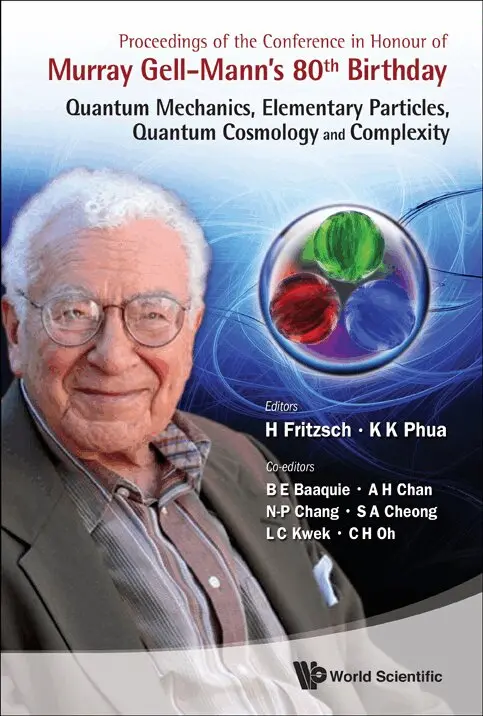
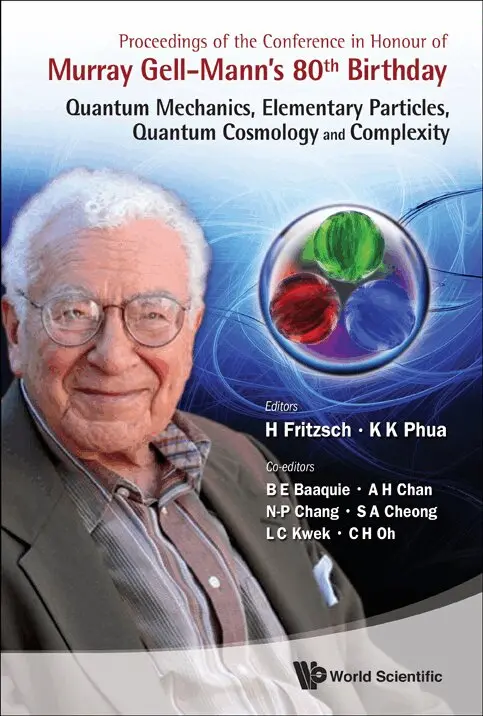
The Conference on Quantum Mechanics, Elementary Particles, Quantum Cosmology and Complexity was held in honour of Professor Murray Gell-Mann's 80th birthday in Singapore on 24–26 February 2010. The conference paid tribute to Professor Gell-Mann's great achievements in the elementary particle physics.This notable birthday volume contains the presentations made at the conference by many eminent scientists, including Nobel laureates C N Yang, G 't Hooft and K Wilson. Other invited speakers include G Zweig, N Samios, M Karliner, G Karl, M Shifman, J Ellis, S Adler and A Zichichi.About Murray Gell-MannMurray Gell-Mann, born September 15, 1929, won the 1969 Nobel Prize in physics for his work on the theory of elementary particles.His contributions span the entire history of particle physics, from the early days of the particle zoo to the modern day QCD. Along the way, even as he proposed new quantum numbers to bring order into the zoo, he had fun in naming them. And thus was born Strangeness, Flavor, Hadrons, Baryons, Leptons, the Eightfold Way, Color, Quarks, Gluons and, with Harald Fritzsch, the standard field theory of strong interactions, Quantum Chromodynamics (QCD).He also proposed with Richard Feynman the V-A theory of beta decay. Gell-Mann discovered the Current Algebra, proposed (with Levy) the sigma model of pions and the see-saw mechanism for the neutrino masses.
Häftad, Engelska, 2010
1 078 kr
Skickas inom 3-6 vardagar
The Conference on Quantum Mechanics, Elementary Particles, Quantum Cosmology and Complexity was held in honour of Professor Murray Gell-Mann's 80th birthday in Singapore on 24–26 February 2010. The conference paid tribute to Professor Gell-Mann's great achievements in the elementary particle physics.This notable birthday volume contains the presentations made at the conference by many eminent scientists, including Nobel laureates C N Yang, G 't Hooft and K Wilson. Other invited speakers include G Zweig, N Samios, M Karliner, G Karl, M Shifman, J Ellis, S Adler and A Zichichi.About Murray Gell-MannMurray Gell-Mann, born September 15, 1929, won the 1969 Nobel Prize in physics for his work on the theory of elementary particles.His contributions span the entire history of particle physics, from the early days of the particle zoo to the modern day QCD. Along the way, even as he proposed new quantum numbers to bring order into the zoo, he had fun in naming them. And thus was born Strangeness, Flavor, Hadrons, Baryons, Leptons, the Eightfold Way, Color, Quarks, Gluons and, with Harald Fritzsch, the standard field theory of strong interactions, Quantum Chromodynamics (QCD).He also proposed with Richard Feynman the V-A theory of beta decay. Gell-Mann discovered the Current Algebra, proposed (with Levy) the sigma model of pions and the see-saw mechanism for the neutrino masses.