H. Kleinpoppen - Böcker
Visar alla böcker från författaren H. Kleinpoppen. Handla med fri frakt och snabb leverans.
4 produkter
4 produkter
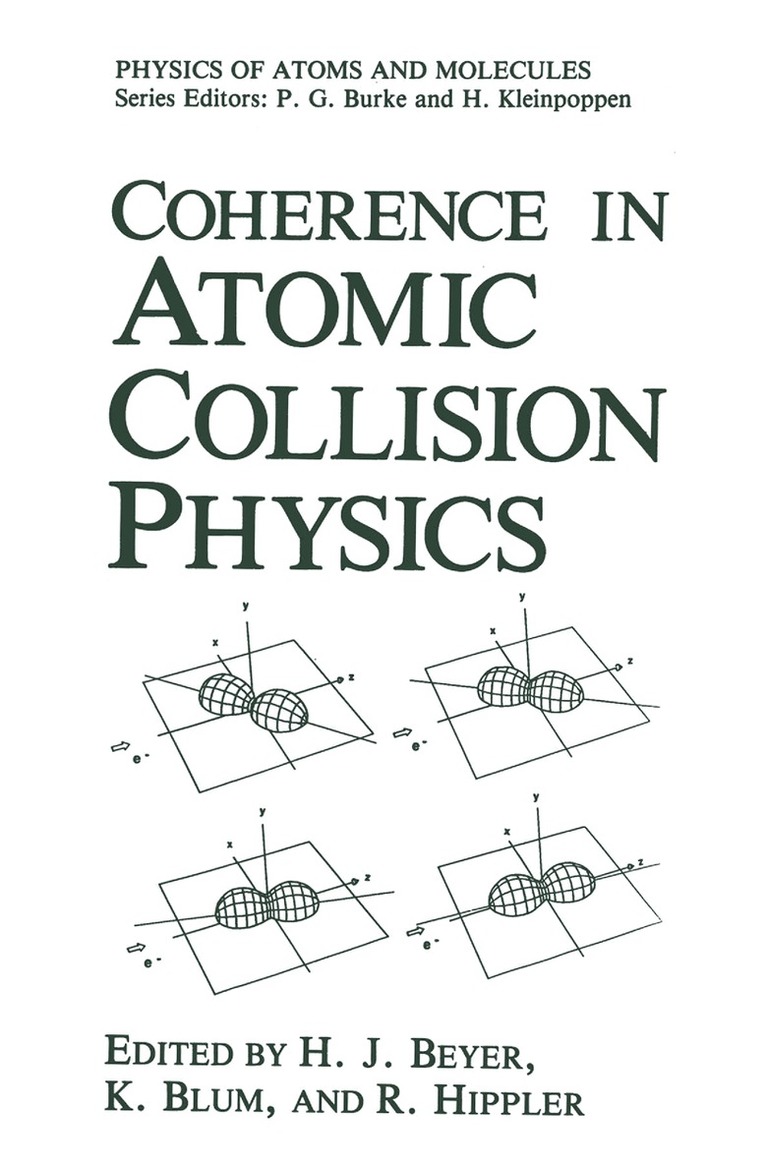
Coherence in Atomic Collision Physics
For Hans Kleinpoppen on His Sixtieth Birthday
Inbunden, Engelska, 1988
1 584 kr
Skickas inom 10-15 vardagar
During the last two decades the experimental investigation of atomic coherence phenomena has made rapid progress. Detailed studies have been performed of angular correlations, spin polarization effects, angular momen tum transfer, and the alignment parameters which characterize the charge cloud of excited atoms. The enormous growth in the number of these investigations was made possible through substantial development and application of new experimental technology, the development of sophisti cated theoretical models and numerical methods, and a fine interplay between theory and experiment. This interplay has resulted in a deeper understanding of the physical mechanisms of atomic collision processes. It is the purpose of the chapters in this book to provide introductions for nonspecialists to the various fields of this area as well as to present new experimental and theoretical results and ideas. The interest in spin-dependent interactions in electron-atom scattering has a long history; it dates back to the early investigations of Mott in 1929. While the more traditional measurements in this field were concerned with the determination of spin polarization and asymmetries, the range of investi gations has been expanded enormously during the last few years and now includes many observables sensitive to one or more of the various spin dependent interactions. The understanding of these effects requires a theoretical description of the orientation and alignment parameters of the target atoms, of the forma tion of resonances, of the influence of electron-exchange processes, and of the relativistic interactions inside the atom and between projectile and target.
1 584 kr
Skickas inom 10-15 vardagar
The EPSRC (Engineering and Physical Science Research Committee of the U. K. ) suggested two Workshops (York University, 22-23 September, 1993 and 15-16 April, 1994) for possible development of polarized electron/photon physics as targeted areas of research. The remit of these meetings included identifying research groups and their activities in polarized electron/polarized photon physics, listing relevant existing facilities (particularly electron spin sources and polarimeters), possible joint projects between research groups in the U. K. , recognizing future needs of projects for research of the highest scientific merit and referring to international comparisons of these research activities. Although very diverse but interconnected, the areas of research presented at the Workshops embrace atomic, molecular, surface, and solid state physics. In more detail these areas covered: electron spin correlations and photon polarization correlations in atomic and molecular collisions and photoionization, electron spin effects in scanning tunneling microscopy, surface and interface magnetism from X-ray scattering and polarized Auger electrons (including analysis of domain structures in solids and surfaces), polarized electrons from multiphoton ionization, quasi-atomic effects in solid state physics, dichroism in molecular and surface processes, Faraday rotation and high-field magneto-optics and polarization effects in simultaneous higher order electron-photon excitations. It is obvious from the spectrum of research fields presented at the Workshops that physicists of primarily two communities, namely those studying electron and photon spin interactions with gaseous atomic and molecular targets and those using condensed matter targets for their studies, interacted very closely witheach other.
538 kr
Skickas inom 10-15 vardagar
The Proceedings of the Advanced study Institute on Fundamental Processes in Atomic Collision Physics (Santa Flavia, Italy, September 10-21, 1984) are dedicated to the memory of Sir Harrie r-1assey, whose scientific achievements and life are reviewed herein by Sir David Bates. At the first School on the above topic (Maratea, September 1983, Volume 103 in this series), Harrie Massey presented the introductory lectures, summarized the entire lecture program, and presented an outlook on future developments in atomic collision physics. In an after-dinner speech, Massey recalled personal reminiscences and historical events with regard to atomic collision physics, to which he had contributed by initiating pioneering work and by stimulating and surveying this branch of physics over a period of almost six decades. Participants in the Maratea School will always remember Harrie Massey as a charming and wonderful person who was most pleased to discuss with everyone--students, postdoctorals, and senior scientists--any topic in atomic collision physics. Harrie Massey was a member of the Scientific Advisory Committee of the 1984 Santa Flavia School. Before his death he expressed his interest in attending this second School devoted to the presentation of recent developments and highlights in atomic collision physics. It is the desire of all authors to honor Harrie Massey with their contributions in these Proceedings.
538 kr
Skickas inom 10-15 vardagar
This volume contains the lectures presented at the NATO Advanced study Institute "Fundamental Processes of Atomic Dynamics" held in Maratea. Italy from September 20th to October 2nd 1987. The institute and this volume were conceived as a natural complement to previous institutes held in Maratea (1982) and in Santa Flavia (1984. ) whose proceedings are to be found in NATO ASI Series B vol. 103 and 134 respectively. The subject matter of these institutes was the study of the funda mental processes occurring in the interactions of atoms with photons. electrons and heavy-ions. The aim has been to unify these processes in a coherent experimen tal and theoretical approach. The present volume brings this approach up to date and contains in addition. for contrast and variety. a description of similar dynamical processes in the study of clusters and surfaces. The institute was opened with a lecture by Joe Macek in which he summarised the current status of atomic collision research. propounded the philosophy of a unified approach to structure, fragmentation and collision and posed the outstanding questions in the field. This lecture forms the introduction to this volume. The subject matter was divided into experiment and theory with the lectures inter-linked so that the one could re-inforce the other. The whole of the theoretical part of the institute was organised by Ugo Fano as an on-going symposium.