H. M. N. H. Irving – författare
Visar alla böcker från författaren H. M. N. H. Irving. Handla med fri frakt och snabb leverans.
7 produkter
7 produkter
E-bok
PDF, Engelska, 2017783 kr
Läs direkt efter köp
Compendium of Analytical Nomenclature: Definitive Rules 1977 focuses on the recommended nomenclature and symbols to be used in various disciplines of analytical chemistry. The book first offers information on recommendations for the presentation of the results of chemical analysis; recommendations for terminology to be employed with precision balances; and recommendations on nomenclature for contamination phenomena in precipitation from aqueous solution. The text also takes a look at recommended nomenclature for automatic analysis and recommendations for nomenclature of thermal analysis and mass spectrometry, as well as recommended nomenclature for titrimetric analysis. The publication reviews the practical measurements of pH in amphiprotic and mixed solvents. Topics include operational pH scale; selection of a pH unit for amphiprotic solvents; and interpretation of the measured pH. The text also considers the recommendations on nomenclature and presentation of data in gas chromatography and recommendations on nomenclature for chromatography. The book is a valuable source of data for readers wanting to study analytical nomenclature.
E-bok
Engelska, 2013344 kr
Läs direkt efter köp
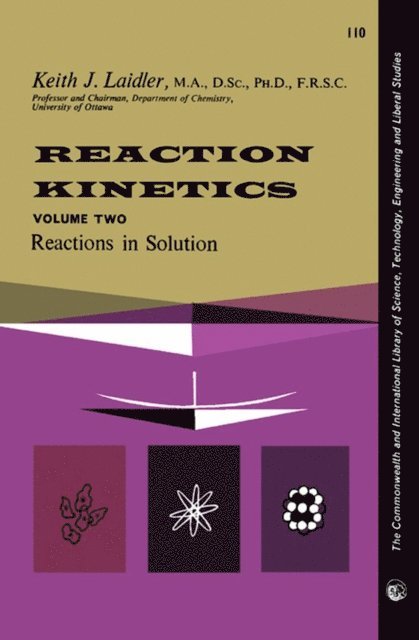
Reaction Kinetics, Volume II: Reactions in Solution deals with the kinetics of reactions in solution and discusses the basic principles and theories of kinetics, including a brief description of homogeneous gas reactions. This book is divided into two chapters. The first chapter focuses on the general principles of reactions in solution that includes reactions between ions and involving dipoles; influence of pressure on rates in solution; substituent effects; and homogeneous catalysis in solution. Chapter 2 primarily deals with general features of reactions in solution, emphasizing the relationship between the results of a kinetic investigation and actual reaction mechanism. This volume is intended for undergraduate students of chemistry who have not previously studied chemical kinetics. This book is also useful to more advanced students in other fields, such as biology and physics, who wish to have a general knowledge of the subject.
E-bok
Engelska, 2013356 kr
Läs direkt efter köp
Non-Aqueous Solvents in Inorganic Chemistry gives a concise treatment of the important inorganic non-aqueous solvents, emphasizing why they do in fact exhibit solvent power, how they are prepared and handled experimentally, how they can be used as media for the synthesis or analysis of inorganic and organometallic compounds, and how far the various acid-base concepts can be useful in accounting for many (but not all) of the reactions observed. This book is intended primarily for the undergraduate reader—both for the intending Chemistry Honours or R.I.C. graduate and the non-specialist student of chemistry. The subject matter is presented in a simple and readable form, without the inclusion of elaborate tables of properties and with the minimum of detail necessary for comprehension. Therefore, those working for the A- and S-level chemistry examinations for the G.C.E. could read much of the book with profit; and the research student who aspires to work in the field of non-aqueous solvents will, it is hoped, find this book a useful introduction to a fascinating branch of inorganic chemistry.
E-bok
PDF, Engelska, 2013344 kr
Läs direkt efter köp
Guide to Trivial Names, Trade Names and Synonyms for Substances Used in Analytical Nomenclature is a list of trivial names, trade names, and synonyms for substances used in analytical chemistry, from acetol and acetylacetone to bromoxine, choline, dithiol, and zincon. This list is intended as a guide to identifying the chemical composition of substances used in analytical nomenclature. Examples of these substances are acetol, whose chemical name is 1-hydroxy-2-propanone and which is synonymous to hydroxyacetone; aspirin (salicylic acid, acetylsalicylic acid); carbazole (carbazole, dibenzopyrrole or diphenylenimine); cetrimide (hexadecyltrimethyl ammonium bromide, cetyltrimethylammonium bromide); chloroxine (5,7-dichloro-8-quinolinol, 5,7-dichloro-8-hydroxyquinoline); cumidine (cumidine, p-isopropylaniline): Dahl acid (6-amino-1-naphthalenesulfonic acid, 2-naphthylamine-5-sulfonic acid); DMG (2,3-butanedione or dioxime, dimethylglyoxime); esculetin (6,7-dihydroxycoumarin, aesculetin); gallic acid (gallic acid, 3,4,5-trihydroxybenzoic acid); glycine (glycine, aminoacetic acid or glycocoll); glyoxaline (imidazole, imidazole); hexone (4-methyl-2-pentanone, isobutyl methyl ketone); isatin (indole-2,3-dione, isatinic acid anhydride); and luminol (5-amino-2,3-dihydro-1,4-phthalazinedione, 2-aminophthaloyl cyclic hydrazide). This monograph will be a useful resource for chemists.
E-bok
Engelska, 2013783 kr
Läs direkt efter köp
An Approach to Chemical Analysis: Its Development and Practice provides an overview of the development of chemical analysis and its application in solving analytical problems in chemistry. The text is comprised of 19 chapters that are organized into two parts. In the first part, the text covers the historical aspects of chemical. The book then proceeds to tackling methods for analysis in which the final measurement is preceded by one or more chemical reactions. The first two chapters of the second part discuss distillation and chromatography, respectively. Next, the title details the physical methods that only occasionally and incidentally need to be preceded by chemical reactions. The text will be of great use for students, researchers, and practitioners of chemistry.
E-bok
Engelska, 2014783 kr
Läs direkt efter köp
Some Electrical and Optical Aspects of Molecular Behaviour deals with dipole moments, molecular science, and molecular polarizability. The author explains the refractive index and the electric permittivity including polarization, polarizability, the Mossotti-Clausius equation, molar polarization, and molar refraction. The author also addresses the results of dipole moment measurements, the significance of the values obtained, and how these can determine molecular structural features. By using the Debye equation, one can determine the molecular moments of polar solutes in non-polar solvents. The book discusses how molecular polarizability and molecular polarization are measured and how these factors are associated with molecular structure. He also explains light scattering and the molecular weight of solutes by employing the research made by Debye which determines the weights, shapes, and interactions of molecules in solution. The author also addresses the form and order of the magnitude of interaction energies and cites typical examples of these occurrences. These energies often represent an electrostatic nature; in some ways, they can be understood as being quantum-mechanical in nature. This book can be helpful for students taking up dipole moments, molecular polarizability or molecular science.
E-bok
Engelska, 2013756 kr
Läs direkt efter köp
Reactions Kinetics: Volume I: Homogeneous Gas Reactions presents a general introduction to the subject of kinetics, including the basic laws of kinetics and the theoretical treatment of reaction rates. This four-chapter book deals mainly with homogeneous reactions in the gas phase. Chapter 1 presents the kinetic laws based on experimental results in terms of their simple concepts, with a special consideration of the way in which rates depend on concentration, while Chapter 2 deals with the interpretation of rates in terms of more fundamental theories. Chapter 3 covers the overall reactions that are believed to be elementary, such as the reaction between hydrogen and iodine, the reverse decomposition of hydrogen iodide, the corresponding reactions involving deuterium instead of hydrogen, and the dimerizations of butadiene and cyclopentadiene, as well as a few elementary termolecular reactions, all involving nitric oxide. This chapter also includes a general account of some of the elementary reactions that occur as steps in more complex mechanisms. Chapter 4 examines the reaction rates of numerous complex gas reactions. Undergraduate physical chemistry and chemical kinetics students, as well as advanced students in other fields, such as biology and physics, will find this book invaluable.