H. MacNeil – författare
Visar alla böcker från författaren H. MacNeil. Handla med fri frakt och snabb leverans.
6 produkter
6 produkter
Del 1 - Archivist's Library
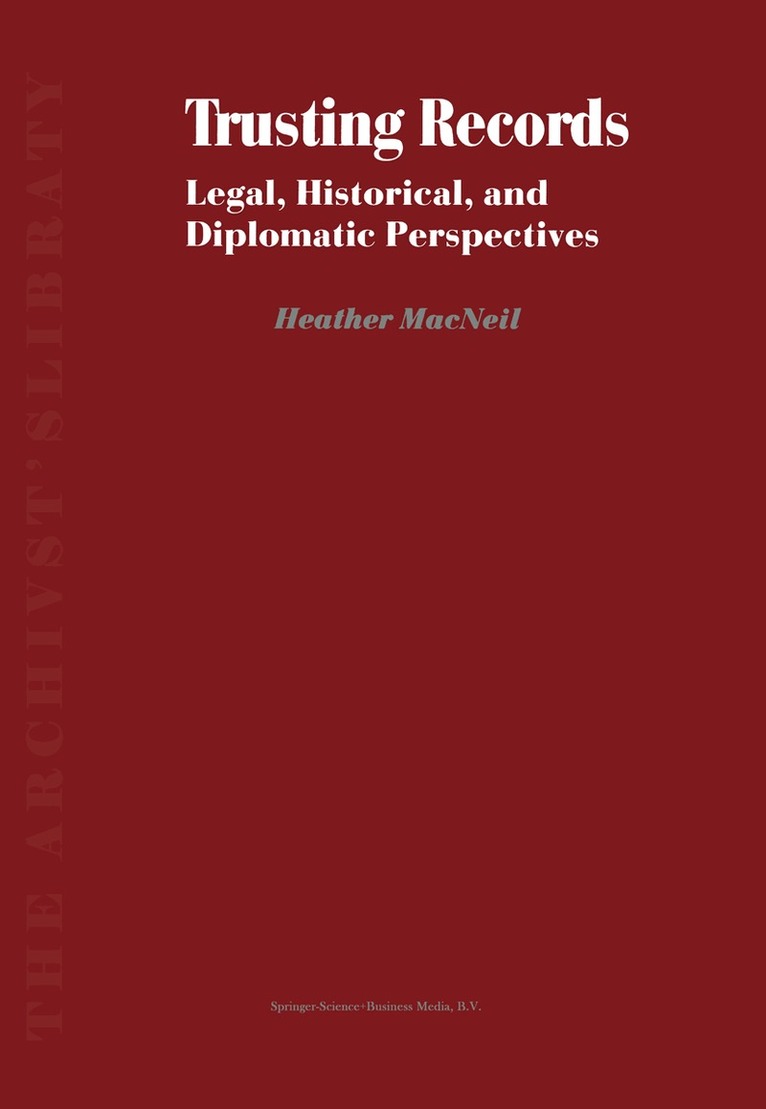
Trusting Records
Legal, Historical and Diplomatic Perspectives
Inbunden, Engelska, 2000
1 113 kr
Skickas inom 10-15 vardagar
A trustworthy record is one that is both an accurate statement of facts and a genuine manifestation of those facts. Record trustworthiness thus has two qualitative dimensions: reliability and authenticity. Reliability means that the record is capable of standing for the facts to which it attests, while authenticity means that the record is what it claims to be. This study explores the evolution of the principles and methods for determining record trustworthiness from antiquity to the digital age, and from the perspectives of law and history. It also examines recent efforts undertaken by researchers in the field of archival science to develop methods for ensuring the trustworthiness of records created and maintained in electronic systems. Audience: The target audience for this study is legal scholars working in the field of evidence law, historians working in the field of historical methodology, and recordkeeping professionals (records managers, information technology specialists, archivists) working on the design and implementation of contemporary organizational recordkeeping systems.
Del 2 - Archivist's Library
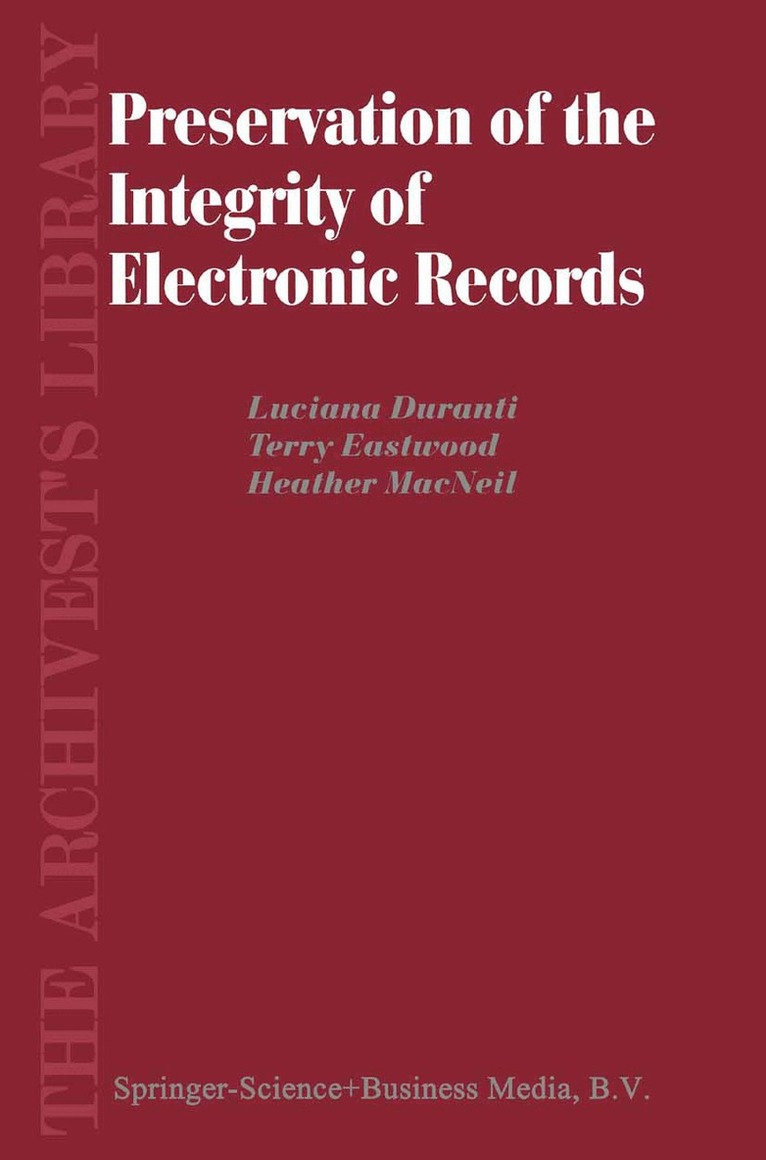
Preservation of the Integrity of Electronic Records
Inbunden, Engelska, 2002
1 065 kr
Skickas inom 10-15 vardagar
By Terry Eastwood This book reports the findings of a research project on the means of protecting the integrity of active and semi-active electronic records. The project, which is commonly referred to as "the UBC Project," was conceived by two of the authors of this book, Luciana Duranti and Terry Eastwood, and conducted between 1994 and 1997. The third author, Heather MacNeil, who worked formally as the principal research assistant on the project, acted as an equal in the research and in the writing of this book. The project investigated a number of fundamental questions that have arisen over the past decade as a consequence of the rapid development and use of computer technology for the creation, maintenance, and preservation of recorded information. One of the first comprehensive studies of the issues associated with the management of electronic records was conducted by the United Nations. The study, commonly known as the ACCIS report, aimed to "develop guidelines for implementation of electronic archives and records management programmes for use by United Nations organizations, taking into account traditional archives and records management practices. " The report of the study of electronic records in eighteen United Nations organizations identified a number of enduring issues. It recognized that the United Nations had to "distinguish between record and non-record material. "l It recognized the problem of ensuring the authenticity of records, which, rather narrowly, it construed as "assuring legality.
Del 1 - Archivist's Library
Trusting Records
Legal, Historical and Diplomatic Perspectives
Häftad, Engelska, 2010
994 kr
Skickas inom 10-15 vardagar
A trustworthy record is one that is both an accurate statement of facts and a genuine manifestation of those facts. Record trustworthiness thus has two qualitative dimensions: reliability and authenticity. Reliability means that the record is capable of standing for the facts to which it attests, while authenticity means that the record is what it claims to be. This study explores the evolution of the principles and methods for determining record trustworthiness from antiquity to the digital age, and from the perspectives of law and history. It also examines recent efforts undertaken by researchers in the field of archival science to develop methods for ensuring the trustworthiness of records created and maintained in electronic systems. Audience: The target audience for this study is legal scholars working in the field of evidence law, historians working in the field of historical methodology, and recordkeeping professionals (records managers, information technology specialists, archivists) working on the design and implementation of contemporary organizational recordkeeping systems.
Del 2 - Archivist's Library
Preservation of the Integrity of Electronic Records
Häftad, Engelska, 2010
1 065 kr
Skickas inom 10-15 vardagar
By Terry Eastwood This book reports the findings of a research project on the means of protecting the integrity of active and semi-active electronic records. The project, which is commonly referred to as "the UBC Project," was conceived by two of the authors of this book, Luciana Duranti and Terry Eastwood, and conducted between 1994 and 1997. The third author, Heather MacNeil, who worked formally as the principal research assistant on the project, acted as an equal in the research and in the writing of this book. The project investigated a number of fundamental questions that have arisen over the past decade as a consequence of the rapid development and use of computer technology for the creation, maintenance, and preservation of recorded information. One of the first comprehensive studies of the issues associated with the management of electronic records was conducted by the United Nations. The study, commonly known as the ACCIS report, aimed to "develop guidelines for implementation of electronic archives and records management programmes for use by United Nations organizations, taking into account traditional archives and records management practices. " The report of the study of electronic records in eighteen United Nations organizations identified a number of enduring issues. It recognized that the United Nations had to "distinguish between record and non-record material. "l It recognized the problem of ensuring the authenticity of records, which, rather narrowly, it construed as "assuring legality.
E-bok
PDF, Engelska, 20131 551 kr
Läs direkt efter köp
A trustworthy record is one that is both an accurate statement of facts and a genuine manifestation of those facts. Record trustworthiness thus has two qualitative dimensions: reliability and authenticity. Reliability means that the record is capable of standing for the facts to which it attests, while authenticity means that the record is what it claims to be. This study explores the evolution of the principles and methods for determining record trustworthiness from antiquity to the digital age, and from the perspectives of law and history. It also examines recent efforts undertaken by researchers in the field of archival science to develop methods for ensuring the trustworthiness of records created and maintained in electronic systems. Audience: The target audience for this study is legal scholars working in the field of evidence law, historians working in the field of historical methodology, and recordkeeping professionals (records managers, information technology specialists, archivists) working on the design and implementation of contemporary organizational recordkeeping systems.
E-bok
PDF, Engelska, 20131 367 kr
Läs direkt efter köp
By Terry Eastwood This book reports the findings of a research project on the means of protecting the integrity of active and semi-active electronic records. The project, which is commonly referred to as "the UBC Project," was conceived by two of the authors of this book, Luciana Duranti and Terry Eastwood, and conducted between 1994 and 1997. The third author, Heather MacNeil, who worked formally as the principal research assistant on the project, acted as an equal in the research and in the writing of this book. The project investigated a number of fundamental questions that have arisen over the past decade as a consequence of the rapid development and use of computer technology for the creation, maintenance, and preservation of recorded information. One of the first comprehensive studies of the issues associated with the management of electronic records was conducted by the United Nations. The study, commonly known as the ACCIS report, aimed to "develop guidelines for implementation of electronic archives and records management programmes for use by United Nations organizations, taking into account traditional archives and records management practices. " The report of the study of electronic records in eighteen United Nations organizations identified a number of enduring issues. It recognized that the United Nations had to "distinguish between record and non-record material. "l It recognized the problem of ensuring the authenticity of records, which, rather narrowly, it construed as "assuring legality.