H. Willems – författare
Visar alla böcker från författaren . Handla med fri frakt och snabb leverans.
3 produkter
3 produkter
Del 103 - Orientalia Lovaniensia Analecta
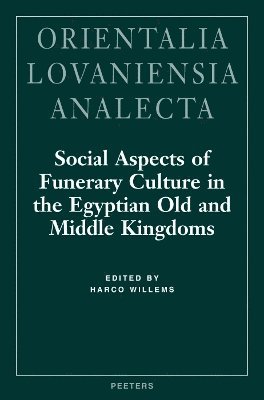
Social Aspects of Funerary Culture in the Egyptian Old and Middle Kingdoms
Proceedings of the International Symposium held at Leiden University 6-7 June, 1996
Inbunden, Engelska, 2001
1 397 kr
Skickas inom 3-6 vardagar
Although Egyptian tombs and funerary texts have been intensively studied, attention has been focused on art historical aspects, archaeological documentation and theological content. Attention for the relationship between burial practices and society has been restricted. The symposium of which this volume presents the proceedings is an attempt to show the scientific potential of the sociology of burial. The underlying philosophy is that both archaeological and textual sources are ultimately reflections of one social reality. Therefore, the volume offers contributions by archaeologists and philologists, many of which frequently bridge the gap between the two disciplines. Bourriau studies the evolution of body position in burials dating between the late Middle Kingdom and early New Kingdom. Delrue reviews a recent interpretation of the predynastic cemetery N7000 at Naga ed-Deir. Fitzenreiter studies the sociological background of ritual scenes in Old Kingdom mastabas. Frandsen's analysis touches upon funerary texts touching on substances inside the body which are considered bwt (taboo). The point of departure for Müller's study is a group of offering deposits at Tell el-dab'a which are studied in the light of textual information on ritual practice. Seidlmayer argues that burial contexts of the First Intermediate Period at Elephantine reflect the same underlying ideas as contemporary tomb scenes. Willems' commentary of Coffin Texts spells 30-41 interprets these texts as a coherent mortuary liturgy and discusses the context in which the letters to the dead were transmitted to the deceased.

Del 9 - Egyptologische Uitgaven - Egyptological Publications
World of the Coffin Texts
Proceedings of the Symposium Held on the Occasion of the 100th Birthday of Adriaan de Buck, Leiden, December 17-19, 1992
Häftad, Engelska, 1996
776 kr
Skickas inom 3-6 vardagar
The proceedings of this symposium offer contributions by leading experts working on the ancient Egyptian Coffin Texts, i.e., the texts written on coffins of the Egyptian Middle Kingdom (c. 2000-1750 B.C.). The volume provides a cross-section of current research activities in this field of study. Apart from progress reports on lexicographical and other projects, the volume contains presentations of 'new' material (e.g. from Lisht or Qâw al-Kabîr), typological assessments of coffin material, text-critical studies of groups of spells, grammatical studies, and discussions of theological and ritual aspects of the texts. The volume is of interest to Egyptologists and historians of religion.
Del 70 - Orientalia Lovaniensia Analecta
Coffin of Heqata (Cairo JdE 36418)
A Case Study of Egyptian Funerary Culture of the Early Middle Kingdom
Inbunden, Engelska, 1996
1 500 kr
Tillfälligt slut
The coffin published in this book represents a type that had some popularity in southern Upper Egypt in the early Middle Kingdom, but which, despite its extraordinary decoration had not attracted attention so far. The most striking feature of the decoration is that the object friezes - the pictorial rendering of ritual implements usually found on coffin interiors of the period - also include complete ritual scenes, some of which are attested only here. Apart from this, the decoration includes an extensive selection of the religious texts know as the Coffin Texts.The author first studies the archaeological context and dating of the coffin and attempts a reconstruction of the construction procedures from his technical description of the monument. The detailed account of the decoration in the rest of the book interprets the ritual iconography and offers fresh translations and interpretations of the Coffin Texts. A methodological innovation is that he regards the scenes and texts not as individual decoration elements, but as components of an integral composition. The background of this composition is argued to be a view of life in the hereafter in which the deceased is involved in an unending cycle of ritual action which reflects the funerary rituals that were actually performed on earth. On the one hand, these netherworldly rituals aim at bringing the deceased to new life by mummification, on the other the newly regenerated deceased partakes in embalming rituals for gods representing his dead father (Osiris or Atum). These gods, in their turn, effectuate the deceased's regeneration. The entire process results in a cycle of resuscitation in which the afterlife of the deceased and of the 'father gods' are interdependent. The sociological bias of this interpretation, with its emphasis on kinship relations, differs significantly from earlier attempts to explain Egyptian funerary religion.