Hai-An Zhu – författare
Visar alla böcker från författaren Hai-An Zhu. Handla med fri frakt och snabb leverans.
2 produkter
2 produkter
Inbunden, Engelska, 2025
1 713 kr
Skickas inom 10-15 vardagar
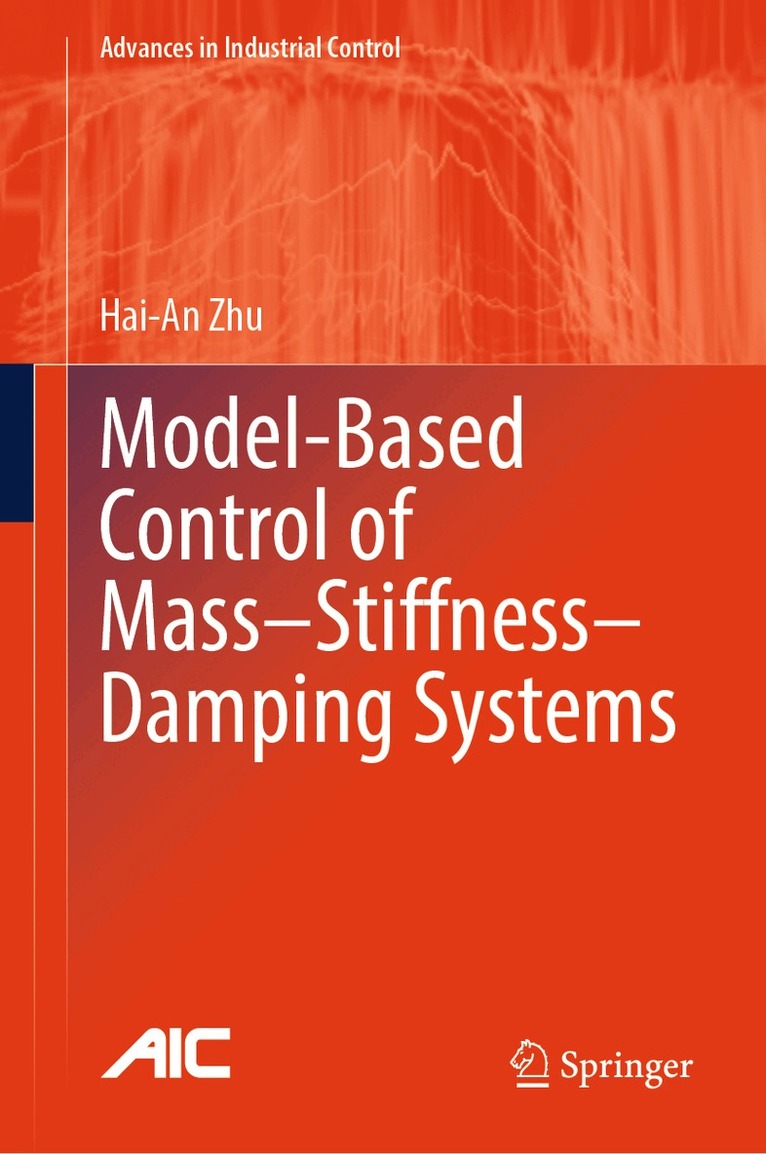
This book provides a comprehensive and practical framework for model-based control of MKC (mass–stiffness–damping or mass–spring–damper) systems, emphasizing seamless integration of theory and application. It explores the intricacies of modeling and control strategies tailored to the complexities of MKC systems, prevalent in various industrial applications. Clear explanations and real-world examples equip readers with advanced techniques for enhancing system performance, robustness, and adaptability in the face of nonlinearities and uncertainties.Key topics include:fundamentals of MKC system modeling;strategies for feedback linearization and dynamic decoupling; androbust control techniques essential for managing real-world systems.This book is an important resource for anyone dealing with multivariable systems, introducing innovative approaches to disturbance and uncertainty reduction, and decentralized adaptive pole placement. It addresses the need for robust and adaptable control strategies that can handle the inherent complexities and uncertainties of MKC systems, often encountered in industries like robotics, automotive engineering, and aerospace. Collectively, these topics help engineers and researchers deal with common challenges in designing controllers for systems with complex dynamics and interactions.Model-Based Control of Mass–Stiffness–Damping Systems is valuable for control engineers, researchers, and postgraduate students looking to enhance their understanding and practical familiarity with advanced control methods. Offering a generally applicable and expandable control framework, this book enables immediate practical improvements in existing control schemes and a solid foundation for further exploration and innovation in the control of complex dynamic systems.

3 413 kr
Kommande
This book presents a comprehensive and practice-oriented framework for situational awareness in power equipment, bridging rigorous theory with real-world engineering implementation. It systematically addresses the three fundamental levels of situational awareness—perception, comprehension, and projection—tailored to the unique operational, physical, and environmental complexities of critical power assets such as transformers, switchgear, transmission systems, rotating machines, and emerging power-electronic equipment.While situational awareness has been extensively studied in fields such as aviation and defense, its application at the equipment level within power systems has remained fragmented. This book fills that gap by offering the first cohesive treatment focused explicitly on power equipment, moving beyond grid-level monitoring to examine how individual assets can perceive their own condition, interpret operational contexts, and anticipate future states.The book integrates sensing technologies, signal processing, system modeling, health assessment, and forecasting methods within a unified framework. Advanced topics—including array-based source localization, digital twins, artificial intelligence, and cybersecurity—are developed with both mathematical rigor and engineering practicality. Throughout, real-world examples and implementation guidance ensure direct relevance to industrial applications.By linking foundational principles with actionable strategies, the book demonstrates how enhanced situational awareness enables more reliable, resilient, and secure power infrastructure. It is written for engineers, system operators, product developers, researchers, and postgraduate students seeking both a deep conceptual foundation and practical tools to advance the next generation of intelligent power equipment.