Hamid Garmestani – författare
1 527 kr
Skickas inom 10-15 vardagar
1 930 kr
Läs direkt efter köp
2 199 kr
Läs direkt efter köp
Statistical correlation functions are a well-known class of statistical descriptors that can be used to describe the morphology and the microstructure-properties relationship. A comprehensive study has been performed for the use of these correlation functions for the reconstruction and homogenization in nanocomposite materials. Correlation functions are measured from different techniques such as microscopy (SEM or TEM), small angle X-ray scattering (SAXS) and can be generated through Monte Carlo simulations. In this book, different experimental techniques such as SAXS and image processing are presented, which are used to measure two-point correlation function correlation for multi-phase polymer composites.
Higher order correlation functions must be calculated or measured to increase the precision of the statistical continuum approach. To achieve this aim, a new approximation methodology is utilized to obtain N-point correlation functions for multiphase heterogeneous materials. The two-point functions measured by different techniques have been exploited to reconstruct the microstructure of heterogeneous media.
Statistical continuum theory is used to predict the effective thermal conductivity and elastic modulus of polymer composites. N-point probability functions as statistical descriptors of inclusions have been exploited to solve strong contrast homogenization for effective thermal conductivity and elastic modulus properties of heterogeneous materials.
Finally, reconstructed microstructure is used to calculate effective properties and damage modeling of heterogeneous materials.
2 199 kr
Läs direkt efter köp
Statistical correlation functions are a well-known class of statistical descriptors that can be used to describe the morphology and the microstructure-properties relationship. A comprehensive study has been performed for the use of these correlation functions for the reconstruction and homogenization in nanocomposite materials. Correlation functions are measured from different techniques such as microscopy (SEM or TEM), small angle X-ray scattering (SAXS) and can be generated through Monte Carlo simulations. In this book, different experimental techniques such as SAXS and image processing are presented, which are used to measure two-point correlation function correlation for multi-phase polymer composites.
Higher order correlation functions must be calculated or measured to increase the precision of the statistical continuum approach. To achieve this aim, a new approximation methodology is utilized to obtain N-point correlation functions for multiphase heterogeneous materials. The two-point functions measured by different techniques have been exploited to reconstruct the microstructure of heterogeneous media.
Statistical continuum theory is used to predict the effective thermal conductivity and elastic modulus of polymer composites. N-point probability functions as statistical descriptors of inclusions have been exploited to solve strong contrast homogenization for effective thermal conductivity and elastic modulus properties of heterogeneous materials.
Finally, reconstructed microstructure is used to calculate effective properties and damage modeling of heterogeneous materials.
1 832 kr
Skickas inom 5-8 vardagar
491 kr
Skickas inom 5-8 vardagar
633 kr
Läs direkt efter köp
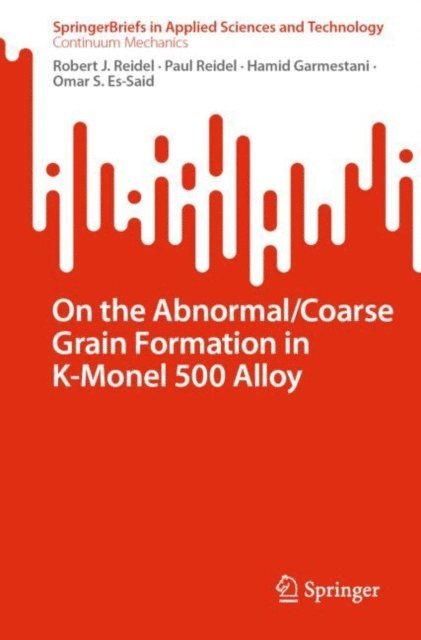
This book helps unlock the root cause of abnormal grain growth in a commercial nickel alloy. The chapters explore the effects of different solution treating and aging techniques, showing how they impact the hardness properties of hot-rolled and cold-drawn Monel K-500. The book covers how high-frequency induction heat treating can lead to severe duplex microstructure, and uncovers the surprising differences between solution treating in vacuum and convection air furnaces. This book is helpful to anyone seeking to optimize the performance of metal alloys.
1 668 kr
Skickas inom 10-15 vardagar
2 066 kr
Läs direkt efter köp
This book focuses on neuro-engineering and neural computing, a multi-disciplinary field of research attracting considerable attention from engineers, neuroscientists, microbiologists and material scientists. It explores a range of topics concerning the design and development of innovative neural and brain interfacing technologies, as well as novel information acquisition and processing algorithms to make sense of the acquired data. The book also highlights emerging trends and advances regarding the applications of neuro-engineering in real-world scenarios, such as neural prostheses, diagnosis of neural degenerative diseases, deep brain stimulation, biosensors, real neural network-inspired artificial neural networks (ANNs) and the predictive modeling of information flows in neuronal networks. The book is broadly divided into three main sections including: current trends in technological developments, neural computation techniques to make sense of the neural behavioral data, and application of these technologies/techniques in the medical domain in the treatment of neural disorders.
1 668 kr
Skickas inom 10-15 vardagar